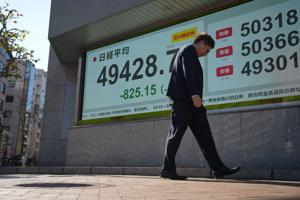
Global markets experienced a downturn on Monday, with U.S. futures and major international share indices mostly lower. The decline followed remarks from the governor of the Bank of Japan, Kazuo Ueda, suggesting a potential interest rate hike could be discussed at the central bank’s meeting on December 19, 2023. Oil prices surged more than $1 per barrel during early trading, adding to the day’s market volatility.
In the U.S., futures for the S&P 500 dropped 0.6%, while the Dow Jones Industrial Average lost 0.5%. In Europe, Germany’s DAX index fell 1%, closing at 23,589.90, and France’s CAC 40 declined 0.5% to 8,079.94. The UK’s FTSE 100 edged down 0.1% to 9,707.68.
In Japan, the Nikkei 225 index declined 1.9% to 49,303.28. Ueda stated that the Bank of Japan has been deliberating the potential for a rate increase, as the country’s benchmark interest rate has remained at 0.5% for several years. This prolonged period of low rates has aimed to stimulate economic growth and combat deflation, but with inflation remaining above the target of 2%, the central bank faces challenges in balancing these priorities.
Regional manufacturing activity is under scrutiny as analysts assess the impact of U.S. tariffs on Asian economies. A recent survey from S&P Global indicated that Japan’s manufacturing sector continued to contract in November, with the Purchasing Managers Index (PMI) registering at 48.7. This figure represents a slight improvement from 48.2 in October but remains below the critical threshold of 50 that indicates expansion. Annabel Fiddes, economics associate director at S&P Global Market Intelligence, noted that demand conditions in Japan’s manufacturing sector remained weak.
China’s factory activity also contracted for the eighth consecutive month, reflecting ongoing economic challenges despite a temporary truce in trade tensions between the U.S. and China. However, Hong Kong’s Hang Seng index rose 0.7% to 26,033.26, while the Shanghai Composite index increased by 0.7% to 3,914.01. In South Korea, the Kospi declined 0.2% to 3,920.37, while Australia’s S&P/ASX 200 dropped 0.6% to 8,565.20.
Despite the regional manufacturing struggles, analysts noted a rebound in exports from Asia. Consumer spending during the recent Black Friday and Cyber Monday retail events is anticipated to surpass expectations, even amid uncertainties about the U.S. economic outlook.
On Friday, November 24, 2023, trading in U.S. markets was significantly affected by a technical issue at the Chicago Mercantile Exchange, which halted trading for several hours. During the abbreviated session, the S&P 500 gained 0.5%, and the Dow increased by 0.6%. The Nasdaq rose 0.7%. Stocks rallied earlier that week amid speculation of potential further rate cuts by the Federal Reserve.
The Federal Reserve has already cut rates twice in 2023 to bolster a weakening job market. Despite the recent increases in inflation and a slowing job market, any further rate cuts could imply a risk of fueling inflation further. Minutes from the Fed’s most recent meeting indicated that policymakers face significant divisions regarding the path forward.
In early trading on Monday, U.S. benchmark crude oil prices increased by $1.14 to reach $59.69 per barrel, while Brent crude, the international standard, also rose by $1.14 to $63.52. The U.S. dollar weakened against the yen, falling to 155.25 from 156.14, while the euro strengthened to $1.1622 from $1.1596. Bitcoin experienced a notable decline, dropping 4.3% to $87,115.
As markets navigate these economic indicators, the interplay between interest rates, inflation, and manufacturing activity will continue to shape investor sentiment and global financial stability.