Recent research has revealed significant findings about a member of the Asgard archaea, specifically the organism known as Candidatus “Y. umbracryptum.” This study, conducted within enriched mixed microbial communities, provides new insights into cellular organization and the evolutionary origins of eukaryotes, which emerged approximately two billion years ago from the merger of an archaeon and a bacterial cell.
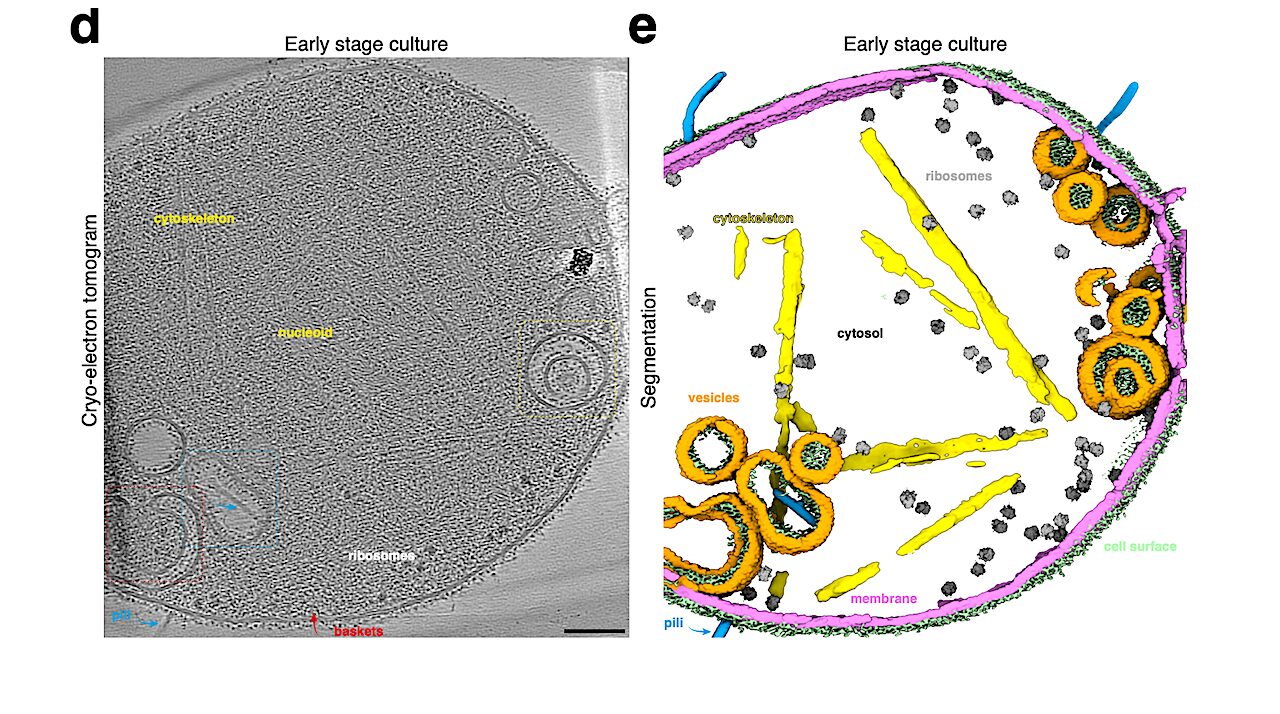
Traditionally, Asgard archaea, also referred to as Prometheoarchaeota, were understood to lack internal membrane-bound compartments. Consequently, their role in elucidating the origins of the eukaryotic endomembrane system remained unclear. However, this latest analysis indicates that Ca. Y. umbracryptum possesses a unique cellular architecture that includes numerous intracellular vesicles, marking a notable departure from previous assumptions.
Revolutionizing Perspectives on Eukaryogenesis
The study highlights the intricate cell biology of Ca. Y. umbracryptum, which has a small genome coding for limited homologues of eukaryotic membrane remodelling machinery. In late-stage cultures, the cells exhibited extensive protrusions similar to those seen in other Asgard archaea. In contrast, during early growth phases, these cells displayed fewer protrusions but were characterized by a diverse array of intracellular vesicles.
These vesicles exhibit a luminal surface that morphologically resembles the outer coat of the plasma membrane. This variability in cell structure based on growth stage suggests that Ca. Y. umbracryptum may possess an endomembrane system that adapts according to its cell state. Such findings significantly alter prevailing views on the evolutionary transition to eukaryotic life.
The research team conducted their analysis in Shark Bay, Australia, where samples were collected from the Hamelin Pool intertidal zone. Images from NASA’s Earth Science Data and Information System (ESDIS) illustrate the sampling site and the surrounding microbial mats, which were crucial for the study.
Implications for Future Research
These discoveries contribute to a deeper understanding of the evolutionary lineage leading to modern eukaryotes. As researchers continue to explore the genetic and structural characteristics of Asgard archaea, the potential for uncovering further evolutionary insights remains considerable. The findings reinforce the importance of studying microbial life forms that have persisted for billions of years, shedding light on the fundamental processes that have shaped cellular complexity.
This research not only enhances our comprehension of early cellular evolution but also opens new avenues for investigating the origins of life on Earth and potentially beyond. The exploration of organisms like Ca. Y. umbracryptum may reveal critical clues about how complex life forms emerged from simpler ancestral entities.