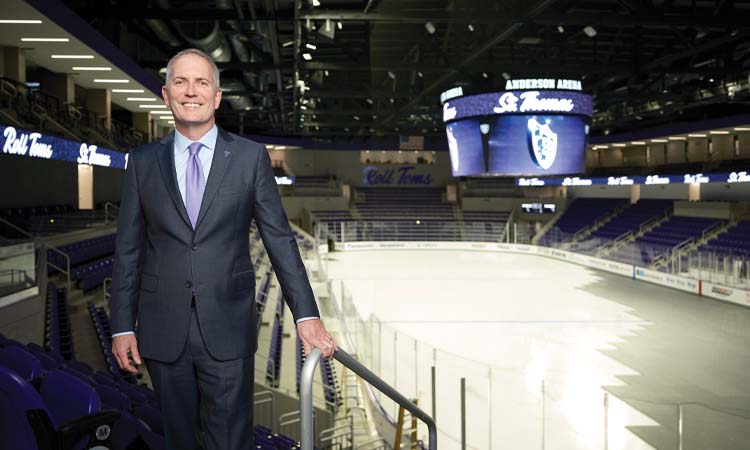
Rob Vischer, president of the University of St. Thomas, has been recognized as the Twin Cities Business Person of the Year for his significant contributions to higher education and community development. After graduating from Harvard Law School, Vischer chose to teach law at the University of St. Thomas in 2005, prioritizing a community-oriented approach for his family and students.
Fast forward two decades, and Vischer now leads Minnesota’s largest private university, which recently welcomed its largest freshman class ever in fall 2025—a total of 1,677 students. Overall enrollment rose 4.6% from the previous year, reaching 9,876 students. St. Thomas is also on track to raise over $100 million in donations for the fourth consecutive year. This success is exemplified by the recent opening of a new $183.4 million arena in St. Paul, marking the university’s transition from NCAA Division III to Division I athletics.
Vischer emphasizes the importance of equipping students not only with academic knowledge but also with the ability to adapt to evolving workforce demands. He believes that while high-achieving students often focus on achievements and credentials, they should also reflect on personal growth and character development. “This is a time of growth and development, where I want our students to be cognizant of asking themselves not just ‘What am I going to do next?’ but ‘Who am I becoming?’” Vischer stated.
Pat Ryan, chairman of Ryan Companies and a member of the St. Thomas board of trustees, commended Vischer for his leadership qualities, saying, “His intellect, leadership, and communication skills make him an excellent fit to lead a high-quality university.” Ryan added that Vischer encourages students to become compassionate community leaders in addition to professionals.
Under Vischer’s leadership, the university has reinforced its commitment to a mission that integrates Catholic social teachings. Ryan explains that St. Thomas aims to “embrace young people with Catholic values to do good in the world in whatever professional career they choose.” This holistic educational philosophy seeks to cultivate not just employable graduates but also responsible citizens.
While St. Thomas has a strong reputation for producing business graduates, it remains rooted in its liberal arts foundation. Vischer acknowledges the challenges posed by a declining demographic of high school students. “Higher ed is now entering a winner-takes-most market,” Vischer explained. “We’re in a sweet spot in the market.” He believes that St. Thomas strikes a balance with just under 10,000 students, offering the advantages of both smaller class sizes and a vibrant campus environment.
The recent opening of the 250,000-square-foot Lee & Penny Anderson Arena is a significant milestone for the university’s athletic program. The transition to Division I, which was finalized by the NCAA in June 2022, is expected to enhance the university’s national visibility. Former president Julie Sullivan initiated this transition before Vischer took the helm in January 2023.
Vischer’s journey from a small-town boy in Muscatine, Iowa, to a leader in higher education reflects a commitment to personal and professional growth. “I tell my students today that the key path for growing and developing is a willing embrace of vulnerability,” he remarked, reflecting on his own experiences growing up.
In his previous role as dean of the law school, Vischer prioritized job placement for graduates, stating, “If you don’t present a strong economic return for students, nothing else matters.” Under his leadership, the St. Thomas School of Law achieved a high job placement rate, with alumni reporting the highest average salaries of any university in Minnesota five years post-graduation.
Vischer’s leadership style is characterized by a commitment to community engagement and building consensus. He actively listens to students, faculty, and trustees, fostering an environment where diverse voices are heard. “He’s really good with building consensus and bringing all parties along,” noted MayKao Hang, dean of the Morrison Family College of Health.
The university continues to innovate, with programs like the Dougherty Family College, which provides additional support for students earning associate degrees. This initiative aims to increase access for underrepresented populations, with about 93% of those served being students of color. Vischer’s focus on community health and holistic education aligns with the university’s mission to prepare students for the evolving job market.
As Vischer looks ahead, he remains committed to fostering a culture of encounter, where students engage in meaningful conversations across diverse backgrounds. “We are made for connection, authentic connection,” he stated, emphasizing the importance of building relationships within the academic community.
With his vision and leadership, Rob Vischer is poised to shape the future of the University of St. Thomas, ensuring it remains a vital institution for education and community service in Minnesota and beyond.