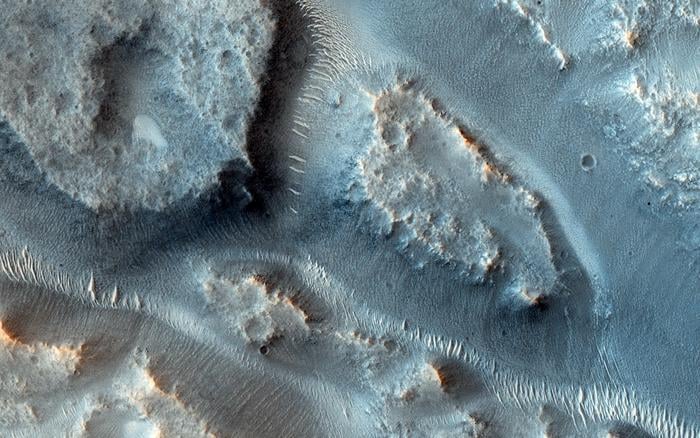
A team of scientists from the University of Texas at Austin has made significant strides in understanding the ancient waters of Mars by successfully mapping its river basins. Their research, published in the Proceedings of the National Academy of Sciences, reveals insights into the Red Planet’s watery past and proposes innovative methods for studying similar features on other celestial bodies.
By examining images from the Mars Orbiter Laser Altimeter (MOLA) and the Context Camera (CTX), the researchers identified and mapped a total of 16 drainage systems across the Martian surface. MOLA, which operated between 1997 and 2006, was instrumental in collecting topographical data, while CTX, currently orbiting Mars, has provided comprehensive coverage of the planet. The study utilized ArcGIS Pro, a mapping software widely used for both Earth and planetary datasets, to analyze where these river systems converge, including features like outlet canyons, lakes, and valley networks.
The researchers focused on mapping drainage systems with areas exceeding 10,000 km², a standard benchmark for large drainage systems on Earth. Their findings estimate that these systems collectively transported around 28,000 km³ of sediment, which is roughly 42 percent of the total sediment volume that flowed on ancient Mars. Notably, the study highlights that outlet canyons contributed approximately 24 percent of the global river sediment on the planet.
Mars, which formed around 4.5 billion years ago, has long intrigued scientists regarding its history of liquid water. While estimates of the duration of surface liquid water vary, a 2022 study suggested that Mars maintained liquid water as recently as 2 billion years ago. This recent mapping study adds to the body of evidence supporting the existence of ancient water on Mars, alongside features such as deltas, outflow channels, and gullies.
The geomorphological characteristics identified in this study, including lakes and river systems, point to a planet that may have once supported conditions suitable for life. Additionally, mineralogical evidence, such as clays and sulfate minerals, further supports the hypothesis of a wetter past. The presence of hematite, commonly referred to as “blueberries,” was notably documented by NASA’s Opportunity rover in 2004.
Scientists continue to explore why Mars lost its liquid water. Factors such as the loss of its magnetic field, climate changes, and geological processes may have contributed to this phenomenon. Unlike Earth, Mars has a smaller core, leading to a quicker cooling process and the subsequent dissipation of its magnetic field. This exposure to solar and cosmic radiation is believed to have stripped away much of the planet’s atmosphere and water, with some water potentially becoming groundwater or being stored in polar regions.
As research into Mars’s ancient river basins evolves, scientists remain optimistic about uncovering more about the Red Planet’s history. The methodologies developed in this study may pave the way for future explorations on Mars and beyond, enhancing our understanding of planetary hydrology in the solar system. The quest for knowledge continues, urging researchers and enthusiasts alike to keep looking skyward.