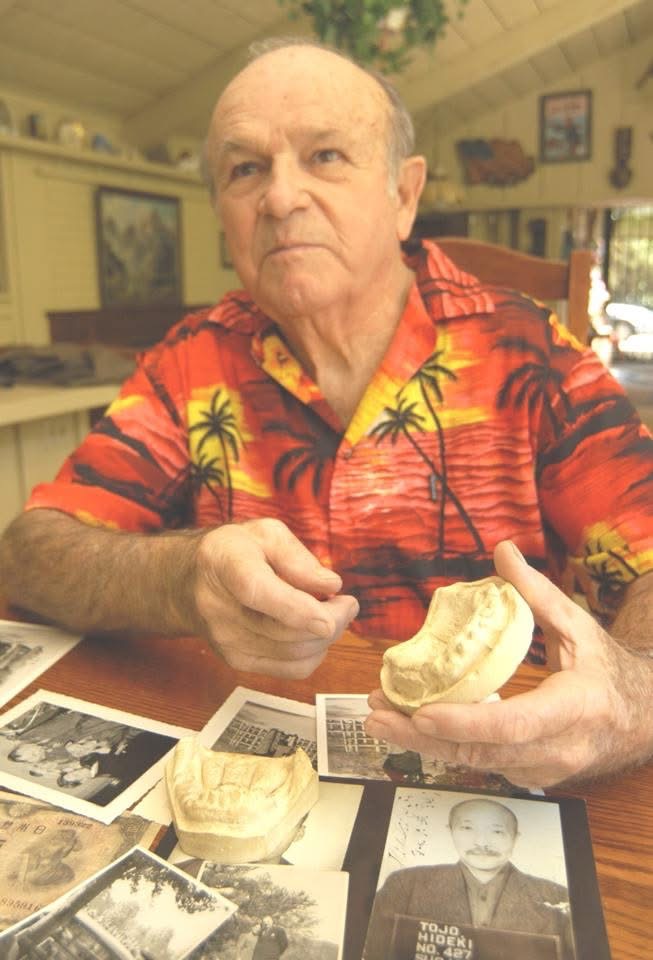
In a remarkable twist of history, a prank orchestrated by a local dentist on General Hideki Tojo, the former Prime Minister of Japan, has resurfaced as part of the commemoration of the 80th anniversary of the bombing of Pearl Harbor. Dr. E.J. “Jack” Mallory, who practiced dentistry in California from 1948 until the mid-1980s, crafted dentures for Tojo while he awaited trial for war crimes in Tokyo’s Sugamo Prison in 1946.
Mallory, then a 22-year-old Navy dentist, was tasked with providing dental care to military personnel in the aftermath of World War II. When he received the assignment to create a set of dentures for Tojo, he never anticipated the story would evolve into a humorous anecdote that would capture public interest decades later.
“My dad and his circle of friends and medical colleagues were all gracious, caring people,” said Paul Mallory, Jack’s son. “Regardless of someone’s background, dad’s personal integrity guided him to give the best care possible, and that’s what he did for Tojo.”
### The Encounter with Tojo
During his time at the 361st Station Hospital in Tokyo, Mallory met Tojo in a dental operatory that was far from luxurious. The general was accompanied by military police guards, his attorney, and a personal dentist. Contrary to his fearsome reputation, Mallory described Tojo as a tired, grandfatherly figure.
Tojo was in dire need of dental work due to advanced tooth decay. After assessing his condition, Mallory recommended the extraction of Tojo’s remaining lower teeth, which led to the creation of full upper and lower dentures. Tojo’s response to the recommendation was striking: “Oh, these will last me six more months, and after that, my teeth I won’t be needing anymore.” His remark elicited laughter from all present, including Mallory.
### Crafting a Unique Prank
As Mallory worked on Tojo’s dentures, he felt an urge to leave a lasting mark on the piece. Although he refrained from inscribing the slogan “Remember Pearl Harbor” outright—due to professional ethics and military protocol—he found a clever compromise. Using a dental drill, he inscribed the phrase in Morse code along the border of the denture.
This secret prank remained confined to a small circle of Mallory’s colleagues until a chance encounter led to its leak. In February 1947, new dental officers learned of the prank and, unbeknownst to Mallory, shared it with others. The story eventually spread, reaching news outlets worldwide.
“I fled to my Dental Commanding Officer, Major William Hill, and confessed the story,” Mallory recounted. The major advised him to go into hiding while he handled the media inquiries.
### The Cover-Up
The situation escalated quickly. Following the story’s dissemination through the Armed Forces Tokyo radio station, Mallory and his colleague had to act swiftly to grind out the Morse code inscription. They managed to do so under the cover of night, fearing the repercussions of their actions.
While the initial coverage suggested that the prank had been successful, Major Hill ensured the story was downplayed. In a tense exchange, he asked Lieutenant George Foster, Mallory’s colleague, if he could safely invite reporters to see the denture. “Yes sir!” Foster replied, ensuring that the prank would remain a secret.
### Legacy of the Story
Mallory’s tale of his encounter with Tojo and the subsequent prank became widely known after its publication in the Chico Enterprise-Record on December 7, 1995. Since then, it has appeared in numerous publications, including Bill O’Reilly’s “Killing the Rising Sun” and Jan K. Herman’s “Battle Station Sick Bay: Navy Medicine in World War II.”
In a recent reflection, Lori Eckhart, Mallory’s daughter, expressed appreciation for the attention the story has received over the years. “It was amazing how the Chico ER article was the window for his story to get out. We didn’t expect that,” she said.
As a final note, Mallory reminisced about his last encounter with Tojo during the war crimes trials. He observed the general’s demeanor and noted a moment of recognition between them, a poignant end to their unusual connection.
The legacy of E.J. “Jack” Mallory lives on through this remarkable story, intertwining humor with the serious history of World War II and its aftermath.