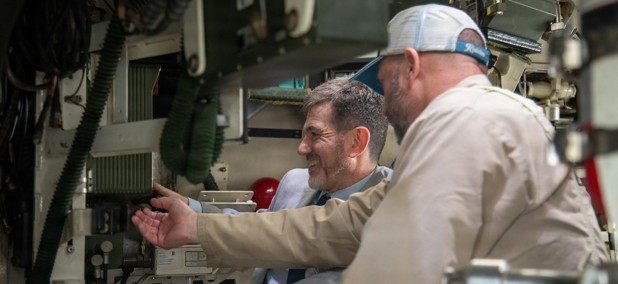
General Dynamics has launched a strategic initiative to foster collaboration among defense technology companies, aiming to accelerate the development and delivery of military innovations. This week, the company unveiled the Mission Emerge Center, a new 5,200 square-foot digital lab located outside Fort Belvoir, Virginia. The facility is designed to partner with various companies, including cloud providers, to create and demonstrate advanced technologies tailored for the Pentagon.
The facility’s objective is to provide a dedicated space where defense officials can observe and engage with new technologies that may not be demonstrable in traditional Pentagon settings. “I’ve spent a lot of time in my life in uniform—and not in uniform—in the Pentagon, and there isn’t the opportunity in the Pentagon to showcase this…to demonstrably show how it works,” said Amy Gilliland, President of General Dynamics Information Technology (GDIT), during a press briefing on December 2, 2023. The Mission Emerge Center aims to create solutions in a collaborative environment, where potential customers can directly witness innovations in action.
The project took over a year to develop and aligns with the Pentagon’s directive for defense contractors to embrace greater risk in technological advancement. Pete Hegseth, the U.S. Secretary of Defense, emphasized the urgency of rapid technological development, stating, “If we are going to prevent and avoid war, which is what we all want, we must prepare now. Our adversaries are not sitting idly by. They’re moving fast.”
Gilliland noted that the current landscape requires defense contractors to anticipate future needs, saying, “What the customer is telling us now is, you understand the mission, and you understand technology, and you need to anticipate what is coming next.” This proactive approach is critical to ensuring that the military remains equipped with the latest advancements.
GDIT has shifted its focus in recent years from being primarily an IT service provider to developing innovative products. The company is moving towards establishing long-term partnerships through strategic collaboration agreements rather than short-term arrangements. The strategy emphasizes understanding the specific needs of the Department of Defense and identifying promising technologies from new companies that could fulfill those requirements.
“Those partnerships can ultimately end up being a teaming arrangement. They could be an acquisition in the future,” Gilliland explained. The lab is open to companies without charge, encouraging voluntary contributions of research and development efforts alongside GDIT.
In a parallel move, General Dynamics Land Systems, which specializes in combat vehicle manufacturing, is set to join a co-working space named Newlab in downtown Detroit. This initiative aims to enhance collaboration with startups and investors, thereby facilitating the exchange of emerging technologies. “We actually just recently signed to become a full member of Newlab,” stated Scott Taylor, who oversees business development for General Dynamics Land Systems. This decision reflects an acknowledgment of the challenges posed by the security protocols inherent in traditional defense facilities, which can impede the swift sharing of innovations.
Last week, General Dynamics Land Systems tested the Newlab environment by hosting an event featuring military leaders, investors, and drone technology firms to discuss solutions for ongoing challenges faced by ground troops. Taylor noted that senior military leaders have been advocating for a more organized approach to collaboration, urging industry players to unite and tackle the Army and Marine Corps’ most pressing issues.
The inaugural event, the Maneuver Warfighter Industry Symposium, brought together notable defense tech companies such as Anduril, Palantir, and Autonodyne. Taylor expressed optimism about the future of these partnerships, stating, “We all have a very similar common goal: We want to support the U.S. military and our allies’ needs.”
Despite the enthusiasm for collaboration, the competitive nature of the defense industry presents challenges. “You fill a room with 24 companies, and some of them are competitors with each other. They’re not always forthright in being very open,” Taylor acknowledged. The journey toward establishing a cohesive and effective consortium of technology developers is still underway, as he noted, “Do we have the right team put together? Not yet. It’s still in development right now.”
As General Dynamics continues to champion collaboration among defense contractors, the success of these initiatives could reshape the landscape of military technology development, ultimately enhancing the capabilities of armed forces around the world.