Astronomers have unveiled surprising new images that reveal the intricate nature of nova explosions, a phenomenon previously misunderstood. These detailed observations of thermonuclear eruptions on white dwarfs within binary systems highlight multiple ejections and shock physics, alongside the formation of high-energy gamma-ray emissions. This research, published in the journal Nature Astronomy, showcases the unexpected complexities of these stellar events.
Nova explosions occur when matter accumulates on the surface of a white dwarf, a dense remnant of a star that has exhausted its nuclear fuel. As the white dwarf draws hydrogen from its companion star, the accumulating material heats up until it triggers a sudden thermonuclear explosion. While some explosive events can lead to the complete destruction of the white dwarf—known as Type Ia supernovae—most novae result in the ejection of material into space without total destruction.
Recent findings from astronomers have focused on two specific novae, V1674 Her and V1405 Cas, which illustrate the evolving understanding of these cosmic phenomena.
Revealing the Unexpected Complexity
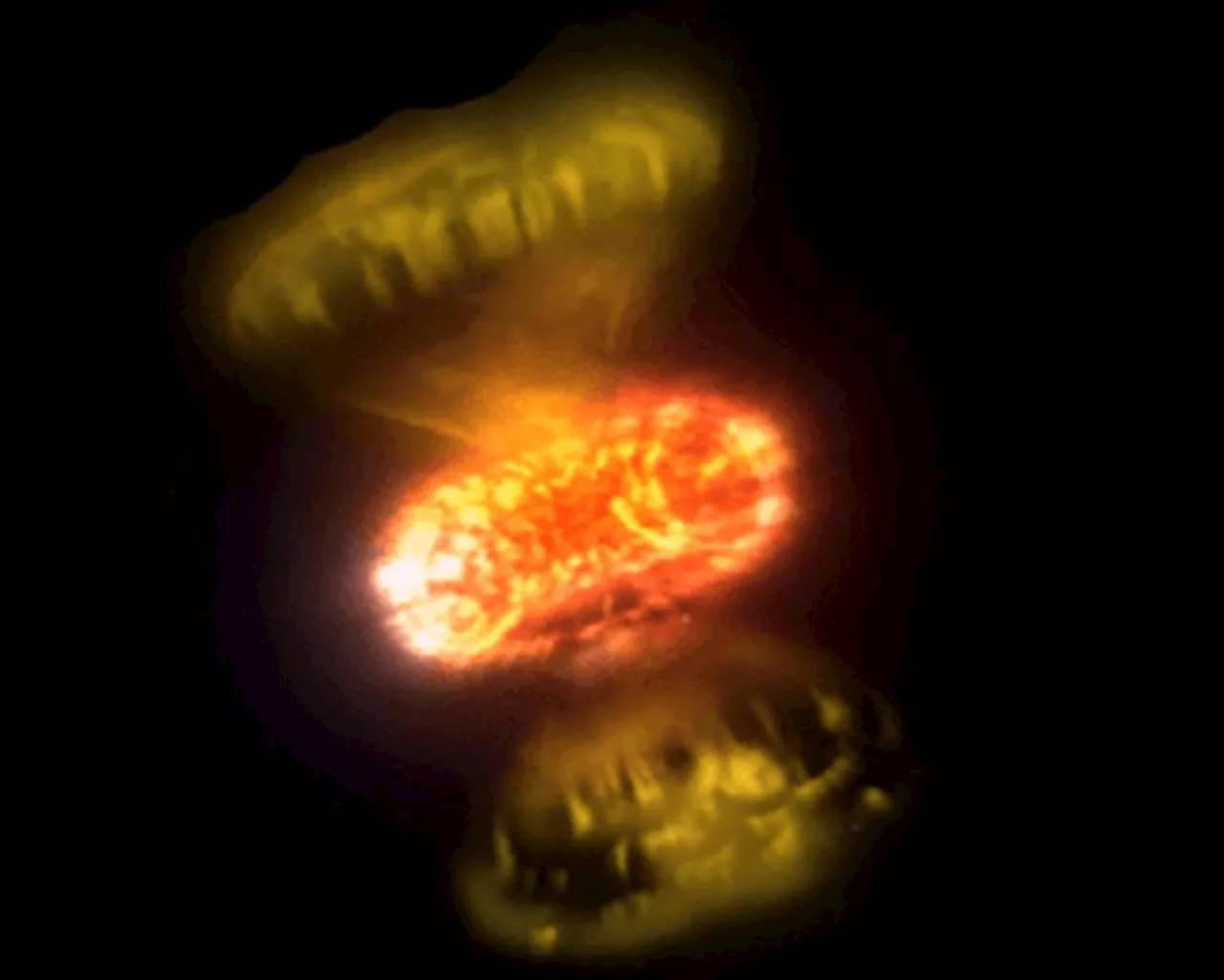
The research team, led by Elias Aydi of Texas Tech University, captured images that demonstrate a variety of explosive behaviors. V1674 Her, classified as a fast nova, displayed material being expelled in two perpendicular outflows just days after the explosion. This rapid expulsion indicates multiple interacting ejecta, suggesting a more nuanced explosion process than previously thought.
Conversely, V1405 Cas is characterized as a slow nova, with significant ejection not observed until 50 days post-explosion. This delay marks the first instance of such behavior in nova events, providing critical insights into the dynamics of material ejection in these stellar explosions.
Aydi noted, “These observations allow us to watch a stellar explosion in real time, something that is very complicated and has long been thought to be extremely challenging.” The advancements in observational technology have transformed the study of novae from a simplistic view of a singular flash to a complex narrative of evolving explosions.
Innovative Techniques Enhance Observations
The research utilized two advanced observational techniques: interferometry and spectrometry. The Georgia State University CHARA Array played a crucial role in capturing fine details of the explosions, while spectrometry provided essential chemical fingerprints of the ejected material. The alignment of spectral data with the structural observations from interferometry confirmed the interactions of material flows in unprecedented detail.
Co-author John Monnier, a professor of astronomy at Michigan State University, remarked on the significance of these findings: “The fact that we can now watch stars explode and immediately see the structure of the material being blasted into space is remarkable. It opens a new window into some of the most dramatic events in the universe.”
The research indicates that novae act as natural laboratories for studying extreme astrophysical environments. The high-energy gamma-ray emissions produced during these events allow scientists to investigate shock physics and particle acceleration processes involved in stellar explosions.
The complexity observed in nova explosions challenges previous assumptions that these events were singular occurrences. “This is just the beginning,” Aydi stated, emphasizing the potential for future research. “With more observations like these, we can finally start answering big questions about how stars live, die, and affect their surroundings.”
As the scientific community continues to refine its understanding of novae, the next steps involve expanding the sample size of observed novae. This expansion will help determine whether delayed ejection is common among other novae, establishing them as vital tools for exploring the physics of stellar interactions in our galaxy.
With each new image and observation, the intricate nature of nova explosions unfolds further, revealing not just the beauty of these celestial events but also their complexity, much richer than scientists previously imagined.