New research has identified a previously unknown state of matter within Earth’s inner core, revealing that it exists in a superionic state. This discovery, published on December 10, 2025, in the National Science Review, indicates that carbon atoms can flow freely through a solid iron lattice, altering our understanding of this dense region at the center of the planet.
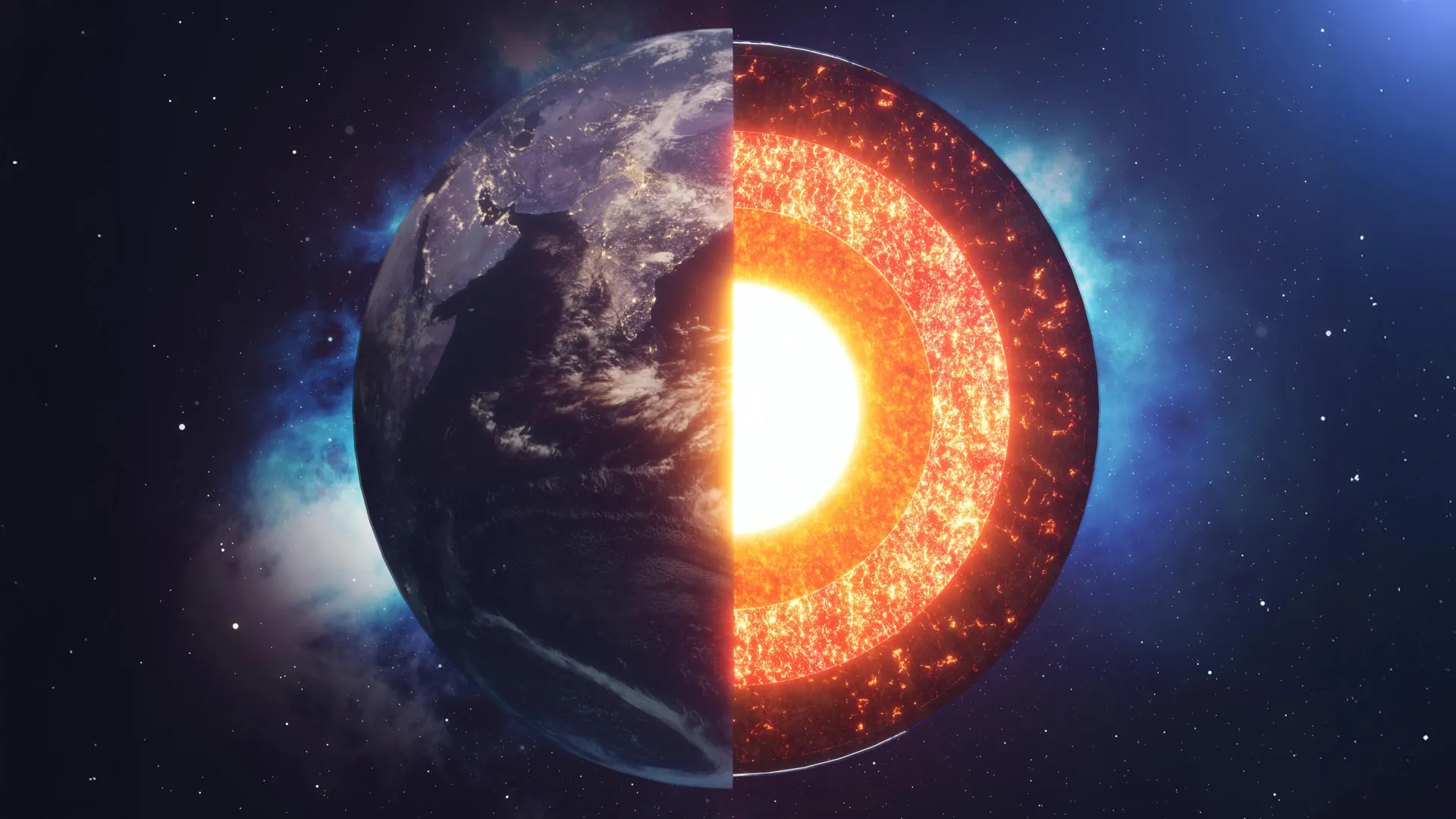
The inner core, a sphere composed of iron and light-element alloys, is subject to immense pressure—over 3.3 million atmospheres—and extreme temperatures comparable to that of the Sun’s surface. For years, scientists have grappled with the paradox of the inner core’s solid nature and its unexpectedly pliable behavior, which has impacted seismic wave propagation.
A research team led by Prof. Youjun Zhang and Dr. Yuqian Huang from Sichuan University, along with Prof. Yu He from the Institute of Geochemistry, Chinese Academy of Sciences, has provided significant insights into this phenomenon. The study reveals that the inner core does not conform to traditional solid-state behavior; instead, it functions in a superionic state under the extreme conditions present within the core.
This new understanding is based on experiments that show that iron-carbon alloys can transition into a superionic phase when subjected to the conditions found in the inner core. The research demonstrated that carbon atoms move rapidly through the solid iron framework, effectively reducing the alloy’s stiffness and allowing for a behavior reminiscent of liquids.
Prof. Zhang noted, “For the first time, we’ve experimentally shown that iron-carbon alloy under inner core conditions exhibits a remarkably low shear velocity.” He elaborated that while the iron remains solid, the carbon atoms behave like children weaving through a square dance, contributing to a softened structure.
Experimental Confirmation of Theories
Prior simulations suggested that the inner core could adopt this unique form, but confirming it experimentally had been a challenge until now. Utilizing a dynamic shock compression platform, the researchers propelled iron-carbon samples to speeds of 7 kilometers per second, achieving pressures of up to 140 gigapascals and temperatures nearing 2600 Kelvin. These conditions closely mimic those found in the Earth’s inner core.
By combining in-situ sound velocity measurements with advanced molecular dynamics simulations, the team detected significant changes in shear wave speed and a notable increase in Poisson’s ratio. These findings correlate with the soft seismic characteristics observed within the Earth, providing a clearer understanding of the inner core’s physical properties.
The data indicated that, at an atomic level, carbon atoms could traverse the iron’s structured lattice without causing it to collapse, effectively weakening the material while allowing it to maintain its solid state.
Implications for Earth’s Dynamics
The superionic model offers explanations for longstanding seismic anomalies and enhances our understanding of the inner core’s role in Earth’s internal processes. The mobility of light elements like carbon may account for seismic anisotropy—variations in seismic wave speeds based on direction—and could also be a contributing factor to the sustainability of Earth’s magnetic field.
Dr. Huang pointed out that “atomic diffusion within the inner core represents a previously overlooked energy source for the geodynamo.” He emphasized that, alongside heat and compositional convection, the fluid-like movement of light elements may help power Earth’s magnetic engine.
The findings also provide clarity in ongoing debates regarding light element behavior under extreme pressures. Earlier studies primarily focused on compounds or substitutional alloys, but this research highlights the significance of interstitial solid solutions, particularly those involving carbon, in influencing the core’s properties.
Prof. Zhang concluded by stating that these revelations represent a major shift in scientific perspective about the inner core. “We’re moving away from a static, rigid model of the inner core toward a dynamic one,” he said.
The implications of this research extend beyond Earth, potentially enhancing our comprehension of magnetic and thermal evolution in other rocky planets and exoplanets. As Zhang remarked, “Understanding this hidden state of matter brings us one step closer to unlocking the secrets of Earth-like planetary interiors.”
This groundbreaking research received support from the National Natural Science Foundation of China, the Sichuan Science and Technology Program, and the CAS Youth Interdisciplinary Team.