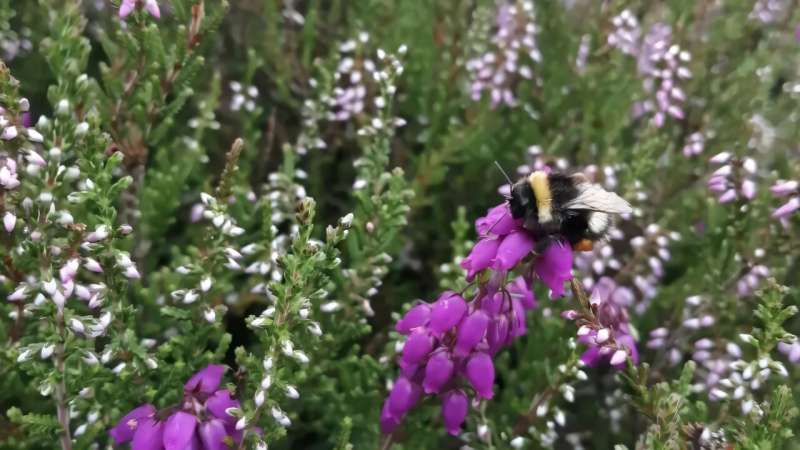
Research conducted by a team from Lund University reveals that the introduction of honeybees into flower-rich heathlands negatively impacts the behavior and size of wild bumblebees. The study, published on December 10, 2025, in the journal Proceedings of the Royal Society B: Biological Sciences, highlights significant ecological interactions in Ireland’s Wicklow Mountains where honeybees are moved to harvest heather honey.
The study tracked the movement patterns of bumblebees across various locations containing between 0 and 35 beehives. The findings indicated that as the number of honeybee colonies increased, bumblebees adapted their behavior in response. According to Lina Herbertsson, a biology researcher at Lund University, “We saw that the bumblebees adapted quite quickly once the honeybees were moved in.”
Behavioral Changes and Size Reduction
The research revealed that bumblebees spent less time foraging on heather flowers in areas populated by honeybees, indicating a decline in the availability of nectar and pollen. Surprisingly, the bumblebees observed in these areas were also smaller in size. This size reduction may be attributed to larger bumblebees relocating to areas with fewer honeybees, leaving smaller bumblebees, typically responsible for brood care, to forage.
“This is not something we expect in places that are absolutely teeming with flowers,” Herbertsson noted. The impact of honeybees was significant, noticeable not only near the beehives but extending up to one kilometer away.
Implications for Pollinators and Ecosystems
The implications of this research extend beyond Ireland, highlighting the delicate balance between honeybees, bumblebees, and other wild pollinators. These species are crucial for the pollination of numerous wild plants, as well as fruit and vegetable crops. With wild pollinators already facing challenges due to habitat loss, the increasing number of honeybees adds another layer of competition for resources.
Beekeeping holds cultural significance and plays a vital role in food production, presenting a challenge in managing the coexistence of honeybees and wild bees. Herbertsson emphasized the need for a strategic approach: “We hope our results can help beekeepers and conservation biologists plan beehive placement so that both honeybees and wild bumblebees can thrive. Ultimately, we want to preserve all pollinators, something that is essential for both farming and wild ecosystems.”
As the research sheds light on these environmental dynamics, it underscores the importance of fostering biodiversity and supporting the delicate web of life that sustains both agriculture and natural ecosystems.