Astronomers have made a groundbreaking observation of a supermassive black hole that is actively consuming a star, providing crucial evidence for the phenomenon known as “Lense-Thirring precession.” This event showcases a black hole’s ability to drag the fabric of spacetime as it spins, a concept first proposed by Albert Einstein in 1915 as part of his theory of general relativity. The findings deepen our understanding of black hole dynamics and stellar interactions.
The study, published on December 10, 2023, in the journal Science Advances, details the observation of a stellar object designated AT2020afhd. The team, led by researchers from Cardiff University, utilized data from the Neil Gehrels Swift Observatory and the Karl G. Jansky Very Large Array to investigate this tidal disruption event (TDE). A TDE occurs when a star ventures too close to a black hole, resulting in immense gravitational forces that can tear the star apart.
Understanding Lense-Thirring Precession
The phenomenon of Lense-Thirring precession, also known as frame dragging, predicts that a rotating mass will influence the spacetime around it. This effect was first detailed by Austrian physicists Josef Lense and Hans Thirring in 1918, but it has remained elusive and difficult to observe in practice. The current research represents a significant advancement in the field, as it provides the most compelling evidence yet for this effect.
“We confirm predictions made more than a century ago,” said Cosimo Inserra, a team member from Cardiff University. He likened the dragging effect to how a spinning top creates currents in water as it moves. The study not only reinforces Einstein’s theories but also sheds light on the nature of TDEs, where stars are shredded by a black hole’s gravitational forces.
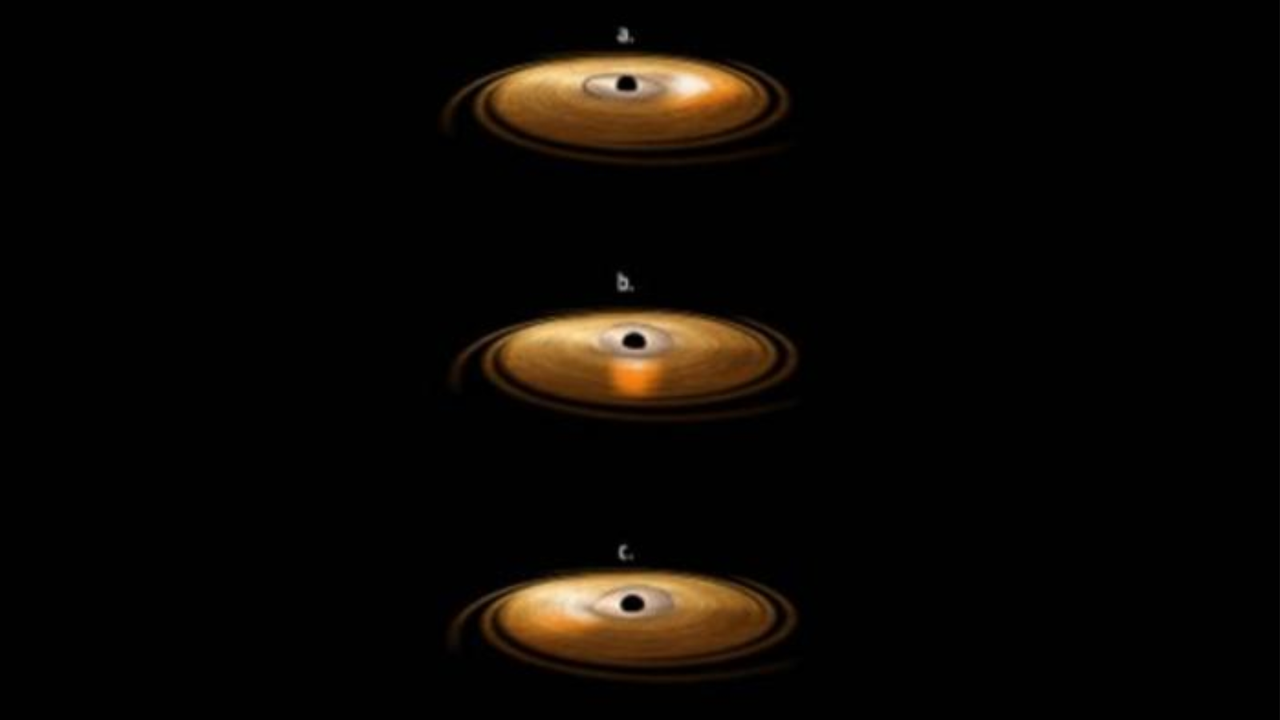
While observing AT2020afhd, the researchers noted rhythmic variations in X-ray and radio emissions. These changes indicated a wobble in the accretion disk—the disc of material surrounding the black hole—suggesting that both the disk and the jets of material were moving in unison. The wobble occurred in a regular cycle of every 20 Earth days, which has implications for our understanding of black hole feeding behaviors.
The Mechanisms Behind Tidal Disruption Events
During a TDE, the gravitational pull of a supermassive black hole can stretch and compress a star, a process known as spaghettification. This results in the formation of an accretion disk, where stellar material spirals into the black hole. The research indicates that black holes are often messy feeders, with some material being expelled as twin jets of plasma at nearly the speed of light, propelled by magnetic fields.
Inserra emphasized the importance of these observations for future research. “This study opens new avenues for probing black holes,” he stated. By confirming that a black hole can drag spacetime, scientists can begin to unravel the complexities of gravitational interactions and how they influence the movement of nearby cosmic objects.
As the research continues, it promises to enhance our understanding of the universe and the intricate dance of celestial bodies. The study serves as a reminder of the vastness of space and the extraordinary phenomena that await discovery, especially as we look to the night sky with wonder.