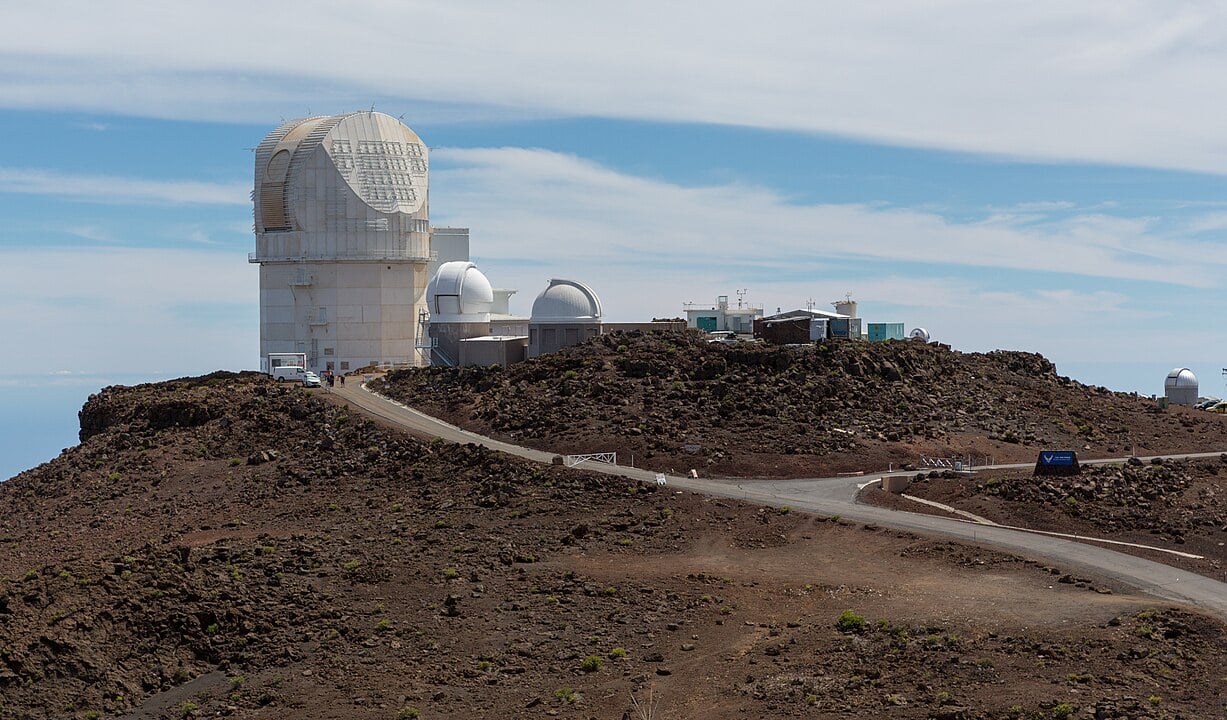
In a groundbreaking collaboration, astronomers have unveiled new insights into the Sun’s complex dynamics by combining observations from the National Science Foundation’s Daniel K. Inouye Solar Telescope and the European Space Agency’s Solar Orbiter. This partnership allows scientists to capture a comprehensive view of solar phenomena, marking a significant advance in solar research.
Revolutionizing Solar Observation
On October 2022, the Inouye Solar Telescope, located near the summit of Haleakalā in Maui, coordinated its observations with the Solar Orbiter, which was positioned closer to the Sun. This dual approach led to a stereoscopic view of our star, enhancing the understanding of its intricate features.
The collaboration provides a unique perspective on the Sun’s various layers. While the Inouye specializes in studying the photosphere and chromosphere, the Solar Orbiter excels at analyzing the hotter transition region and corona from space. This synergy allows for a detailed examination of solar structures from their origins deep within the solar atmosphere to the outer layers.
The precision of this observation is remarkable. To illustrate, if the Sun were represented by a chair at one end of a football field, the Solar Orbiter’s field of view would be comparable to a five-pound note placed on that chair. Within that small area, the Inouye’s observing window is represented by a tiny coin, with the structures under investigation being even smaller than half the thickness of a penny.
Discovering the ‘Campfires’
Through this coordinated effort, astronomers identified structures known as “campfires.” These tiny extreme ultraviolet brightenings had previously gone unnoticed but may hold crucial insights into the Sun’s behavior. Despite their seemingly insignificant individual appearances, they occur in vast numbers and could help answer long-standing questions regarding the heating of the solar corona, which reaches temperatures exceeding 1 million degrees Celsius while the visible surface remains at around 5,500 degrees.
“By coordinating high-resolution ground observations with space-based perspectives, scientists can now track how these small-scale events interact with larger magnetic structures,” said a spokesperson from the National Science Foundation.
This innovative approach not only enhances our understanding of solar dynamics but also demonstrates the power of collaboration in scientific discovery. As researchers continue to analyze the data gathered from this unique partnership, further revelations about the Sun’s behavior and its impact on the solar system are anticipated.
The mission serves as a reminder of the complexities of our nearest star and the ongoing efforts to unravel its mysteries. With each observation, scientists move closer to understanding the fundamental processes that govern the Sun and, by extension, our own planet’s climate and environment.