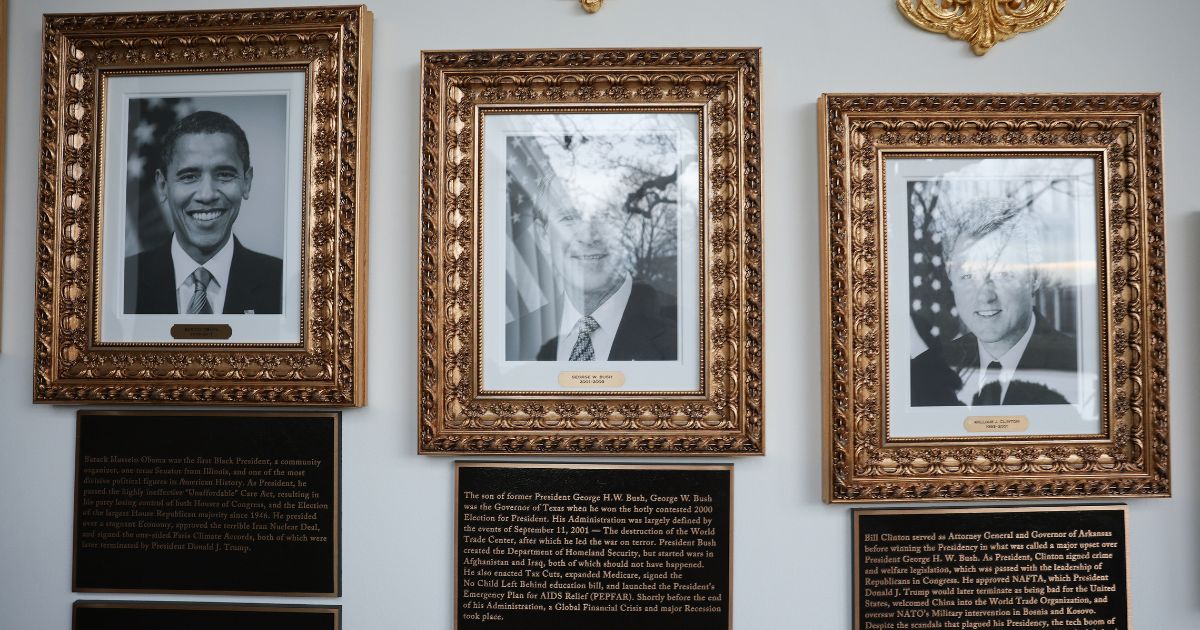
The White House has recently unveiled new plaques in the Presidential Walk of Fame, drawing attention for their controversial descriptions of former presidents. Among them, the plaque honoring former President Bill Clinton has sparked considerable discussion, with many noting its pointed final line. This initiative is widely seen as part of Donald Trump’s ongoing efforts to reshape the White House environment in a manner that aligns with his political identity.
The plaques, situated beneath the portraits of previous presidents, reflect a distinctive tone that some critics describe as biting. The plaque for Clinton, who served as the 42nd president of the United States, is considered one of the more favorable among the recent additions. In stark contrast, the descriptions of Barack Obama and current President Joe Biden are notably harsher.
Obama’s plaque states, “Barack Hussein Obama was the first Black President, a community organizer, one-term Senator from Illinois, and one of the most divisive political figures in American history.” This characterization has drawn mixed reactions from the public and political commentators alike.
Biden’s plaque, which refers to him as “Sleepy Joe,” is particularly striking, labeling him “the worst President in American history” who “oversaw a series of unprecedented disasters.” Such statements exemplify the polarization surrounding Biden’s presidency and highlight the contentious nature of Trump’s administration.
The decision to include these descriptions underscores a larger narrative of political rivalry and division in the United States. Critics argue that the plaques serve as a means for Trump to assert his legacy and cast aspersions on his predecessors, particularly those he views as political adversaries.
In the broader context, these plaques reflect a trend where political messaging is increasingly displayed in public spaces, often leading to intense public debate. Trump’s approach to the Walk of Fame is not just a personal expression but also an attempt to communicate his perspective on American history and the legacies of those who came before him.
The unveiling of these plaques has also reignited discussions about the role of the White House in shaping historical narratives and the extent to which political figures influence public perception. As the nation continues to navigate its complex political landscape, such actions by the former president serve as a reminder of the enduring impact of political legacies.
While some view the plaques as an entertaining jab at past leaders, others see them as a troubling reflection of the current state of American politics. As Trump’s influence remains significant within certain circles, the implications of these new additions to the White House are likely to resonate well beyond the confines of the Presidential Walk of Fame.
In a political environment where sentiments can quickly shift, the lasting effects of these plaques may be felt as future leaders grapple with the complexities of history, legacy, and public perception. The dynamic between Trump’s administration and those who preceded him continues to be a defining element of contemporary American politics.