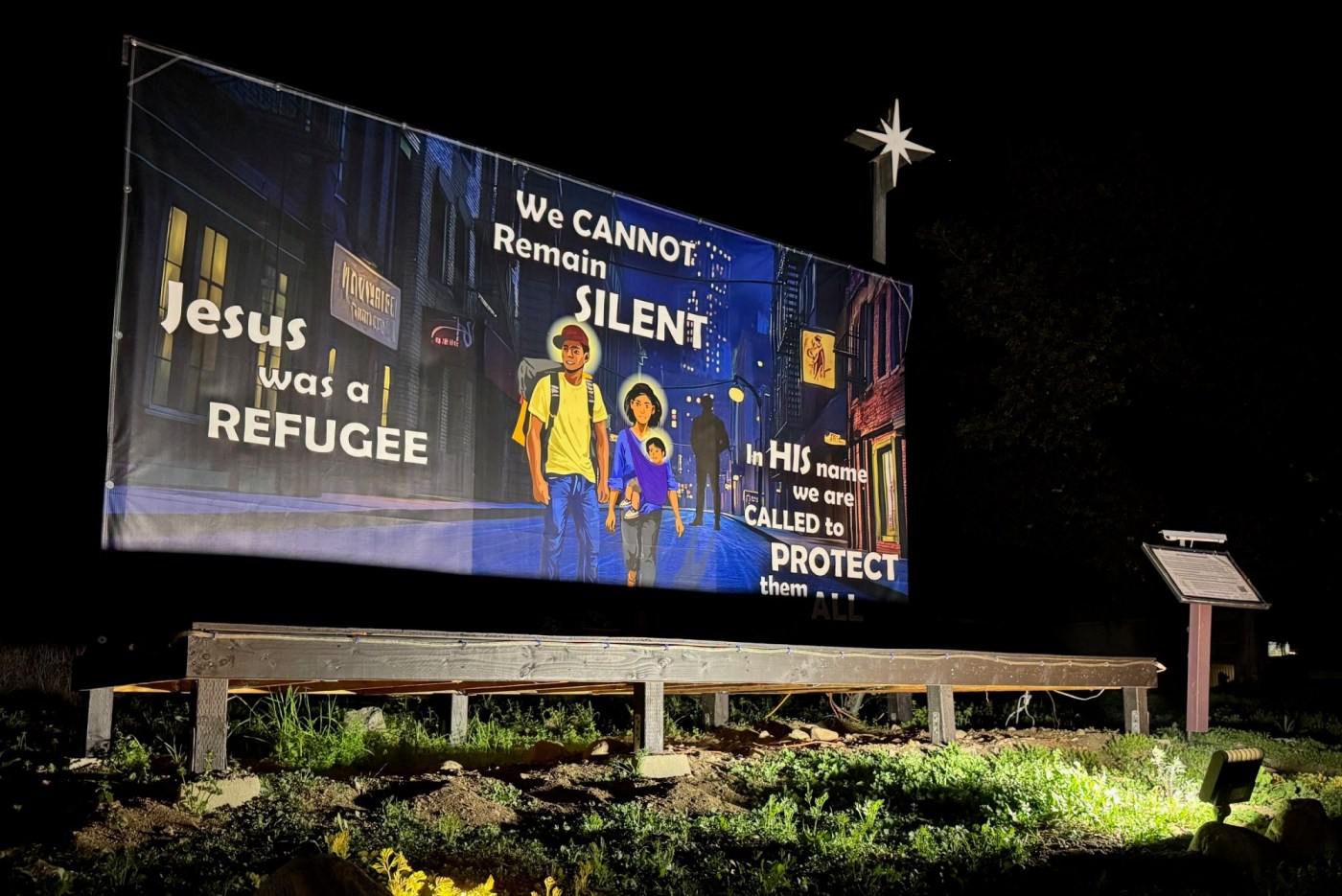
A church in Claremont, California, is drawing attention with a provocative Nativity display that connects a 2,000-year-old biblical story to contemporary issues facing immigrant communities. The Claremont United Methodist Church has unveiled a large banner that reads, “We cannot remain silent. Jesus was a refugee,” underscoring the plight of those fleeing violence and seeking safety.
The vinyl banner, measuring approximately 8 feet by 16 feet, is mounted prominently in front of the church on Foothill Boulevard. It features a cartoon illustration of a young Latino couple with their infant son, set against an urban backdrop at night. The message aims to evoke empathy and reflection on the current immigration crisis affecting families across the nation.
This annual Nativity display has gained recognition for its bold reinterpretations over nearly two decades. Rather than adhering to traditional imagery of the Nativity, the church’s scenes often depict the holy family in modern contexts, such as prisoners, war refugees, or in settings that comment on pressing social issues, including climate change and gun violence.
In previous years, the Nativity has featured striking visuals, such as Mary portrayed as a homeless mother with her newborn at a bus stop and a scene representing family separation policies in 2019 with a manger enclosed in wire cages. These creative choices have sparked national conversations about the intersection of faith and social justice.
This year’s display, which comments on immigration raids, aligns with similar themes presented in Nativity scenes across the United States. In Boston, one church has replaced the Christ child with a sign stating, “ICE was here,” while in Chicago, another display features Jesus bound by zip ties, flanked by soldiers labeled “ICE.”
The Claremont church’s leaders emphasize that their Nativity reflects the realities faced by many in their community. A statement accompanying the display highlights the need for solidarity with immigrants who experience violence and persecution. “Our nativity depicts the holy family, who had to flee government-sanctioned violence as refugees,” the statement reads.
The church draws on biblical scripture to support its position, quoting Leviticus 19:33-34, which encourages the faithful to treat immigrants with kindness and love. Yet, this approach has not been without controversy. Critics argue that the church is using religious imagery for political purposes, while supporters believe the Nativity’s contemporary framing is a necessary call for justice.
Local residents have shared varied responses to the display. One passerby, Philip Schmidt, expressed appreciation for any representation of Jesus that encourages reflection during the holiday season. Conversely, dissenting voices have emerged on social media, with some quoting scripture to argue that obeying government authorities is a divine mandate.
The church’s co-pastors, Jay Campbell and Katie Monfortte, have spoken publicly about the significance of the Nativity’s message. Monfortte, a Mexican American immigrant herself, highlighted the emotional impact of the display on those who share similar experiences of displacement and marginalization.
As the Claremont United Methodist Church continues its tradition of reimagining the Nativity, it remains a focal point for discussions about faith, advocacy, and the urgent issues surrounding immigration. The display can be viewed best at night, where a star-shaped light illuminates the scene, inviting all to reflect on the deeper meanings embedded within the Christmas narrative.