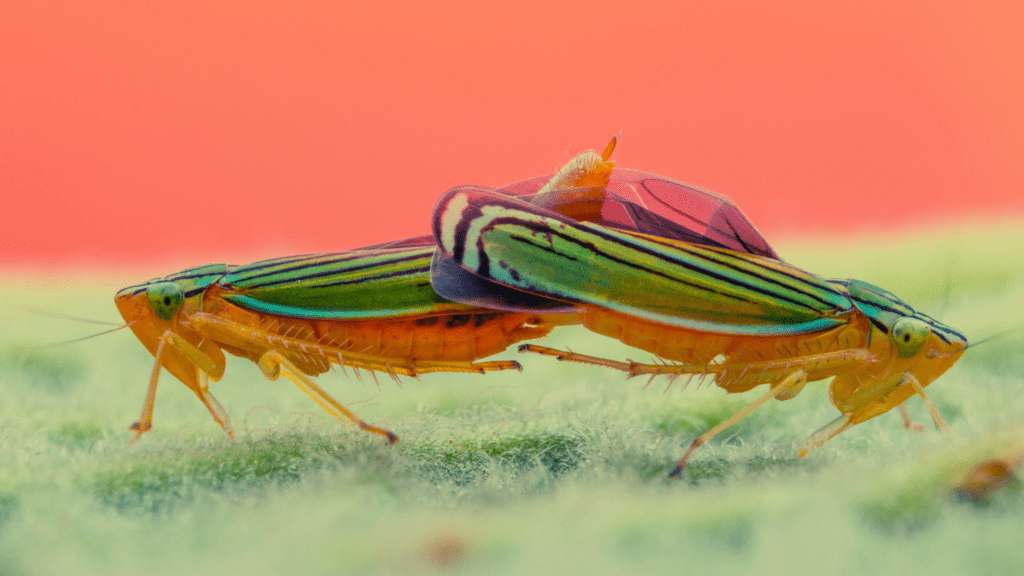
BREAKING: Scientists at Penn State University have successfully replicated the remarkable light-bending abilities of leafhoppers, common insects known for their extraordinary camouflage. This groundbreaking research, published in ACS Nano, reveals how these tiny creatures turn ‘invisible’ by utilizing microscopic particles that drastically reduce glare, making them nearly undetectable to predators.
Leafhoppers produce structures called brochosomes, miniature spherical particles that scatter light rather than reflect it. The Penn State team found that these particles can reduce glare by an astonishing 80 to 96 percent across visible and ultraviolet light. This significant reduction could revolutionize multiple industries, from energy devices to military applications.
In a developing study, researchers employed an innovative chemical approach using a microfluidic system to create these brochosomes. By generating over 100,000 particles per second, the method far surpasses traditional nanoscale manufacturing speeds. As the solvent evaporates, polymers transform into hollow spheres with precise pore patterns, mimicking the natural designs found on leafhoppers.
The team successfully recreated five different brochosome designs, ranging from a few hundred nanometers to about two micrometers in size. Adjusting polymer chemistry allowed for control over particle size and pore shape, enabling patterns resembling pentagons and hexagons.
This research opens up exciting possibilities. Surfaces designed to reflect less light could enhance the efficiency of energy devices, while optical materials might benefit from improved glare control. Military camouflage applications have also been suggested, though further testing is necessary for practical use. Additionally, researchers hint at potential biomedical applications, such as drug delivery, based on the unique properties of these particles.
What makes this study particularly compelling is the source—a common backyard insect. As scientists learn to replicate the leafhopper’s natural talent, the implications for technology are profound. This revelation not only highlights the ingenuity of nature but also demonstrates the potential for innovative solutions derived from biological inspiration.
Stay tuned for more updates as this research progresses. The implications of this study are vast, and its applications could soon transform various fields, making it a topic of interest for industries worldwide. This is a developing story that could change the landscape of technology and innovation.