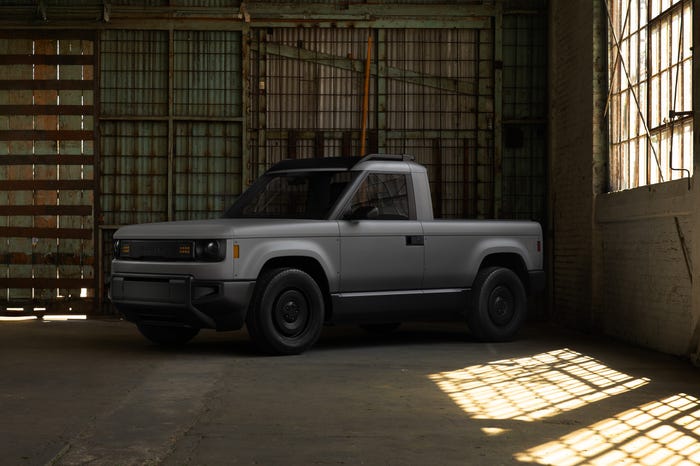
Electric vehicle startup Slate has introduced a groundbreaking approach to the market with its newly unveiled affordable electric truck, set to launch in 2026. Priced in the mid-$20,000s, the truck opts for a minimalist design, omitting features like screens, stereos, and power windows. This strategy targets consumers seeking a straightforward, functional vehicle free from the clutter of modern digital controls.
Minimalism Takes Center Stage
Tisha Johnson, Slate’s head of design, explained that the decision to create a no-frills truck stems from consumer fatigue with overly complicated vehicles. In an interview with Business Insider, Johnson noted, “People recognize that they don’t use half of what is afforded in the vehicle. And then they ask, openly they ask, ‘So why am I paying for this?'” This reflects a growing sentiment among drivers who prefer practical over extravagant features.
The Slate truck has generated considerable attention since its unveiling in April, with the base model designed to attract those who are overwhelmed by excessive technology in vehicles. Johnson emphasized, “It’s as much what you have as what you don’t have when you get inside the cabin of the Slate.” Consumers can choose to add features such as screens and radios, but the core design emphasizes simplicity and functionality.
Responding to Industry Trends
The automotive industry is witnessing a significant shift towards complex infotainment systems and digital controls, often at the expense of user-friendliness. Recent incidents, such as Jeep owners experiencing pop-up ads on their central screens due to a software glitch, highlight the frustrations many consumers face with advanced technology in vehicles. Tesla has also faced criticism over its electronically powered door handles, which have raised safety concerns in emergency situations.
Some automakers are beginning to acknowledge the potential pitfalls of this digital revolution. In March, Andreas Mindt, design chief at Volkswagen, stated that future models would revert to manual buttons for essential controls, calling the reliance on screens a “mistake.” This commentary reflects a growing recognition that a balance between technology and usability is essential.
Slate’s strategy of minimalism appears to be resonating with potential buyers. The startup reported having received over 150,000 refundable reservations by December, indicating strong interest despite challenges in the broader electric vehicle market. The recent removal of the federal $7,500 tax credit for new electric vehicles has complicated matters, leading Slate to adjust its marketing messaging regarding pricing.
Durability and Functionality
In addition to its minimalist design, Johnson highlighted the importance of durability in the Slate truck. The presence of crank windows is a deliberate choice aimed at reinforcing the truck’s appeal as a “collector’s item” that can be maintained and passed down through generations. “We want the vehicle to be very robust. We want people to be able to own it or pass it on for many years,” she stated.
The U.S. auto industry has been historically dominated by large, gas-guzzling pickups, making it difficult for electric vehicles to gain traction. Despite the challenges faced by notable models like Tesla’s Cybertruck and Ford’s F-150 Lightning, which sold 16,000 and 23,000 units respectively in the first nine months of the year, Slate’s approach may pave the way for smaller, more affordable electric options.
With competitors like Ford planning to launch a new midsize electric truck priced at around $30,000 by 2027, and Toyota considering a compact pickup, the market dynamics are shifting. Johnson believes that the emerging interest in smaller pickups validates Slate’s vision, stating, “If we’re stimulating the industry to do things differently, then we’re doing the right thing, because the problem is an industry problem. There’s a void in the market.”
As Slate prepares for production, its commitment to a simplified and durable electric truck model may redefine consumer expectations in the evolving landscape of electric vehicles.