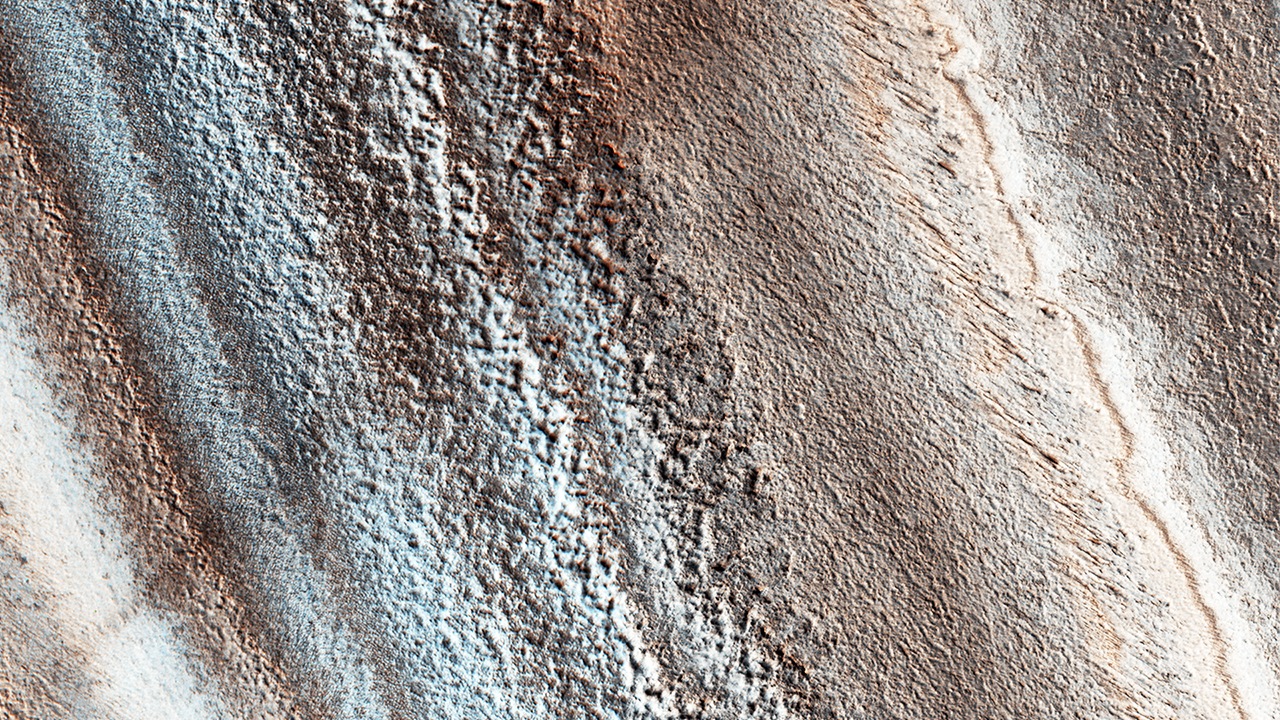
Recent observations of Mars’ North Pole have unveiled significant alterations in its layered deposits. A distinct straight-line feature has emerged, cutting across many layers and resulting in variations in brightness. This change is believed to reflect a fundamental transformation in the properties of these layers, raising intriguing questions about the planet’s geological history.
The feature, initially striking, has been attributed to wind processes that have influenced the area. On one side of the streak, superficial frost has been removed or dust has been deposited, while the opposite side remains less affected. Notably, when examined at full scale by the High-Resolution Imaging Science Experiment (HiRISE), the texture across the line does not exhibit any significant change.
Examining the Effects of Wind
The visual impact of this streak is pronounced when considering the entire image. Some layers that appear brighter on one side of the feature are noticeably darker on the other. This contrast likely results from the interplay of local slope and roughness with wind activity. Consequently, distinguishing the actual properties of the layers based solely on their brightness becomes a complex challenge in this environment.
Astrobiologists and astrogeologists are keenly interested in these observations, as they provide valuable insights into Mars’ climatic and geological processes. Understanding these changes is crucial for interpreting the planet’s history and assessing its potential for past life.
As researchers continue to analyze data from HiRISE, further investigations are expected to clarify the implications of these findings. The layered deposits at Mars’ North Pole are not only a subject of scientific curiosity but also a vital component in the ongoing quest to understand our neighboring planet.