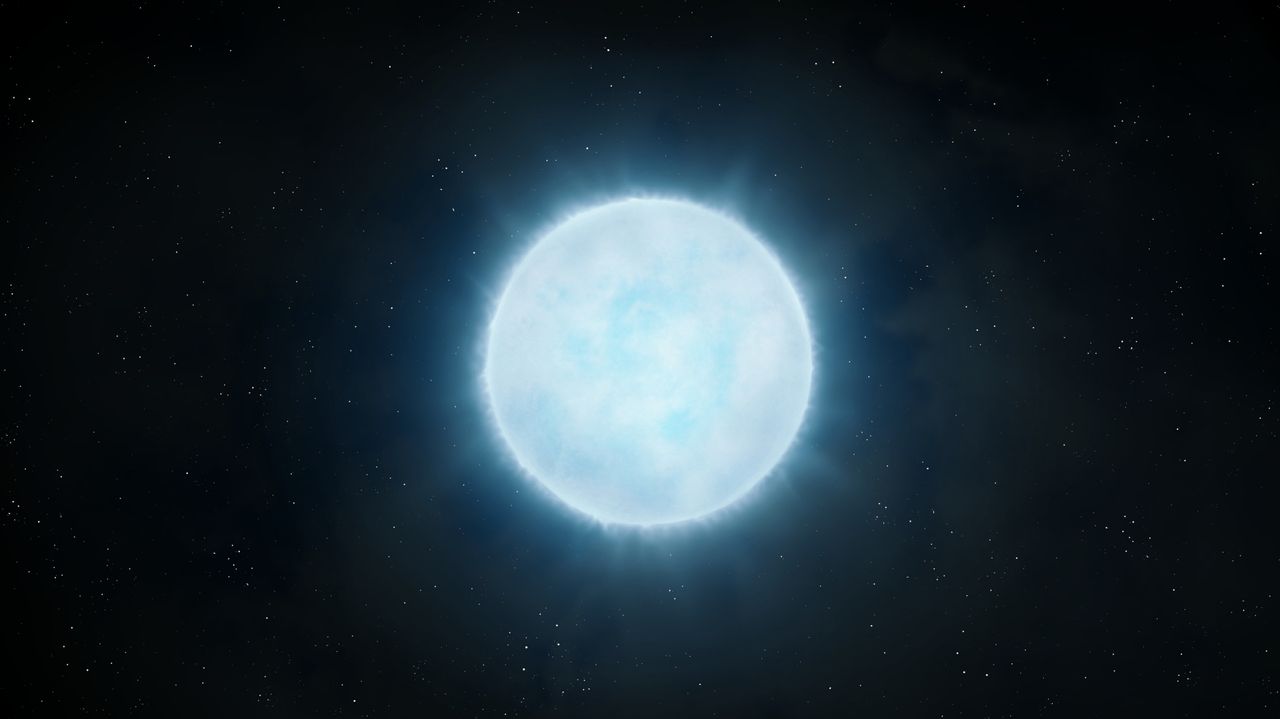
Recent research has advanced the search for axions, a theoretical particle considered a potential candidate for dark matter. By examining white dwarfs—dense remnants of stars—scientists aim to uncover clues about these elusive particles. A study published in November 2025 on the open-access server arXiv detailed how researchers utilized archival data from the Hubble Space Telescope to explore this possibility.
The study focused on white dwarfs, which are the remnants of stars that have exhausted their nuclear fuel. These compact objects can contain the mass of the sun within a volume smaller than that of Earth. They remain stable due to a phenomenon known as electron degeneracy pressure, where a large number of free electrons resist collapse, following the principles of quantum mechanics.
The theoretical framework surrounding axions suggests that these particles could be produced by electrons under specific conditions. If an electron moves rapidly enough, it may generate an axion. Inside a white dwarf, where electrons travel at nearly the speed of light, this process could occur frequently, leading to a significant number of axions escaping from the star. This escape would result in a loss of energy, causing the white dwarf to cool at a faster rate than expected.
To test these theories, researchers developed a sophisticated model simulating the temperature and brightness evolution of white dwarfs, incorporating the effects of axion cooling. They then analyzed data from the globular cluster 47 Tucanae, which provided a large sample of white dwarfs formed around the same time.
The findings revealed no evidence supporting axion cooling among the white dwarfs in this cluster. Nevertheless, the research established new constraints on the interaction between electrons and axions, suggesting that the production of axions from electrons occurs at a rate of less than once per trillion interactions. While this result does not eliminate the possibility of axions, it indicates that their direct interaction with electrons is unlikely.
As the quest for axions continues, this study highlights the need for innovative approaches to detect these mysterious particles. By refining our understanding of the universe’s composition, researchers hope to unlock further secrets that may illuminate the nature of dark matter and its role in cosmic evolution.