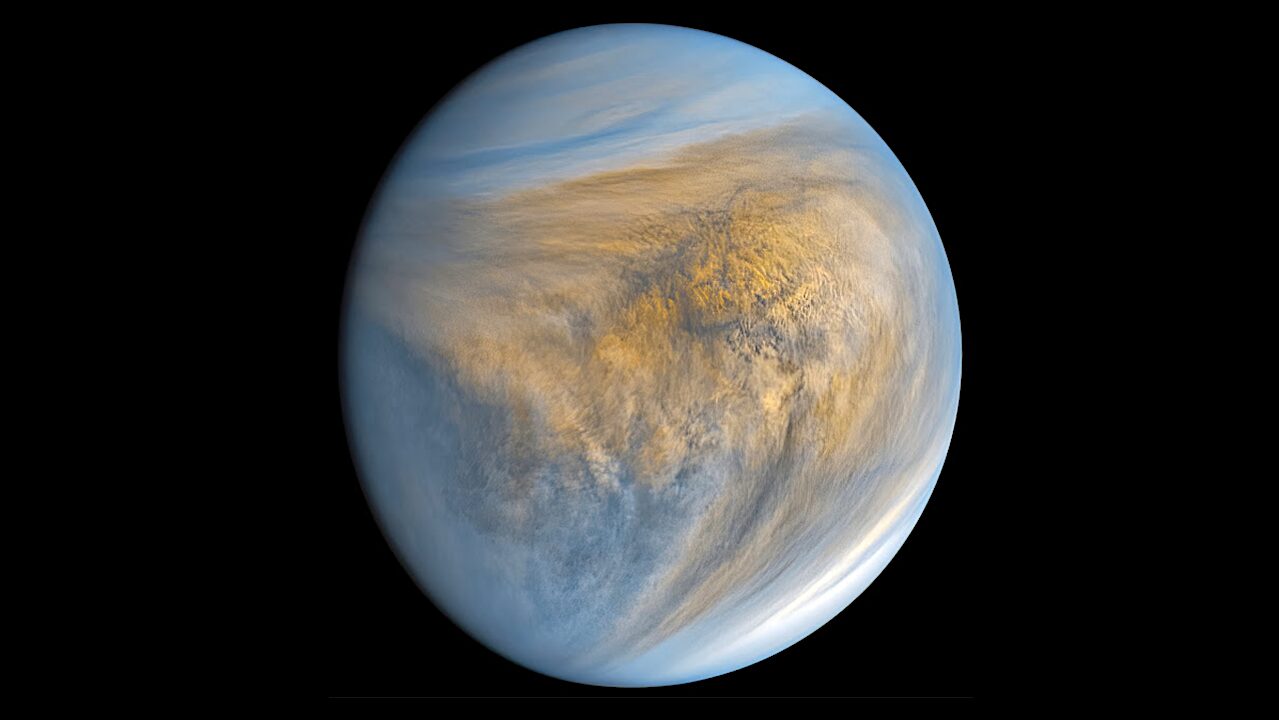
Recent research from astronomer Sylvio Ferraz-Mello sheds light on the intricate relationship between a planet’s atmosphere and its rotational dynamics. This study revisits the rotational characteristics of Venus to provide insights into potential behaviors of exoplanets situated within the habitable zone of solar-type stars.
Understanding how atmospheres affect planetary rotation is crucial for astrophysics. The focus of this study is on how dense atmospheres can influence a planet’s rotational state over time, leading to either synchronous or asynchronous rotational solutions. To explore this, the research employs the creep tide theory to calculate the gravitational tidal torque acting on planets. This mathematical approach allows for a thorough examination of the differential equations that emerge from the combined effects of tidal and atmospheric torques.
Atmospheric Influence on Planetary Rotation
The findings reveal that the formation of a dense atmosphere on a planet can significantly alter its original rotation. In particular, one notable possibility is that a planet may gradually shift towards retrograde rotation, a phenomenon exemplified by Venus. This rotation reversal indicates a critical aspect of planetary dynamics where external forces, such as atmospheric pressure and tidal interactions, play a pivotal role.
The research provides detailed analysis, highlighting the variations in the rotational elements of Venus before and after its rotation reversal. Measurements include changes in obliquity and equinox, as well as the comparison of the planet’s rotation period and orbital period. The study illustrates how the longitude of the First Equinoctial Point, which marks the intersection of the planet’s equator and its orbit, can shift notably due to these torques.
Implications for Exoplanet Studies
This research has significant implications for our understanding of exoplanets located in the habitable zone. As scientists continue to discover new worlds beyond our solar system, the insights gained from Venus may offer a framework for predicting the rotational dynamics of these distant planets. By understanding the interactions between atmospheric conditions and tidal forces, researchers can better assess the potential habitability of exoplanets.
The study was presented at the XIII Taller de Ciencias Planetarias in Montevideo and is available for further review on the arXiv platform, cited as arXiv:2512.06526. As ongoing research in Earth and Planetary Astrophysics progresses, the findings related to Venus’s rotation and atmospheric effects will likely fuel future explorations into the dynamics of exoplanets.
In a rapidly evolving field, this research serves as a crucial step towards enhancing our understanding of how various factors contribute to the rotational behavior of planets, both within and beyond our solar system.