
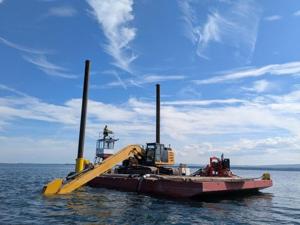
A cutting-edge technique utilizing high-velocity water jets is being implemented to enhance the habitat for lake trout in Lake Erie. The project, led by the New York State Department of Environmental Conservation (DEC), is taking place at Brocton Shoal in Chautauqua County. This innovative approach aims to improve the ecological conditions for fish in the area.
The Seaway Marine Group is conducting the jetting work, which involves blasting away accumulated organic material on the lakebed. This process not only cleans the substrate but also promotes the growth of essential aquatic vegetation. Such vegetation serves as a vital habitat for fish, particularly the lake trout, which have faced challenges in recent years due to habitat degradation.
Pascal Wilkins, a fish biologist with the Lake Erie Fisheries Research Unit, and Aleksandr Davis, a fish technician with Region 9 fisheries, have been closely monitoring the progress of the project. Using an underwater drone, they conducted assessments before and after the jetting process, which revealed promising results. The assessments indicate a significant improvement in the lakebed environment, suggesting that the technique may be effective in supporting the lake trout population.
The initiative is part of ongoing efforts to restore and maintain the health of aquatic ecosystems in the region. As habitats become degraded, fish populations often decline, resulting in imbalances that can affect the entire ecosystem. By employing this innovative jetting technique, the DEC aims to create a more conducive environment for the lake trout, ensuring their survival and enhancing biodiversity in Lake Erie.
Environmental experts are optimistic about the potential impact of this project. The high-velocity jetting not only addresses immediate habitat concerns but also sets a precedent for future ecological restoration efforts in other areas facing similar challenges. The project exemplifies the importance of integrating technology and environmental science to safeguard aquatic life.
As the project progresses, stakeholders and local communities will be keenly observing the results. The success of this initiative could pave the way for similar interventions in other regions, contributing to the broader goal of ecological preservation and restoration.


