High school sophomore Abigail Merchant has developed a flood-detecting CubeSat, aiming to reduce flood-related fatalities. Living in Orlando, Florida, a state frequently affected by flooding due to its low elevation, Merchant is driven by the increasing risks posed by climate change. According to the U.S. Environmental Protection Agency, warmer air holds more moisture, resulting in heavier rainfall and subsequent flooding.
Traditional methods rely on satellites and radar to gather data, but Merchant highlights that technology failures and slow data transmission can hinder emergency responses. The urgent need for more efficient systems has motivated her to innovate.
Innovative Approach to Flood Detection
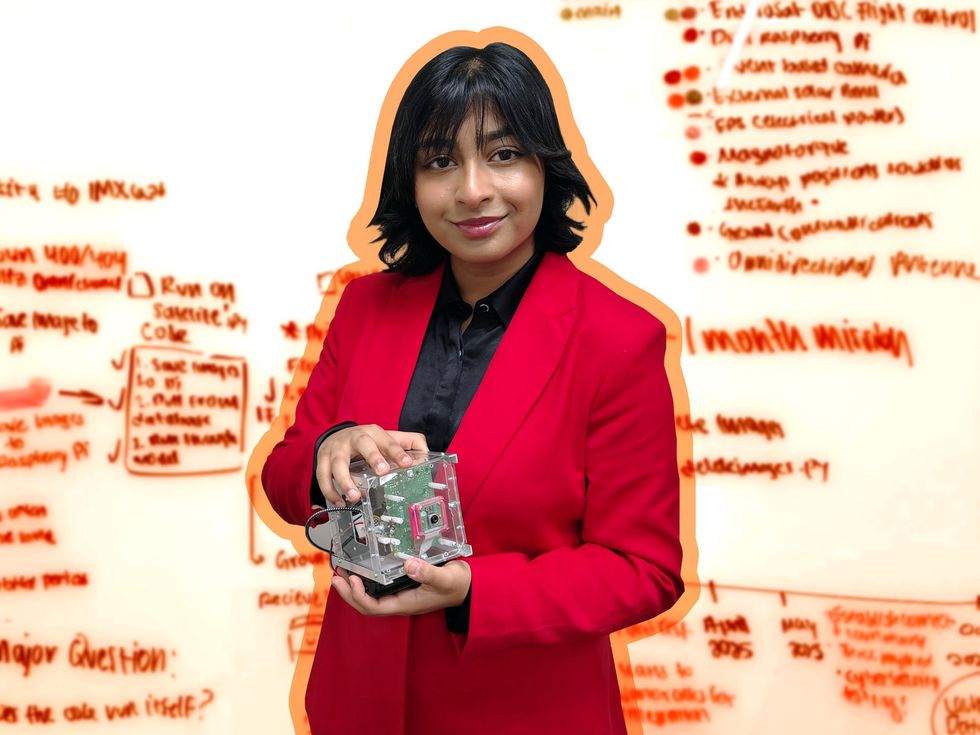
In response to these challenges, Merchant created a small, cost-effective CubeSat integrated with artificial intelligence. This device employs a standardized design of 10-centimeter units, allowing manufacturers to utilize off-the-shelf components for its construction. The CubeSat captures images of affected areas and applies pattern recognition to identify flooding, assess damage to infrastructure, and track survivors.
Merchant presented her findings at the IEEE SoutheastCon conference in March 2023. “IEEE is a foundational part of my growth as a young researcher,” she stated. “It turned engineering from my dream to reality.”
Her interest in disaster response was piqued by the lengthy delays in satellite data transmission, which can take several hours to reach emergency responders. Realizing the potential of CubeSats, she embarked on a project that emphasizes speed and accuracy. “CubeSats are agile and can form constellations that update data in nearly real time,” she explained.
Merchant’s breakthrough came when she and three classmates participated in the MIT Beaver Works Build a CubeSat Challenge. Their team, known as the Satellite Sentinels, developed a CubeSat powered by a convolutional neural network (CNN) capable of identifying flood-affected zones and gathering data. Merchant served as the group’s payload programmer, leading efforts in mission design and simulation.
Developing and Testing the CubeSat
The CubeSat, which cost approximately $310 to build, weighs around 495 grams. It has been successfully tested by connecting to a laptop via Bluetooth, allowing for image transmission every two minutes. The machine learning algorithm, created by Merchant using Python, analyzes these images to detect flooding and can alert emergency services via SMS or email.
To validate their system, the team constructed a model city using Lego blocks, simulating a flood scenario in an empty bathtub. The CubeSat accurately captured and transmitted images, successfully detecting water levels. Out of 30 competing teams, the Satellite Sentinels secured third place.
Merchant is currently expanding her research at Accenture in Richmond, Virginia, where she works remotely as a payload designer for the company’s CubeSat launch team. After completing the MIT program, she encountered challenges with her initial model, particularly in detecting flooding under varying conditions. To address this, she retrained the algorithm to better recognize flood indicators through pixel color analysis.
Recognizing that Bluetooth transmission would not suffice for satellites in orbit, she proposed using SubMiniature Version A (SMA) antennas for more reliable communication.
“It has been one of the most formative experiences of my career,” Merchant said, reflecting on her development process. Her CubeSat is expected to launch early next year.
Merchant is also interning at the MIT Computer Science and Artificial Intelligence Laboratory, conducting research on cognitive cartography, which involves structuring complex information into semantic maps. She hopes to continue her academic journey at prestigious institutions like MIT or Stanford.
Her introduction to the IEEE community, facilitated by former finance chair Joe Jusai, has been transformative. Initially drawn to IEEE while developing a robotic arm for a science fair project, she found inspiration and mentorship that have profoundly shaped her understanding of engineering.
Merchant is enthusiastic about becoming an IEEE student member and aspires to lead the organization in the future. “I hope to step into the same shoes as leaders like Kathleen Kramer, who have made significant contributions to the field,” she expressed.
Through her innovative work, Abigail Merchant is not only advancing technology but also paving the way for future generations to harness engineering for impactful change.