Ukrainian and European officials have firmly dismissed claims from Moscow that Ukraine attempted a drone attack on Russian President Vladimir Putin‘s residence in the Novgorod region. This incident has the potential to disrupt ongoing peace negotiations led by the United States as the new year approaches. On March 11, 2024, Russian Foreign Minister Sergei Lavrov alleged that Ukraine launched a coordinated drone strike targeting Putin’s personal residence, asserting that Moscow would reassess its negotiating stance in light of these claims.
Reports from U.S. national security officials contradict Lavrov’s assertions. According to the Wall Street Journal, the CIA has determined that there was no attempt to target Putin or any of his residences. A CIA spokesperson was not immediately available for comment. Initial reactions from former President Donald Trump indicated sympathy towards Russia’s position, as he stated that Putin expressed anger over the alleged incident. However, by March 13, he appeared more skeptical, sharing an editorial that criticized Russia for impeding peace efforts in Ukraine.
Ukrainian authorities have categorically denied the attack, labeling the allegations as part of a Russian disinformation effort intended to create discord between Kyiv and Washington. Following a meeting between Trump and Ukrainian President Volodymyr Zelenskiy, described by both parties as constructive, Ukraine distributed a detailed briefing paper to European Union delegations, asserting that Russia’s claims were designed to “sabotage” the agreements made during the discussions.
EU Officials Call Claims a Distraction
The European Union‘s chief diplomat, Kaja Kallas, condemned Russia’s allegations, describing them as “a deliberate distraction.” In a statement on social media platform X, Kallas emphasized, “No one should accept unfounded claims from the aggressor who has indiscriminately targeted Ukraine’s infrastructure and civilians since the start of the war.” As of March 13, independent verification of the alleged attack remains absent.
The Russian accusations and the responses from Ukraine and the EU highlight the ongoing battle for narrative control surrounding the nearly four-year-long conflict in Ukraine. According to Kurt Volker, a former U.S. ambassador to NATO, there is “no evidence” that Putin is pursuing peace or desires Ukraine’s success, countering Trump’s recent remarks suggesting otherwise.
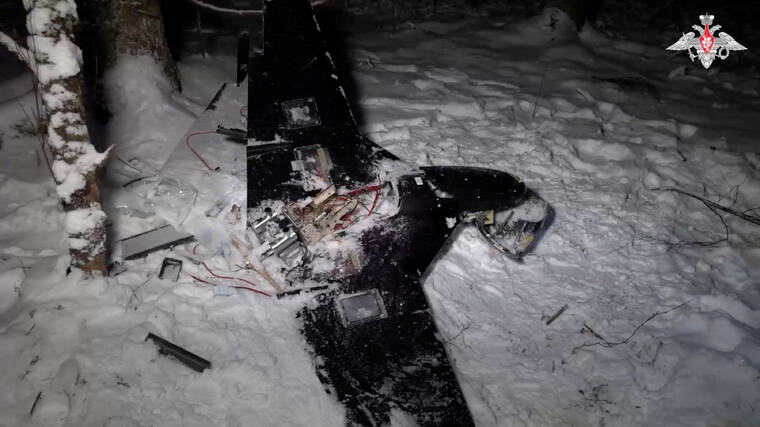
In a related development, the Russian defense ministry released video footage purportedly showing details of the alleged attack. Major General Alexander Romanenkov detailed how Moscow believes Ukraine targeted the Novgorod residence. The footage included a Russian serviceman next to debris claimed to be from a downed Ukrainian drone, which allegedly carried a 6-kg explosive device that failed to detonate. Ukraine’s foreign ministry quickly dismissed the video as unfounded, reiterating their confidence that no such attack occurred.
Discrepancies and Doubts Surround Allegations
Prior to Lavrov’s allegations, Novgorod Governor Alexander Dronov had reported that air defense systems were successfully intercepting Ukrainian drones in the area. Trump speculated that the incident could be a Russian false flag operation, although he has also shown a tendency to accept controversial statements from Putin at face value. Earlier in 2024, Trump reiterated Russian claims regarding Ukrainian encirclement in Kursk, despite contradicting U.S. intelligence.
The controversy surrounding the alleged attack coincides with concerns among some Western intelligence officials that Russia may be attempting to delay further punitive measures from Washington aimed at compelling Moscow to enter peace negotiations. It remains unclear whether the U.S. intelligence community has assessed the validity of the alleged attack or communicated any relevant findings to Congress.
In the briefing paper reviewed by Reuters, Ukrainian officials noted the striking similarity in public comments from various Russian officials shortly after the alleged attack, suggesting a coordinated strategy. Residents living near Putin’s Novgorod residence reported to local media that they did not hear any air defense activity during the night of the purported incident.
The Russian defense ministry’s narrative has also exhibited inconsistencies. In a statement released on March 10, it reported intercepting 89 long-range Ukrainian attack drones throughout the country, with 18 intercepted over the Novgorod region. However, a follow-up statement claimed that 91 drones were intercepted, all allegedly aimed at Putin’s residence, with 41 downed over Novgorod.
As tensions continue to rise, the situation underscores the complexities of the ongoing conflict and the critical need for accurate information in a landscape rife with propaganda and misinformation.