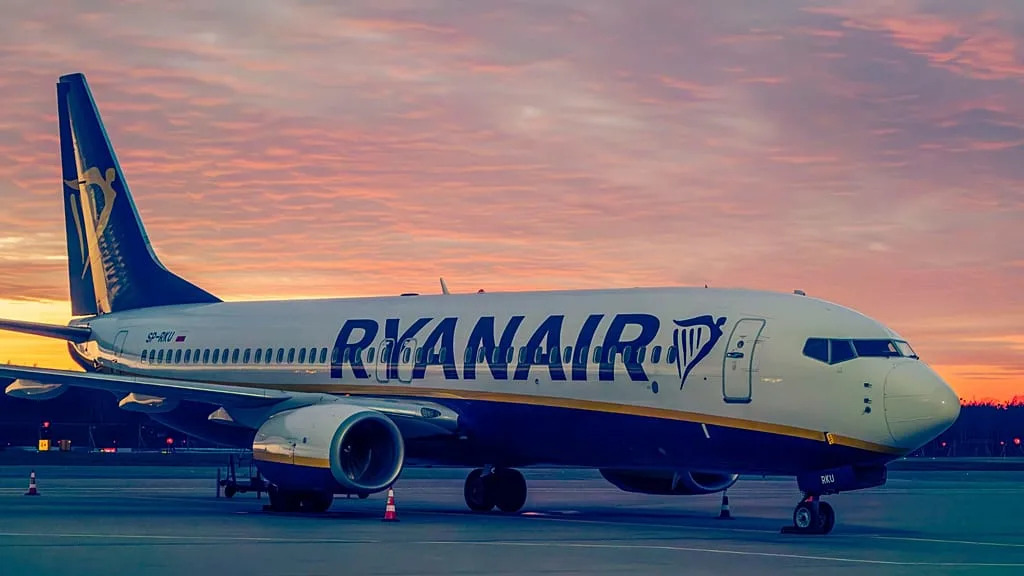
European budget airline Ryanair is significantly reducing its flight offerings in 2026, impacting millions of passengers across various countries. The airline’s decision to cut routes comes amid ongoing challenges and operational changes as it adjusts to the evolving aviation landscape. This move will eliminate approximately three million seats, affecting connections and convenience for travelers, particularly in smaller cities.
Ryanair’s Route Reductions Across Europe
In October 2025, Ryanair announced the elimination of **24 routes to and from Germany**, resulting in a loss of nearly **800,000 seats** for the Winter 2025/2026 schedule. Affected airports include **Hamburg, Berlin, Cologne, Memmingen,** and **Frankfurt-Hahn**. Operations will remain suspended at **Leipzig, Dresden,** and **Dortmund** airports throughout 2026. The airline attributes these cuts to high air traffic control (ATC) fees, increased aviation taxes, and frequent airport changes, criticizing the German government for undermining competitiveness in the sector.
According to Ryanair, “Germany’s sky-high access costs are in stark contrast with countries such as Ireland, Spain, and Poland, which have no aviation taxes.” The airline emphasized that Germany is lagging in air traffic recovery, operating at just **88% of pre-COVID levels**. It has warned of further capacity reductions if the government does not address these issues.
Ryanair’s strategy includes reallocating resources to countries with more favorable operational costs, which could lead to additional withdrawals if conditions do not improve.
Significant Cuts in Spain and Other Countries
Ryanair is also scaling back its operations in Spain, announcing a **1.2 million seat reduction** for its summer 2026 schedule. Key changes include the cessation of all flights to **Asturias** and **Vigo**, along with the closure of its base at **Santiago de Compostela**. The airline has halted operations to **Tenerife North** for the winter and closed its base in **Jerez**. Ongoing disputes with the Spanish airport operator **Aena** over rising fees and taxes are cited as the primary reason for these cuts.
The airline argues that regional Spanish airports are becoming less competitive compared to alternatives in **Morocco** and **Italy**. Ryanair criticized Aena’s pricing strategy, stating that small regional airports should not charge similar rates to major hubs like **Madrid** and **Barcelona**. As a result, the airline is shifting focus to larger airports where demand and fares are higher.
In France, Ryanair has already cut **750,000 seats** and **25 routes** for Winter 2025, mainly due to increased aviation taxes. Although it plans to resume flights to **Bergerac** in summer 2026, services to **Brive** and **Strasbourg** remain suspended, with additional cancellations likely.
Belgium is not spared either, as Ryanair plans to cut **20 routes** and **one million seats** from **Brussels** and **Charleroi** due to a new aviation tax set to double to **€10** per passenger. The airline has called for the abolition of this tax to stimulate traffic and tourism.
In Portugal, Ryanair will eliminate all **six routes** to and from the **Azores** by the end of March 2026, affecting around **400,000 passengers** annually. This is primarily due to high ATC fees and a new **€2** travel tax that the airline deems counterproductive. Ryanair has urged the Portuguese government to intervene, asserting that the current operational costs and monopoly pricing hinder low-fare connectivity.
Additionally, reductions are expected in **Bosnia** and **Serbia**, as Ryanair reallocates resources to destinations with growing demand, such as **Croatia**. This includes cutting back on flights from **Banja Luka** and **Niš**.
Ryanair’s strategic adjustments indicate a significant shift in the airline’s operational focus, determined by external economic pressures and competitive dynamics across Europe. As the airline navigates these challenges, it remains open to expanding capacity again if conditions improve.