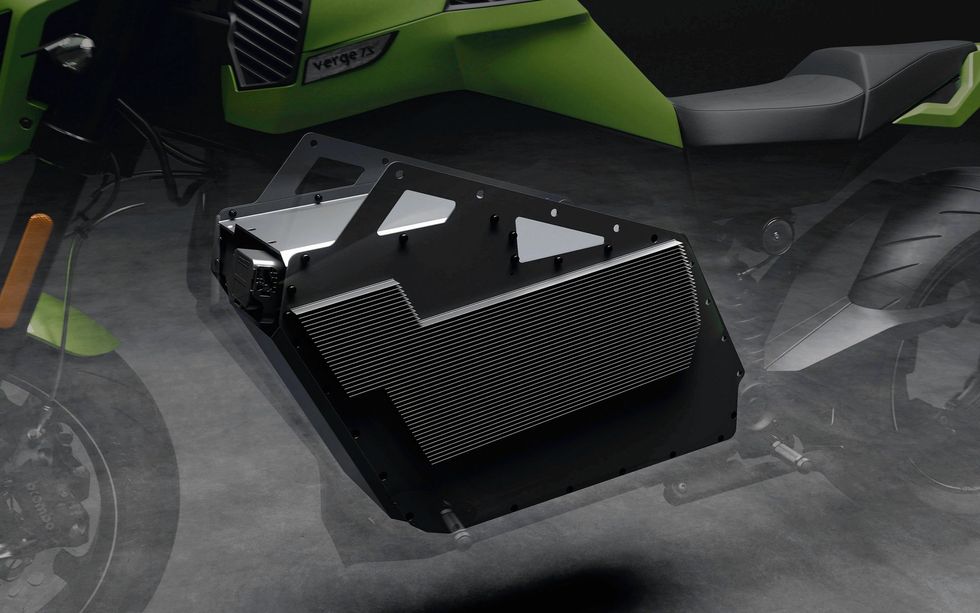
At CES 2026 in Las Vegas, Estonia’s innovative companies Verge Motorcycles and its tech spin-off, Donut Lab, announced a significant advancement in electric vehicles: the Verge TS Pro motorcycle will be the first to feature solid-state batteries. The companies claim to have achieved what major players like Tesla and BYD have yet to accomplish, marking a pivotal moment in the push for more efficient electric mobility.
While Tesla and other industry giants face the challenge of mass-producing batteries for large-scale vehicles, Verge and Donut Lab are focusing on a more manageable production scale with their low-volume motorcycles. The Verge TS Pro is set to begin shipping in the first quarter of this year, with plans for all Verge motorcycles to follow suit with solid-state battery technology sourced from Finland.
Electric motorcycles have historically struggled with short ranges and lengthy charging times, factors that deter many potential riders. The Verge team aims to overcome these challenges by integrating batteries that do not use lithium or liquid electrolytes. Instead, they utilize ceramics to enhance safety, performance, and charging speed. Buyers will have the option to choose between a 20.2- or 33.3-kilowatt-hour battery pack, boasting an energy density of 400 watt-hours per kilogram. This is a substantial improvement over the 200-300 watt-hours per kilogram typical of lithium-ion batteries.
Performance and Range Innovations
The Verge TS Pro’s larger battery variant is expected to offer a range of up to 600 kilometers (approximately 370 miles), more than double that of conventional electric motorcycles. With a peak charging rate of 200 kilowatts, the motorcycle can recharge from 20 percent to nearly full in less than 10 minutes. The starting price for the TS Pro is set at $29,900 in the United States, with an additional $5,000 for the larger battery option.
Despite the excitement surrounding this new technology, skepticism remains regarding the viability of solid-state batteries. Notable experts, including Kurt Kelty from General Motors, have indicated that solid-state technology may still be years away from widespread adoption. Ville Piippo, co-founder and CTO of Donut Lab, openly acknowledges the doubts surrounding their innovation, particularly given the company’s limited experience in battery design and manufacturing.
Piippo argues that the industry’s focus on traditional methods has hindered progress, stating, “If the world is pouring billions and billions of dollars into solid state, why haven’t they figured this out?” He emphasizes that the Verge and Donut Lab teams are approaching the challenge differently.
Unique Design and Future Prospects
The distinctive design of the TS Pro features a hubless rear wheel, which has drawn comparisons to the futuristic light cycles from the movie Tron. Donut Lab’s latest motor weighs just 21 kilograms, significantly lighter than its predecessor, and generates 102 kilowatts (approximately 137 horsepower) with a peak torque of 1,000 Newton-meters. This allows the motorcycle to accelerate from 0 to 60 mph (0 to 102 kph) in 3.5 seconds, making it competitive, although still slower than many combustion-engine sport bikes.
Marko Lehtimäki, co-founder and CTO of Verge, expressed confidence in their product, stating, “All the claims by other companies have made it hard for us to be believable, but the reality is that solid state has arrived.” The companies are prepared to demonstrate their technology through media rides and factory tours in the near future.
In addition to motorcycles, Verge and Donut Lab are collaborating on several projects, including a tactical buggy and drone platform. They are also exploring the development of lightweight electric sports cars, a challenge that has perplexed manufacturers like Porsche and Tesla.
The CES platform showcased a wealth of technological advancements from these innovative Baltic companies, including Donut Lab’s in-wheel motors set to power a new limited-production sports car from Longbow. This highlights the increasing potential for electric vehicles to evolve beyond traditional designs, with a shared goal of creating new, efficient driving experiences.
As the landscape of electric vehicles continues to change, the introduction of solid-state technology could represent a significant step forward, transforming not only motorcycles but potentially the entire automotive market.