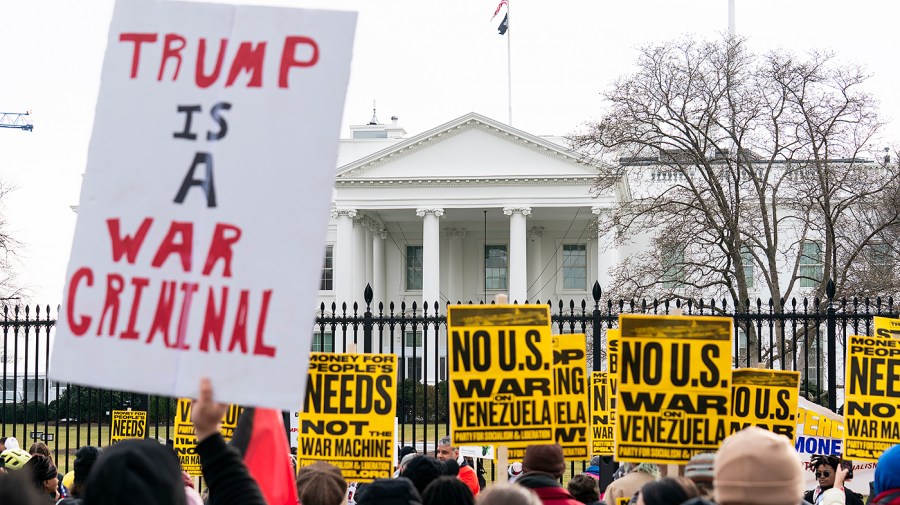
The U.S. government is encountering significant backlash regarding the legal rationale for its military operation aimed at capturing Venezuelan President Nicolás Maduro. On January 3, 2024, U.S. forces conducted an operation at Maduro’s residence in Caracas, leading to his detention. Critics argue that this action may have violated both international law and the U.S. Constitution.
Legal experts have raised serious concerns about the legitimacy of the operation. They cite potential breaches of international norms governing military intervention and the sovereignty of nations. The lack of explicit authorization from the United Nations or any regional body further complicates the situation. This is particularly pertinent given Venezuela’s ongoing political turmoil, which has drawn international attention and condemnation.
The Trump administration’s justification for the operation hinges on claims of protecting democracy in Venezuela. However, critics contend that the approach taken undermines the principles of international law, which typically discourage unilateral military actions without broad consensus. Concerns are also mounting over the implications for U.S. foreign policy and its relationships with other nations, especially in Latin America.
In response to the criticisms, the administration has defended its actions, asserting that the operation was necessary to counter what it describes as Maduro’s authoritarian regime. They argue that Maduro poses a threat not only to Venezuelans but also to regional stability. Nonetheless, the administration’s rationale has not quelled the skepticism voiced by legal analysts and human rights advocates.
Furthermore, the U.S. Constitution mandates that Congress plays a key role in decisions regarding military engagements. The operation’s execution without explicit congressional approval raises questions about adherence to domestic laws. This aspect of the operation has prompted calls for further investigation into the decision-making process that led to the military action.
The political fallout from this operation is likely to be significant. Analysts suggest that it may embolden other governments to question the U.S.’s commitment to international law, potentially leading to a decline in its influence on the global stage. The operation’s implications for U.S.-Venezuela relations, already strained, could deepen the divide.
As the situation evolves, the legal and diplomatic ramifications will be closely monitored. Observers are particularly interested in how this incident will affect future U.S. interventions in Latin America and beyond. The ongoing debate highlights the complex balance between national security interests and the respect for international legal standards.
In conclusion, the operation against Nicolás Maduro presents a multifaceted issue that intertwines legal, ethical, and political considerations. As the Trump administration faces scrutiny, it remains to be seen how this incident will shape the discourse surrounding U.S. foreign policy in the years to come.