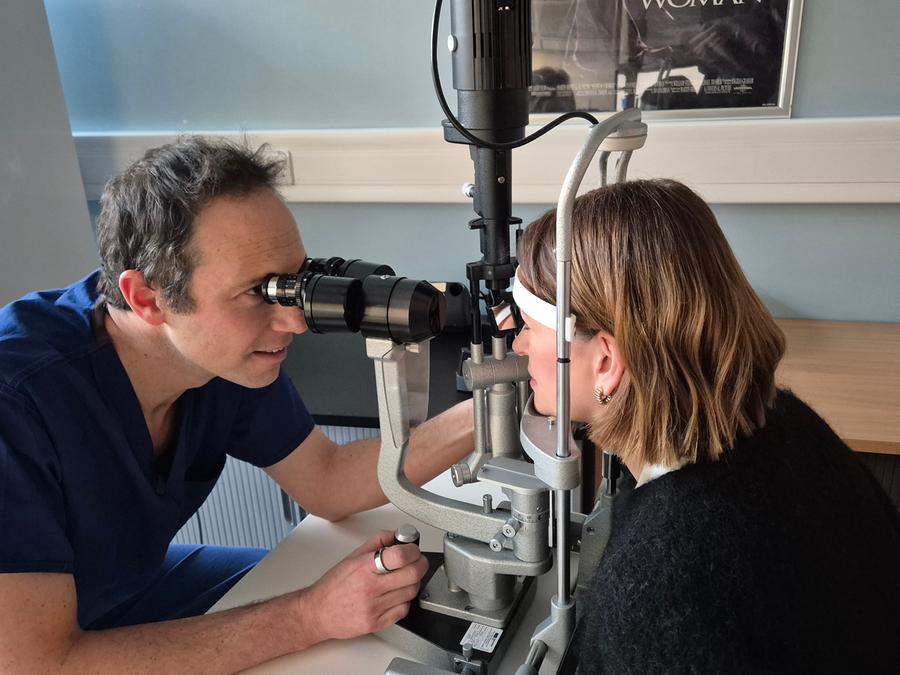
A breakthrough treatment developed by Dr. Harry Petrushkin at Moorfields Eye Hospital has successfully restored vision in patients suffering from hypotony, a condition previously deemed incurable. This innovative approach has provided hope for individuals like Nicki Guy, a 47-year-old patient whose eyesight was severely impaired due to the disorder.
Hypotony is characterized by abnormally low pressure within the eye, which can lead to its collapse and eventual blindness. Dr. Petrushkin, a consultant ophthalmologist, has been actively treating young children and adults with inflammatory eye conditions. He noted that while many cases of hypotony are asymptomatic in children, adult patients often present with advanced forms of the disease. “I have seen many adult patients turn up with end-stage hypotony throughout my career,” he explained.
Nicki Guy’s journey began after she experienced vision problems following the birth of her son in 2017. By 2019, she had sought help from Dr. Petrushkin after suffering a catastrophic loss of vision in one eye following routine cataract surgery. “Her eye just deflated,” he recounted. Despite extensive immunosuppressive treatment, her condition did not improve, leading them to consider a new treatment option.
The innovative method involved injecting hydroxypropyl methylcellulose (HPMC) gel into Guy’s eye every few weeks for ten months. This technique aimed to restore the eye’s shape, akin to pumping air into a flat tire. Dr. Petrushkin emphasized that while previous efforts had the right concept, they often lacked the frequency necessary for success: “We were taught that this was end-stage eye disease, you can’t do anything about that. That has always bothered me.”
The results have been remarkable. Seven out of eight patients at Moorfields have responded positively to this pioneering treatment. Nicki Guy described her experience as “life-changing,” expressing gratitude for the ability to witness her child grow up. “I’ve gone from counting fingers and everything being really blurry to being able to see,” she shared with the BBC.
Dr. Petrushkin estimates that between 500 and 1,000 patients per year could benefit from this revolutionary treatment. He hopes this success will shift traditional perceptions regarding hopeless cases in ophthalmology. “This happens to be a scenario where what we normally do doesn’t work. I’m very happy for Nicki, but I hope it leads to a paradigm shift in how we approach end-stage eye diseases,” he said.
With this new treatment, Dr. Petrushkin aims to encourage his colleagues to remain open-minded and persistent in exploring potential solutions for patients with previously deemed irreversible conditions. Through his innovative approach, he has not only impacted individual lives but has also paved the way for a more hopeful outlook on the future of eye care.