Researchers at the University of Konstanz have introduced an innovative, contact-free technique to efficiently remove liquids from delicate microstructures. This method utilizes vapor condensation to create surface currents that transport droplets away without damaging the underlying materials. The findings, led by physicist Stefan Karpitschka, were published on January 13, 2026, in the journal Proceedings of the National Academy of Sciences.
Microstructures play a crucial role in various modern technologies, particularly in the production of microchips found in smartphones and other electronic devices. During manufacturing, these microcomponents are often exposed to several types of liquids that must be meticulously cleaned off to ensure optimal functionality. Traditional methods of removal can be ineffective or harmful due to the delicate nature of these structures.
Karpitschka emphasized the challenges faced during microchip fabrication, where even minimal surface tension can compromise the integrity of sensitive materials like silicon wafers. “For example, transistors must undergo wet processing, including etching in acid baths,” he explained. “After these processes, it is essential to remove any residual liquids without leaving contaminants behind.”
The research team aimed to develop a gentler approach to liquid removal. They turned to the Marangoni force, a physical phenomenon that occurs when there are differences in surface tension across a surface. “When adjacent areas have varying surface tensions, a tug-of-war ensues, causing the stronger side to displace the weaker one,” Karpitschka noted. This movement allows the liquid to be directed efficiently.
In their experiments, the researchers introduced additional liquid—specifically, alcohol with a lower surface tension than that of water. As the alcohol evaporated, the resulting vapor condensed on the water present, creating the necessary difference in tension to generate fluid currents. This technique effectively transported the remaining liquid droplets into larger formations, making them easier to remove.
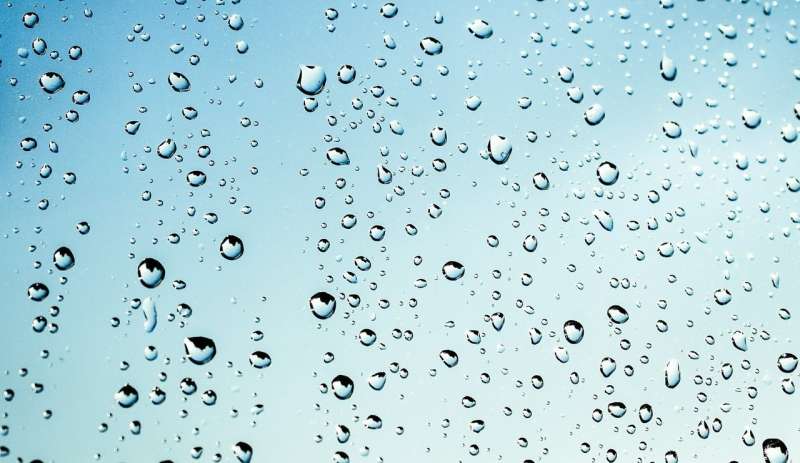
The methodology draws parallels to how raindrops coalesce and flow down a windowpane. However, in this case, the researchers are able to control the movement of the droplets precisely. This innovation has wide-ranging applications; it opens up new avenues for drying micro-patterned surfaces without risking damage.
The ability to handle micro and nanomaterials with such precision could significantly enhance production efficiency across various industries, from electronics to biotechnology. As Karpitschka concluded, “Our method has the potential to revolutionize how we interact with small surface structures, paving the way for improved manufacturing processes.”
For further reading, refer to the study by Ze Xu et al., titled “Vapor-mediated wetting and imbibition control on micropatterned surfaces,” published in the Proceedings of the National Academy of Sciences. This research highlights the intricate balance of physics and engineering in advancing technology while ensuring the integrity of sensitive materials.