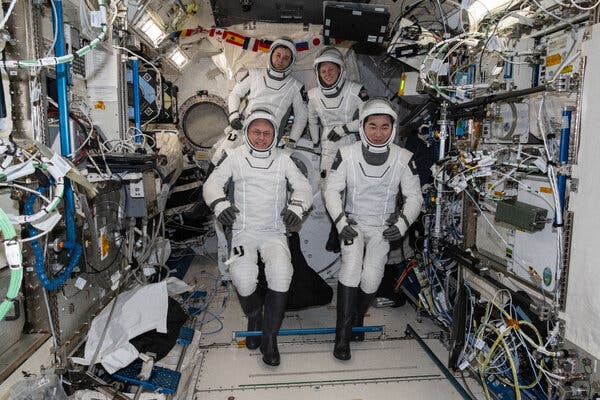
The crew aboard the Crew Dragon capsule successfully returned to Earth on March 30, 2024, concluding a groundbreaking mission to the International Space Station (ISS). The spacecraft, operated by SpaceX, undocked from the ISS and began its descent, marking an important milestone for NASA’s commercial space program.
Following a two-week stay at the ISS, the astronauts completed a series of experiments and technology demonstrations. The Crew-7 mission included a diverse team of four astronauts: NASA’s Jasmine Wright and Tom Harris, ESA’s Marco Rossi, and JAXA’s Aiko Tanaka. Their collaborative efforts contributed to advancements in understanding microgravity’s effects on various scientific processes.
Undocking and Descent
The undocking occurred at approximately 01:52 UTC, with the Crew Dragon capsule executing a series of maneuvers to safely separate from the ISS. This crucial phase involved a series of automated systems designed to ensure a smooth transition back to Earth. According to NASA, the capsule’s onboard systems performed flawlessly throughout the undocking process.
As the capsule re-entered Earth’s atmosphere, it encountered temperatures of around 1,600 degrees Celsius. The spacecraft deployed its heat shield to protect the crew from the intense heat generated during descent. A successful parachute deployment followed, allowing the capsule to splash down in the Atlantic Ocean off the coast of Florida at 06:10 UTC.
Post-landing Recovery and Impact
Recovery teams were dispatched to the splashdown area, ensuring the astronauts’ safety during their transition back to land. The crew was greeted with enthusiasm upon their return, as their mission not only advanced scientific research but also reinforced the importance of international collaboration in space exploration.
The successful return of the Crew-7 mission highlights the ongoing partnership between NASA and SpaceX. This collaboration has revolutionized the approach to human spaceflight, significantly reducing costs and increasing accessibility to space. NASA Administrator Bill Nelson remarked, “The success of this mission is a testament to the hard work and dedication of everyone involved.”
The astronauts are now undergoing medical evaluations and debriefings as part of standard procedure following their time in microgravity. Their experiences and findings during the mission will contribute to future projects and enhance our understanding of living and working in space. The Crew Dragon program continues to push the boundaries of what is possible in space travel, paving the way for more ambitious missions in the years to come.