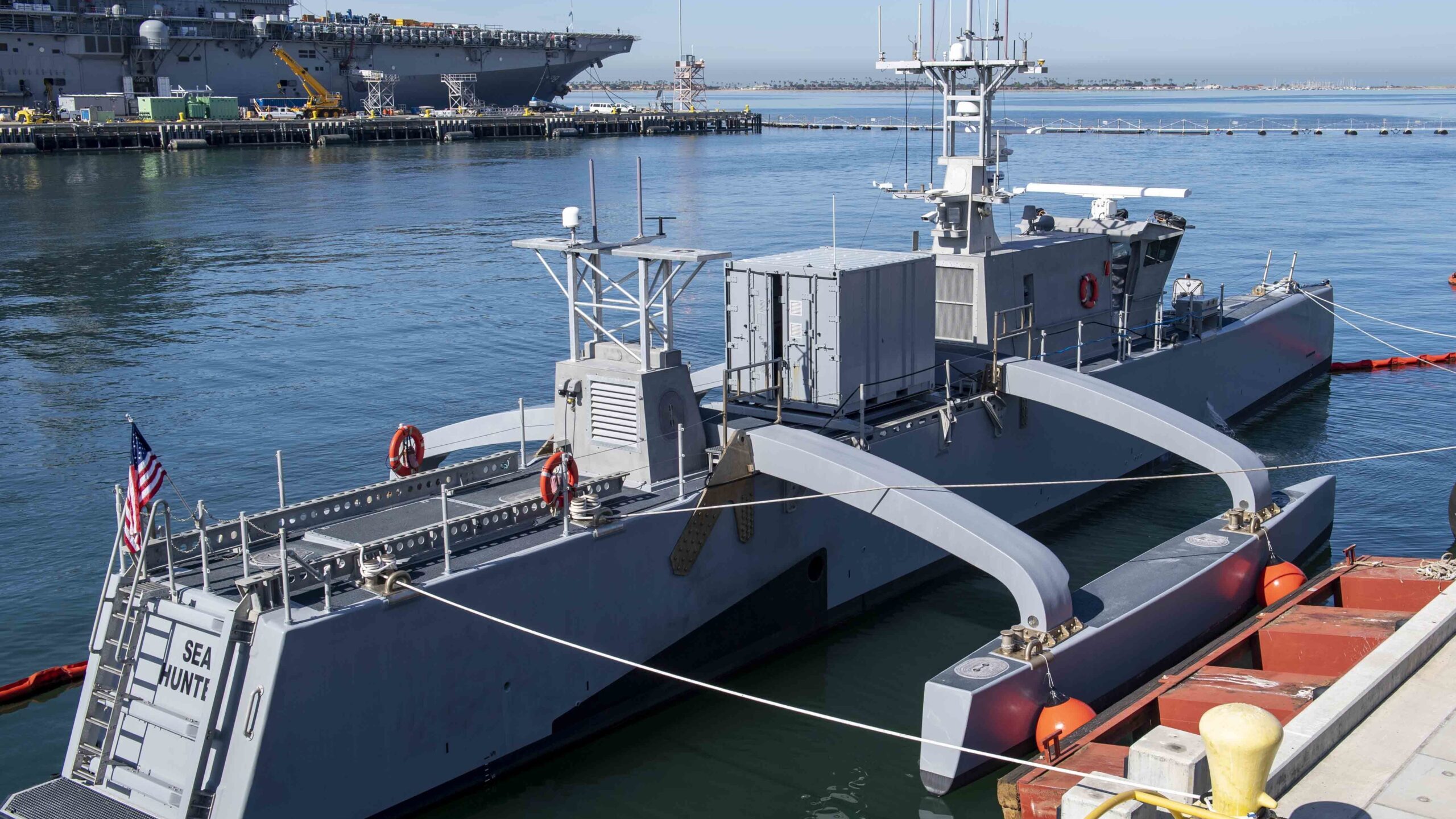
The United States Navy is set to deploy two medium-sized drone boats, marking a significant shift in maritime operations. According to Capt. Garrett Miller, the commodore of Surface Development Group One, these vessels, known as the Sea Hunter and Seahawk, will officially transition from experimental prototypes to operational assets this year.
During a presentation at the Surface Navy Association conference in Washington on March 15, 2024, Miller announced that these uncrewed surface vessels (USVs), referred to as medium displacement USVs (MDUSVs), will be placed under fleet control and assigned to surface forces. He emphasized their readiness to undertake various missions, stating, “They will actually be under fleet control, assigned to surface forces to be able to actually go out and do great things.”
In an exciting development, one of these drones is expected to deploy with a carrier strike group in 2026. While Miller did not disclose which drone would accompany the strike group, reports indicate that it is likely to be the Seahawk. Furthermore, Miller announced plans for the Navy to establish three “early command” USV divisions within the next week, paving the way for future developments in unmanned technologies.
By 2027, the Navy anticipates having a total of 11 MDUSVs in its inventory, with projections to increase this number to over 30 by 2030. Both the Sea Hunter and Seahawk are manufactured by Leidos and have previously served as essential prototypes in Navy exercises, with the Sea Hunter initially developed as an unmanned sub-tracker under a DARPA program. The Seahawk followed, with a contract awarded in 2017 and delivery to the Navy in 2021.
These uncrewed vessels aim to enhance a variety of maritime missions, including counter-mine operations, kinetic strikes, and intelligence, surveillance, and reconnaissance (ISR). However, Navy officials acknowledge that further work is required to develop specific operational concepts for these systems.
Looking ahead, drones are expected to constitute a significant portion of the Navy’s overall displacement in the near future, particularly in the envisioned Golden Fleet. Officials stress that these uncrewed vessels will complement, rather than replace, manned ships.
In a panel discussion on March 16, Rear Adm. Christopher Alexander, special assistant to the commander for naval surface forces at the US Pacific Fleet, noted the anticipated growth of unmanned systems over the coming decades. He projected that by 2045, approximately 45 percent of the surface force will consist of unmanned systems, reflecting a broader push by the Pentagon to leverage drone technology.
“The future is now,” Alexander stated, emphasizing that advancements in unmanned and autonomous systems, including artificial intelligence, are already transforming naval operations. This transition underscores the Navy’s commitment to modernizing its fleet and adapting to the evolving landscape of maritime warfare.