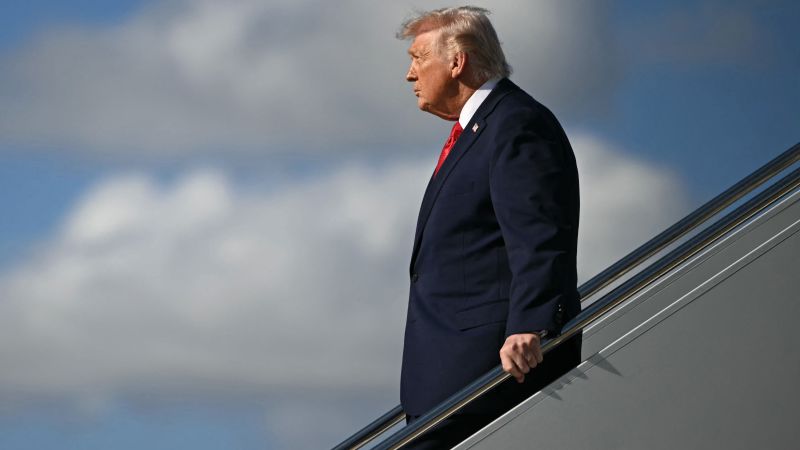
Tensions are rising as Donald Trump continues to push for the United States to acquire Greenland, a semiautonomous territory of Denmark. This demand has prompted significant concern among European leaders who are grappling with how to respond to a president known for his unorthodox and aggressive negotiation tactics. The situation underscores the complexities of international diplomacy in an era marked by Trump’s unpredictable foreign policy.
European officials, particularly in Denmark, have expressed alarm at Trump’s insistence on acquiring Greenland. Rasmus Jarlov, a member of the Danish Parliament, emphasized the importance of standing firm against what he termed an unacceptable demand. “We can never give in to a demand that we should just hand over land and people that the United States has absolutely no right to,” Jarlov stated during an interview with CNN. His comments reflect a broader sentiment among European leaders who view Trump’s approach as a threat to international norms and stability.
The demand for Greenland has sparked varied responses across Europe. Some lawmakers are contemplating retaliatory measures, including potential trade wars or targeted strikes against US tech industries. Others have even discussed the possibility of boycotting the upcoming FIFA World Cup, co-hosted by the US. These discussions reveal a growing frustration with Trump’s disregard for established diplomatic protocols.
In this context, Trump’s negotiating strategy appears to hinge on a willingness to disrupt longstanding alliances, particularly NATO. His approach has often been described as confrontational, as he seems prepared to leverage the security of the alliance to achieve his goals. This tactic raises concerns among European NATO members, who fear that such a strategy could jeopardize the very foundation of the alliance that has ensured Western security for nearly 80 years.
Trump’s rhetoric surrounding Greenland has become increasingly bizarre, with claims that the territory could be at risk from Russia or China, despite it being NATO territory. The president’s assertions that he requires Greenland for military advantages, such as a site for his proposed missile defense system, have been met with skepticism. NATO’s existing treaties already grant the US significant military access to the island.
European leaders are currently faced with a dilemma: how to engage with a president who operates outside conventional frameworks of diplomacy. Lars Løkke Rasmussen, Denmark’s Foreign Minister, has attempted to appeal to Trump’s sense of international law, stating, “You can’t cross this line.” Yet, many believe that traditional diplomatic arguments are unlikely to resonate with Trump, who prioritizes strength and power in his dealings.
As Europe contemplates its next steps, there are calls for a more assertive stance. Emmanuel Macron, the French President, has urged the European Union to activate its “trade bazooka” against US coercion, potentially imposing export controls or limiting US access to EU markets. These measures come in response to Trump’s threats of new tariffs on NATO allies if they do not acquiesce to his demands regarding Greenland.
The ramifications of a trade conflict could prove severe for both sides. A full-scale trade war might disrupt economies on both sides of the Atlantic, potentially exacerbating existing tensions within NATO. Observers have noted that Trump’s approach could alienate allies and undermine the strategic cooperation necessary to address global challenges.
Despite the growing tensions and threats, there remains hope among some European leaders that Trump’s bluster is merely a negotiating tactic. British Prime Minister Keir Starmer has indicated that calm discussion remains the preferred route forward, but he has firmly rejected Trump’s encroachments on Greenland’s sovereignty.
As the saga over Greenland unfolds, it becomes increasingly clear that European nations must navigate the complexities of dealing with a leader who operates on different principles. The challenge lies not only in responding to Trump’s demands but also in maintaining the integrity of international alliances that have been built over decades. The coming weeks will likely be pivotal in determining how Europe chooses to assert its position in the face of Trump’s unconventional approach.