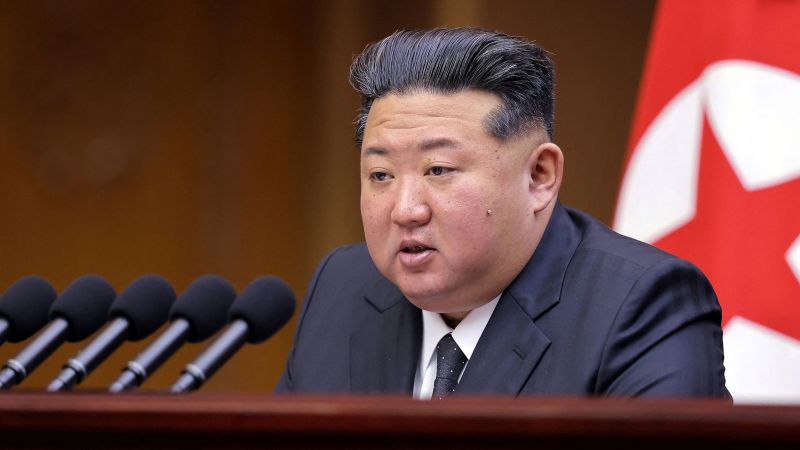
North Korean leader Kim Jong Un has dismissed Yang Sung Ho, the vice premier responsible for the machine-building industry, following difficulties in a factory modernization project. This decision appears to be part of Kim’s strategy to enforce discipline among officials as the country approaches a significant political conference. The forthcoming congress of the ruling Workers’ Party of Korea, the first in five years, is expected to assess past projects, outline new political and economic priorities, and facilitate a reshuffle of party officials.
According to the Korean Central News Agency (KCNA), Kim criticized Yang for causing “unnecessary man-made confusion” during the modernization of the Ryongsong Machine Complex, located in northeastern North Korea. In a speech delivered on January 15, 2024, marking the completion of the complex’s first-phase modernization plan, Kim indicated that the project had incurred “not a small amount of economic loss” due to the actions of irresponsible and incompetent officials. He noted that he had previously reprimanded Yang regarding similar issues during a party meeting in December but observed that Yang displayed a lack of accountability.
In a striking metaphor, Kim remarked, “To speak figuratively in simpler words, he was like a goat yoked to pull an ox cart. We should see this as an incidental mistake in our practice of personnel appointment.”
Management Style and Political Context
Publicly reprimanding and dismissing officials is a hallmark of Kim’s management style. Analysts suggest that this tactic aims to instill fear and urgency among senior officials, compelling them to deliver improved results ahead of the party congress. Kwak Gil Sup, head of the One Korea Center, a website focused on North Korean affairs, explained that such actions likely create tension among top leaders.
Experts, including Moon Seong Mook from the Korea Research Institute for National Strategy, argue that the factory’s challenges stem from broader systemic issues rather than the failings of individual officials. Moon pointed out that North Korea’s fundamental structural problems—such as the prioritization of limited resources for weapons programs—have hampered economic management. “Kim Jong Un has gone all-in on nuclear and missile programs, but he’s mismanaged the economy. He’s just passing the blame for his fault to a subordinate,” Moon stated.
North Korea’s economy has struggled significantly, particularly during the COVID-19 pandemic. Although South Korea’s central bank reported a growth of 3.7% in 2024, many analysts believe that achieving substantial growth remains unlikely due to the regime’s excessive focus on military capabilities and the challenges posed by international sanctions. Kwak noted that any economic benefits have largely accrued to the ruling elite and the weapons development sector, exacerbating inequalities within the country.
Party Congress and Future Prospects
The party congress is anticipated to commence later in January or February 2024, with speculation surrounding its agenda. Analysts suggest that Kim is likely to reinforce policies fostering cooperation with Russia, China, and other nations to stimulate gradual economic development. There is also keen interest in whether Kim will initiate steps to revive long-stalled diplomatic relations with the United States.
With President Donald Trump planning a visit to Beijing in April, experts believe this could create opportunities for renewed discussions between the U.S. and North Korea. Moon posited that Kim might use the congress to formalize his aims of advancing both nuclear and conventional weapons programs simultaneously.
In summary, Kim Jong Un’s recent dismissal of Yang Sung Ho underscores the complexities of North Korea’s political landscape, where the interplay of internal discipline, economic challenges, and international relations continues to shape the regime’s trajectory.