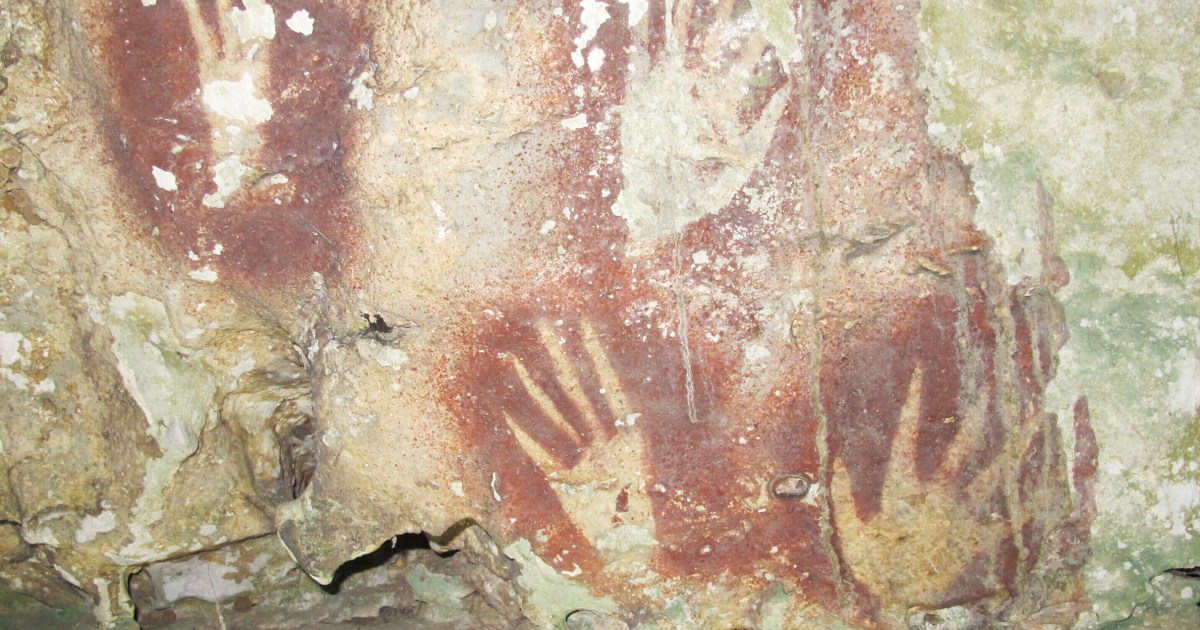
Researchers have unearthed what is now recognized as the world’s oldest known example of cave art, dating back at least 67,800 years. This remarkable discovery was made in a limestone cave known as Liang Metanduno, located on Muna Island, part of eastern Indonesia’s Sulawesi region. The finding contributes significantly to the understanding of when and where early humans first began creating art and how their artistic expressions evolved over time.
The hand stencils, although faded and only partially visible, were created by blowing pigment onto a hand pressed against the rock surface, leaving a distinct outline. Analysis of mineral crusts that formed over the stencils allowed researchers to accurately date them. Fingertips appearing more pointed indicate that these stencils likely belonged to early humans, potentially linked to the ancestors of the first Australians.
According to Adam Brumm, a professor of archaeology at Griffith University in Brisbane and a co-author of the study published in the journal Nature, the significance of this find is profound. “This is pretty extraordinary, because usually rock art is very difficult to date, and it doesn’t date back to anywhere near that old,” he stated.
Insights into Human Artistic Culture
This hand stencil predates a previously discovered cave painting in Sulawesi, which was dated to around 51,200 years ago and depicts three humanoid figures interacting with a pig. Brumm expressed astonishment at the age of the new find, noting, “I thought we were doing pretty well then, but this one image just completely blew that other one away.” He emphasized that this discovery illustrates the long history of rock art in the region, indicating that humans have been creating sophisticated artistic expressions there for tens of thousands of years.
Brumm and his team are optimistic about uncovering even older forms of art in Indonesia, including more complex storytelling art. Much of the region remains archaeologically unexplored, presenting opportunities for further discoveries. Liang Metanduno is already a well-known site for cave art open to tourists, though most of the previously found artworks, such as those depicting domesticated animals, are believed to be much more recent, around 4,000 years old.
The lead author of the recent paper, Adhi Oktaviana, an Indonesian rock art specialist, first identified the faint outlines of the hand stencils in 2015. “No one had ever observed them before. No one even knew that they were there,” Brumm remarked, highlighting Oktaviana’s keen insight.
Shifting Perspectives on Early Human Migration
The implications of this discovery extend beyond artistic achievements. It could also provide insight into the timelines of human migration into Australia. While Aboriginal peoples are widely acknowledged to have arrived in Australia at least 50,000 years ago, one archaeological site in Australia has been dated to 65,000 years old. Brumm noted that finding rock art dating back to 67,800 years on Sulawesi, which is geographically close to Australia, increases the likelihood that modern humans were present in Australia at least 65,000 years ago.
Brumm’s research challenges the long-held belief that significant artistic culture first emerged in Europe, specifically in Ice Age cave paintings in regions like France and Spain, which date to about 30,000 to 40,000 years ago. “Recent discoveries in Indonesia show that humans outside Europe were making incredibly sophisticated cave art tens of thousands of years earlier,” he stated, underscoring the global significance of these findings.
The research not only reshapes the understanding of artistic development among early humans but also prompts a reevaluation of migration patterns and cultural evolution. As exploration continues in Indonesia, the potential for uncovering a deeper history of human creativity and movement remains promising.