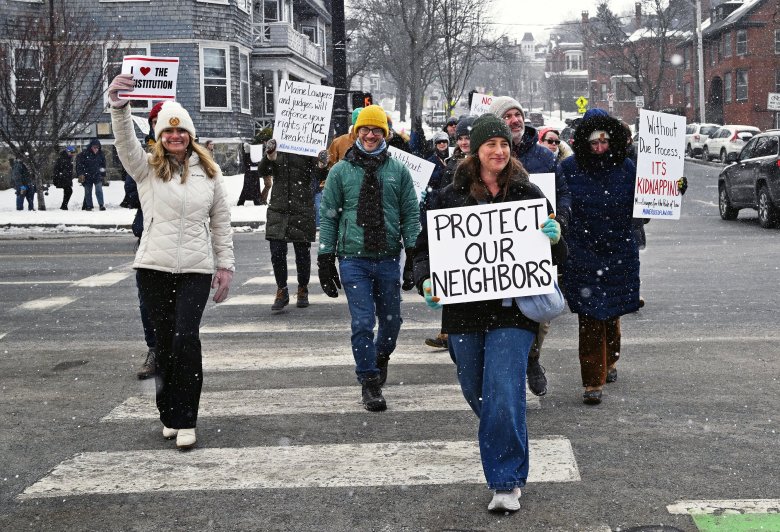
Lawyers and legal advocates gathered in Portland, Maine, on March 15, 2024, to protest what they describe as unlawful arrests by the U.S. Immigration and Customs Enforcement (ICE). The march took place in the Bayside neighborhood, where participants attracted supportive honks from passing vehicles as they made their way across Park Avenue.
The protest was organized by members of the Maine Lawyers for the Rule of Law, a group that has been vocal about perceived challenges to the legal system under the previous administration. Many of the lawyers involved have previously engaged in events addressing concerns about the erosion of the rule of law, a fundamental principle asserting that laws should be applied equally and in accordance with human rights.
David Webbert, a prominent attorney and member of the organizing group, expressed his outrage at the increasing ICE activities in Maine. He highlighted recent reports indicating that ICE had transferred approximately 50 detainees from the Cumberland County Jail after the local sheriff publicly criticized the agency for its actions against a corrections officer.
Court records reveal that a federal judge had issued an order temporarily barring the government from moving at least four detainees out of state. In a court filing, the U.S. Attorney’s Office for the District of Maine stated that ICE had violated this order when it moved a detainee on the evening of March 14. Assistant U.S. Attorney Andrew Lizotte noted that his office was not informed of ICE’s decision until the afternoon of March 15.
Webbert condemned ICE’s actions, asserting, “They don’t care about following court orders. They’re just mad at the sheriff; they want to punish him.” He also expressed disappointment with a recent statement from U.S. Attorney Andrew Benson, who was appointed by former President Donald Trump. Benson had called for public respect for federal officers enforcing the Constitution, while also advising against divisive rhetoric.
Critics of ICE’s tactics, including the governor and local officials from Portland and Lewiston, have urged for greater accountability. Webbert remarked, “I was disappointed that the U.S. Attorney issued a statement that didn’t acknowledge the evidence that we have reason to be concerned about ICE violating civil rights,” emphasizing the need for federal representatives to stand up for the constitutional rights of Maine residents.
As the march progressed, Webbert paused to adjust his sign reading “Rule of Law,” engaging with a driver who inquired about the protest. The driver suggested that ICE was merely “cleaning up” after the previous administration. Webbert countered, “Open your eyes,” underlining the complexities surrounding immigration enforcement and community impact.
The protest attracted a couple of dozen participants, highlighting ongoing tensions regarding immigration policy and enforcement in Maine. As advocates continue to voice their concerns, the legal community remains focused on the implications of federal actions and their adherence to established laws and human rights. The situation in Maine reflects broader national discussions about immigration enforcement and the role of federal agencies in local communities.