Researchers at the Massachusetts Institute of Technology (MIT) have made a significant breakthrough in superconducting memory technology. They have developed a new scalable superconducting nanowire memory array that demonstrates a notably low error rate, making it a promising candidate for future quantum computing systems. This advancement was detailed in a paper published on January 25, 2026, in the journal Nature Electronics.
Superconducting memories utilize materials that conduct electricity without resistance when cooled below a critical temperature. This unique characteristic allows them to operate more efficiently than traditional memory systems. However, many existing superconducting memory devices face challenges, including high error rates and difficulties in scaling up to larger systems.
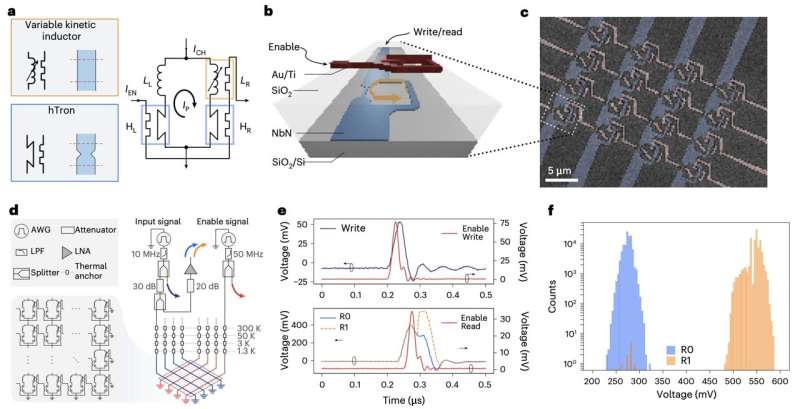
In their research, a team led by Owen Medeiros and Matteo Castellani developed a compact 4 × 4 superconducting nanowire memory array. This array is designed for scalable operations and boasts a functional density of 2.6 Mbit cm −2. The researchers noted that traditional superconducting memory cells have a large footprint, limiting their scalability. In contrast, their nanowire-based cells offer a more compact solution but have historically struggled with high error rates.
The newly designed memory array consists of superconducting nanowire loops that feature two temperature-dependent switches and a variable kinetic inductor. These components work together to manage electrical current, ensuring stable operation. The researchers implemented multiflux quanta state storage and destructive read-out techniques at a temperature of 1.3 K, optimizing their write- and read-pulse sequences to minimize bit errors.
During initial tests, the nanowire memory array demonstrated a remarkable performance, achieving an error rate of about 1 in 100,000 operations. The research team reported a minimum bit error rate of 10 −5, significantly lower than most competing superconducting memory technologies introduced in recent years.
The successful design of this superconducting memory could play a critical role in advancing low-energy superconducting computers and fault-tolerant quantum computers. The researchers emphasized that their findings could facilitate the transition of superconducting memory systems from experimental setups to practical applications.
Future developments may further enhance the reliability and performance of these memory systems, paving the way for their integration into larger-scale computing environments. The research represents a vital step towards making superconducting memories a viable option in the rapidly evolving landscape of quantum computing.
This research underscores the potential for superconducting nanowire technology to reshape the future of computing, providing faster and more energy-efficient memory solutions. As the field continues to evolve, the implications of such advancements could extend far beyond theoretical applications, potentially revolutionizing how data is processed in quantum systems.