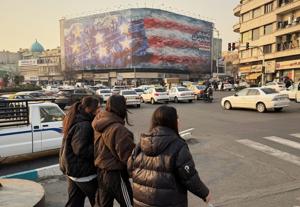
Iran’s ongoing crackdown on widespread protests has resulted in the deaths of at least 6,126 people, according to the Human Rights Activists News Agency, a U.S.-based organization that monitors human rights in the country. This alarming figure highlights the severity of the unrest, which began on December 28, 2023, following the dramatic decline of Iran’s currency, the rial. As the situation escalates, the U.S. military has positioned the USS Abraham Lincoln aircraft carrier and guided missile destroyers in the region, ready to respond if necessary.
The Iranian rial has fallen to a record low, trading at 1.5 million rial to $1, exacerbating the economic crisis. Amid this turmoil, Iranian authorities have reported a significantly lower death toll of 3,117, labeling many victims as “terrorists.” This discrepancy raises concerns, as Iran has historically underreported fatalities from civil unrest.
The protests, which have swept across Iran, have been met with a violent response from the government. The Human Rights Activists News Agency reports that among the deceased are at least 5,777 protesters, along with 214 government-affiliated forces, 86 children, and 49 civilians who were not part of the demonstrations. The agency has verified each death through a network of activists on the ground, despite significant challenges posed by internet blackouts and government censorship.
Regional Tensions and Military Positioning
The arrival of the USS Abraham Lincoln and its accompanying vessels signifies a potential increase in U.S. military readiness in response to threats from Iran. President Donald Trump has warned of military action should Iran escalate its crackdown on protesters or proceed with mass executions. Meanwhile, two Iranian-backed militias in the region have indicated their willingness to retaliate against U.S. interests, further complicating the landscape in the Middle East.
Iran’s government has accused external forces, particularly the U.S. and Israel, of inciting the unrest. During a recent meeting of the U.N. Security Council, Iran’s ambassador, Amir Saeid Iravani, stated that Trump’s threats of military force are clear and unequivocal. He also alleged that the U.S. supports “armed terrorist groups” without providing evidence for these claims.
The Iranian economy is under severe strain, with inflation driving the price of everyday goods beyond the reach of many citizens. In response, the government has limited subsidized currency rates and is providing $7 a month to most citizens to help mitigate rising costs. Despite these measures, the rial has plummeted from 32,000 to $1 just a decade ago, significantly eroding the savings of ordinary Iranians.
Potential for Further Violence
Iran’s influence in the region, particularly through its network of proxy groups known as the “Axis of Resistance,” is facing challenges. The ongoing conflict in Gaza and recent military actions against Iranian-aligned groups in Lebanon and Yemen have diminished Iran’s regional power. Notably, Iranian-backed rebels in Yemen have threatened to resume attacks on shipping in the Red Sea, further escalating tensions.
Leaders of militias such as Iraq’s Kataib Hezbollah have issued warnings to their adversaries, stating that any conflict with Iran will not be easily won. Hezbollah’s leader, Sheikh Naim Kassem, acknowledged that the group is preparing for potential aggression but did not disclose specific plans, emphasizing that strategies will be determined based on the evolving situation.
As Iran continues to grapple with both domestic unrest and international pressures, the potential for further violence remains high. The government’s ability to address the economic crisis while managing the fallout from protests will be crucial in the coming weeks. The unrest not only highlights the deep-seated grievances of the Iranian people but also poses significant challenges for the Iranian regime as it seeks to maintain control amidst growing dissent.