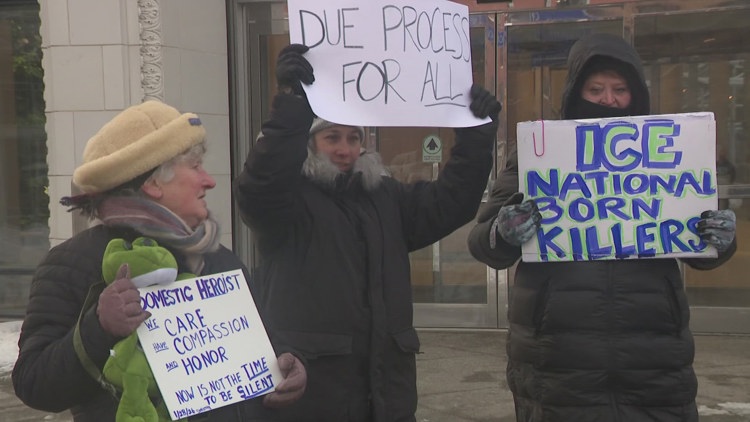
Protests against immigration enforcement continued in Buffalo, New York, on March 6, 2024, following the tragic killing of nurse Alex Pretti in Minnesota. Approximately two dozen demonstrators gathered outside the U.S. Immigration and Customs Enforcement (ICE) field office located at the intersection of Delaware Avenue and Chippewa Street. The protest reflects a broader national response to recent incidents involving federal law enforcement and immigration policies.
Participants held signs expressing their discontent with current immigration practices, calling for reform and accountability. Dave O’Donnell, a resident of Clarence, New York, shared his thoughts on the demonstration. “It’s cold, and I look at the people in Minnesota, and I look at the people that died for 250 years, laying in trenches to fight for what we’re losing right now,” he said. O’Donnell emphasized the importance of collective action, urging individuals to engage in discussions with those who hold differing views. “It’s time to get uncomfortable. We’re going to lose democracy if we don’t,” he added.
Concerns Raised by Law Enforcement Expert
The demonstration was also a platform for voices within law enforcement to express their concerns. Dr. Steve MacMartin, a retired federal agent and current cybersecurity professor at Hilbert College, emphasized the challenges faced by officers during high-pressure situations. In a conversation with local media, he reflected on his experiences in the field. “An officer has to have deep, solid concentration on what they’re doing. And imagine trying to do that with people throwing things at you, making noise, and running up and back,” he explained.
The rally is part of a growing movement across the United States, where activists are increasingly vocal about their opposition to immigration enforcement practices. These actions often aim to highlight perceived injustices and call for comprehensive immigration reform. The death of Pretti, who was reportedly killed during an incident involving federal officers, has intensified these discussions.
As protests continue, the focus remains on the need for dialogue and understanding among communities. Advocates argue that only through concerted efforts can society address the complexities of immigration policy and its impact on individuals and families.
In Buffalo, as in many other cities, demonstrators are determined to make their voices heard, advocating for a more humane approach to immigration enforcement and greater accountability from federal agencies. The conversation surrounding these issues is far from over, and the events of March 6 serve as a reminder of the power of collective action in the face of tragedy.