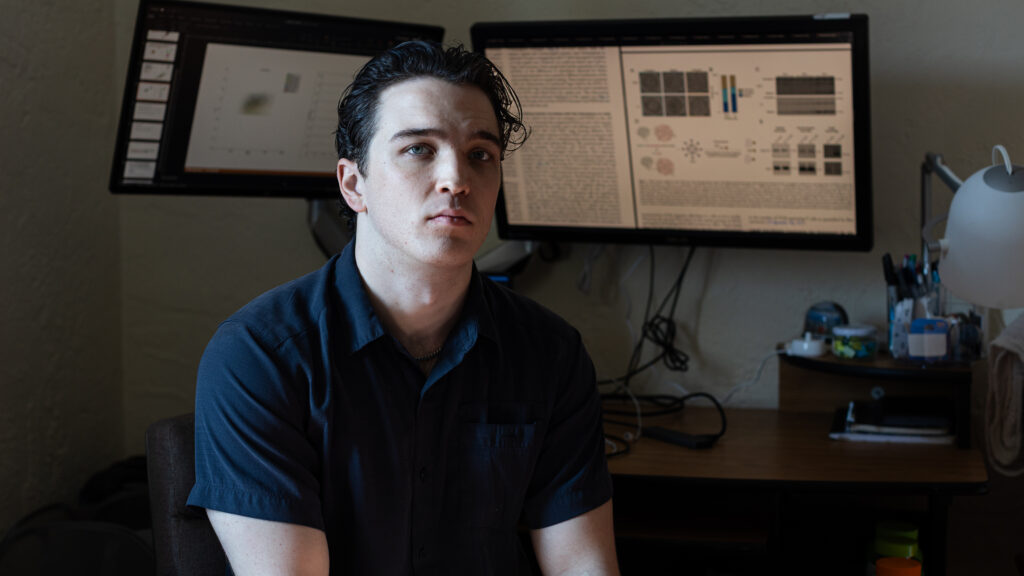
The landscape for first-year biomedical Ph.D. students has become increasingly precarious due to tightening funding from federal sources. Students like Alex Sathler, an aspiring bioengineer, are facing challenges in securing positions in research labs despite having earned prestigious fellowships. Sathler, who was awarded a National Science Foundation fellowship worth $37,000 per year for three years, found himself turned away by multiple labs that cited financial constraints.
Sathler, enrolled in a joint program at the University of California, Berkeley, and UC San Francisco, described his disappointment after being rejected by labs he had approached for his dissertation research. “The real sense that I get is that there aren’t enough labs with funding to give everyone their best fit,” he said, echoing sentiments shared by many of his classmates. This situation reflects a broader trend among first-year biomedical graduate students across the United States.
The funding environment for biomedical research has been particularly tense, with the National Institutes of Health (NIH) funding fewer projects than in previous years and projecting a similar trend for 2026. As a result, competition for positions in well-funded labs has intensified, leading some students to feel disillusioned. This sentiment is underscored by Chevelle Newsome, president of the Council of Graduate Schools, who noted that the issues being faced are widespread and significant. “These are deep issues that we should be concerned about,” she stated.
Many Ph.D. programs predicted these funding challenges and preemptively reduced their incoming class sizes. Despite this, recent data shows a slight increase in overall biomedical graduate enrollment for the previous fall. First-year life science students typically engage in lab rotations, allowing them to experience various research environments before committing to a specific group. However, many students are finding it increasingly difficult to secure a spot.
For instance, Hannah Barsouk, a biochemistry student at Stanford University, has experienced repeated rejections from labs regarding her potential placement. “Funding issues have cast a ‘cloud of general anxiety’ over my first year,” Barsouk remarked. She has contacted between 30 and 40 labs in her search, keeping meticulous notes on their responses.
This funding uncertainty has also led to procedural changes at some institutions. Both Georgia Tech and Emory University have shifted to a direct-admission system for their joint bioengineering program, requiring students to secure a lab commitment prior to acceptance. While this model is more common in Europe, it places additional pressure on students to navigate the selection process without firsthand experience.
At Stanford, the independent funding guarantee for bioscience graduate students has been reduced from four years to two, with plans to further cut it to just one year for incoming students. Joe Wu, director of the Stanford Cardiovascular Institute, emphasized the need for careful selection of students, noting that faculty are becoming increasingly cautious about commitments.
Some students have reported feeling misled about their prospects in specific labs. One student, who wished to remain anonymous, shared her experience of accepting an offer based on a professor’s verbal assurance of available space. During a recent lab rotation, however, the professor informed her that she would need to secure her own funding to remain in the lab, leaving the student feeling betrayed.
The uncertainty surrounding funding is causing many students to reconsider their long-term career goals. For Sathler, while he still has time to find a lab, the anxiety about funding has raised questions about the sustainability of a career in academic research. He noted that the seminar course designed to showcase faculty research struggled to fill slots, a sign of the changing dynamics within the academic community.
As the academic year progresses, students remain hopeful that the funding climate will improve. Recent congressional discussions have suggested a slight budget increase for the NIH, but the outcome remains uncertain. For many aspiring scientists, the ongoing instability raises serious concerns about their ability to navigate a career in research, fundamentally altering their educational experience.
The implications of these funding challenges extend beyond individual students. As the federal government continues to reshape its relationship with research institutions, the long-term prospects for the next generation of scientists remain unclear. As one biology student lamented, “I still very much want to be a professor, and I just don’t know if that’s ever going to be possible.” The situation continues to evolve, but for now, many students find themselves in a state of limbo, questioning their futures in the world of academic research.