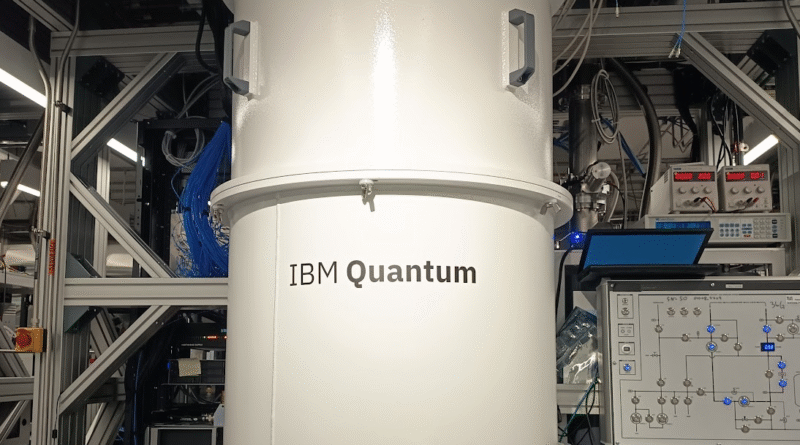
IBM has made a significant advancement in quantum computing with the introduction of its new processor, the Nighthawk, aimed at enhancing clean energy technologies. Unveiled in November 2025, this 120-qubit system represents a pivotal shift in IBM’s roadmap toward achieving fault-tolerant quantum computing. The company is focusing on practical applications rather than merely theoretical capabilities, a move that aligns with the urgent need for innovative solutions in the clean energy sector.
The Nighthawk processor is designed not just to increase the number of qubits but to enhance operational depth. This design approach addresses a critical limitation faced by previous generations of quantum processors. By incorporating the Loon chip, which focuses on error isolation instead of brute-force correction, IBM aims to tackle the persistent issues of noise and decoherence that have historically hindered quantum computing’s scalability. The objective is to localize failures, thereby maintaining overall system productivity.
By 2028, IBM aims to achieve a milestone of 1,000 logical qubits, integrating quantum processing units (QPUs) with classical high-performance computing systems. This hybrid model does not seek to replace classical computing but rather to augment it in areas where traditional systems struggle with combinatorial complexity. The architecture of Nighthawk, which utilizes a square lattice topology, allows each qubit to connect directly to four neighbors. This design supports quantum circuits with up to 5,000 two-qubit gates, enhancing circuit depth by approximately 30% compared to IBM’s earlier Heron processors.
IBM’s goals for the Nighthawk processor include increasing the gate count to 7,500 gates by late 2026 and 10,000 gates by 2027, contingent on the successful performance of error isolation. This emphasis on circuit depth is crucial, especially for applications in clean technology, where shallow circuits do not provide the necessary coherence to explore complex state spaces effectively.
The anticipated rollout of the Nighthawk systems will commence by late 2025, providing select users access through IBM’s Quantum Network. This initiative marks IBM’s transition towards what it describes as “quantum-centric supercomputing.” In practical terms, this means that QPUs will tackle specific subproblems, while classical GPU clusters manage other computational demands. IBM is targeting early demonstrations of quantum advantage by 2026, focusing on narrow applications that can justify integration into existing systems.
Long-term objectives for IBM include the development of fault-tolerant systems exceeding 1,000 qubits, utilizing 300-mm wafers to improve production yields and forming modular, networked architectures. Partnerships with companies such as Cisco suggest a vision for distributed quantum systems that span multiple data centers, moving beyond laboratory experimentation into real-world applications.
The Heron processor, introduced in 2023, marked a shift in IBM’s approach from merely increasing qubit counts to enhancing the fidelity and controllability of quantum hardware. Although Heron improved gate accuracy and stability, it still faced limitations such as high error rates and an inability to support the deep quantum circuits needed for many industrial applications. This experience informed IBM’s development of the Nighthawk processor, which prioritizes circuit depth and error isolation to effectively address the challenges in energy, materials, and climate research.
The relevance of quantum computing in clean technology largely hinges on its ability to expedite research and development timelines in areas where classical simulations struggle. For instance, in photovoltaics, quantum systems can model molecular degradation and defect propagation under variable climate conditions, issues that do not scale well on traditional computing architectures. Such advancements are particularly pertinent for projects in the Asia-Pacific region, where climate variables significantly influence energy solutions.
In the nuclear energy sector, quantum algorithms can explore neutron interactions and fission dynamics at unprecedented resolution levels, enhancing reactor safety modeling and potentially aiding fusion research. While timelines for these breakthroughs remain uncertain, the immediate prospects in fuel cells and electrolyzers are promising. Quantum computing has the potential to revolutionize catalyst discovery and electrolyte optimization, leading to significant advancements in green hydrogen economics.
IBM’s collaboration with industry leaders such as the BMW Group demonstrates early signs of quantum’s applicability in clean technology. Over the years, BMW has employed quantum tools to optimize supply chains and enhance powertrain efficiency. The company’s broader quantum strategy includes collaborations with other technology firms, indicating a diversified approach rather than a singular commitment.
Additionally, Airbus is utilizing IBM’s systems for hydrogen aircraft research as part of its ZEROe program, demonstrating the practical applications of quantum computing in meeting future emissions targets. Other partnerships reportedly involve companies like ExxonMobil, focused on carbon capture modeling, and collaborations with national laboratories to study grid-scale renewable solutions.
Despite these promising developments, IBM acknowledges that challenges remain. Current error rates are still too high for workflows critical to production, and many cleantech firms lack the internal expertise to leverage quantum technologies effectively. IBM’s response has been to expand its Qiskit framework and Quantum Network, aiming to cultivate a developer ecosystem in anticipation of hardware maturation.
While quantum computing will not single-handedly solve climate change or replace classical computing in the near future, IBM’s Nighthawk processor stands as a significant step toward shortening development cycles for critical technologies such as batteries, electrolyzers, and advanced materials. As the world strives towards a 1.5°C climate pathway, the ability to accelerate innovation in chemistry and materials science could yield cost reductions that policy changes alone may not achieve. The Nighthawk platform is poised to address cleantech as an engineering challenge, marking a pivotal moment in the intersection of quantum computing and sustainable energy solutions.