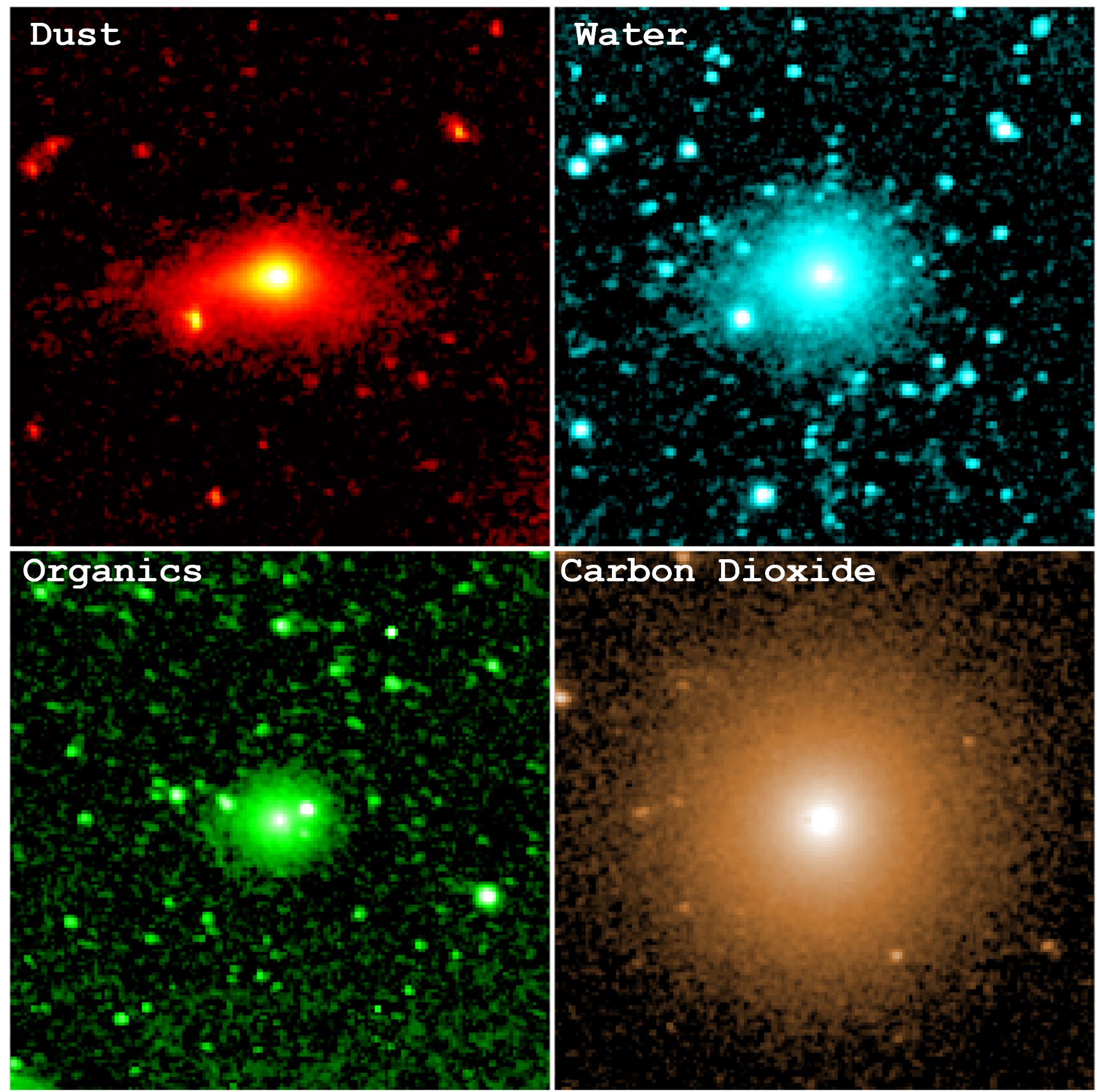
NASA’s SPHEREx mission has made significant strides in understanding interstellar objects, recently capturing data on 3I/ATLAS, the third known interstellar object in our Solar System. After re-emerging from behind the Sun in December 2022, this object offered a unique opportunity for scientists to study its bright coma, the gaseous envelope surrounding it.
The SPHEREx mission, formally known as the Spectro-Photometer for the History of the Universe, Epoch of Reionization and Ices Explorer, is designed to conduct an extensive all-sky survey over its two-year mission. By analyzing data from over 450 million galaxies and 100 million stars within the Milky Way, SPHEREx aims to uncover the origins and evolution of the Universe. Yet, the mission team took a moment to focus on 3I/ATLAS, as its journey through the Solar System presented a valuable opportunity for research.
Utilizing its advanced triple-mirror telescope, SPHEREx captured a series of infrared images, observing the sky in 102 colors corresponding to different infrared wavelengths. This capability enables the probe to gather crucial data regarding various cosmic features, including galaxies and planet-forming regions. In the case of 3I/ATLAS, the mission revealed important information about the composition of its coma, which forms as the object approaches the Sun.
As the comets draw nearer, water and other frozen volatiles begin to sublimate, releasing dust, metals, and other materials from within. The infrared images collected by SPHEREx broke down wavelengths to highlight key elements such as water vapor, carbon dioxide, dust, and organic molecules. This data will enhance scientists’ understanding of 3I/ATLAS and how its icy components interact with solar radiation during its transit through the Solar System.
Scientists had been eagerly anticipating the moment 3I/ATLAS would become visible to instruments again after it disappeared behind the Sun in late October. Following its closest approach, researchers noted an increase in outgassing, providing further insights into the object’s composition. Observations from SPHEREx, in conjunction with other missions, are expected to yield valuable information about the object’s origin and the system from which it came.
The data gathered may also illuminate the formation of complex organic molecules, which could have implications for our understanding of the building blocks of life in the cosmos. As 3I/ATLAS continues its journey, NASA’s SPHEREx mission remains at the forefront of astronomical exploration, using innovative technology to enhance our grasp of the Universe and its myriad wonders.