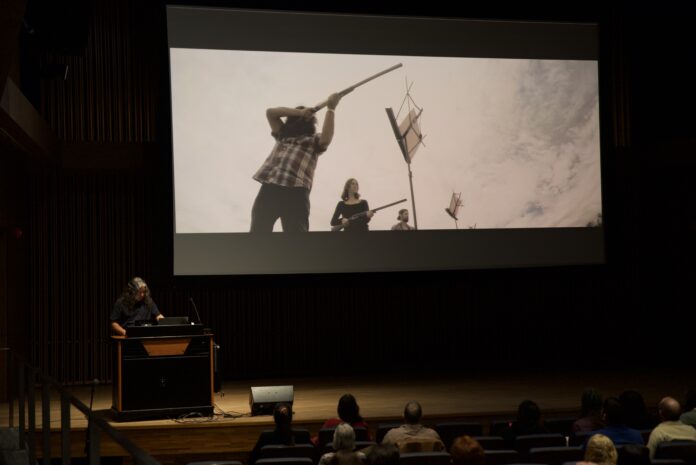
URGENT UPDATE: On February 5, 2023, renowned installation artist and composer Raven Chacon captivated audiences at UC Davis with a powerful public lecture. As the spotlight artist for The California Studio: Manetti Shrem Artist Residencies, Chacon discussed his innovative works, showcasing his significant contributions to both art and music over his impressive twenty-year career.
Chacon, hailing from Fort Defiance, Navajo Nation, has gained international recognition, including the prestigious Pulitzer Prize for Music in 2022 and the MacArthur Fellowship in 2023. His lecture was marked by sharp insights and a unique blend of humor as he guided attendees through his diverse body of work, emphasizing themes of silence, cultural reflection, and political commentary.
Among the pieces highlighted was “Field Recordings” (1999), Chacon’s first creation, which involves capturing audio tracks from quiet locations in the Southwest. “The idea was to find a very quiet day and make a field recording of that place,” Chacon explained, emphasizing the importance of recognizing silence in our landscapes. The resulting tracks, amplified to showcase their subtlety, challenge audiences to rethink their awareness of the natural world.
Chacon’s innovative approach continued with “Report” (2001), a composition for a restrictive instrument—guns. “This piece reflects on the uniqueness of the weapon and a recognition of the land upon which it is often fired,” he stated before presenting a video of the performance. His work invites viewers to engage in complex conversations about gun culture without taking an explicit stance.
He also discussed the acclaimed installation “Repellent Fence” (2015), created with the Indigenous artistic collective Postcommodity. This provocative piece, initially inspired by a bird repellent balloon, features a two-mile-long installation designed to challenge perceptions of the U.S.-Mexico border. “If a 10-inch balloon could scare away pigeons, then maybe a 10-foot balloon could ward off western civilization,” Chacon quipped, illustrating the work’s political symbolism.
Chacon’s Pulitzer-winning composition “Voiceless Mass” was also a focal point of the talk. Initially hesitant due to its performance on Thanksgiving inside a Catholic cathedral, he crafted a piece that reflects the loss of Indigenous languages and culture. “This piece was never meant to be accusatory,” he clarified. “It was meant to bring this history to light.” His work has sparked dialogues with church leaders, encouraging them to confront their historical roles.
Looking ahead, Chacon shared insights into his upcoming large-scale composition, “Tiguex” (2025), designed for the city of Albuquerque. Enlisting over two hundred musicians, this ambitious piece aims to celebrate the area’s Indigenous heritage. “Tiguex is the Indigenous name for the area now occupied by Albuquerque,” he noted, showcasing his commitment to infusing local culture into his art.
On February 6, UC Davis music students performed Chacon’s “American Ledger No. 1” (2018), a piece that intertwines sound with America’s historical conflicts. Incorporating unconventional elements like coins and wood chopping, it encapsulates the emotional depth of Chacon’s artistry, resonating with his belief that “music is the things we don’t know how to speak about.”
Raven Chacon’s lecture not only illuminated his artistic journey but also highlighted the urgent need for dialogue around cultural history and identity. His work continues to inspire and provoke thought, making it clear that his contributions to the arts are far-reaching and deeply impactful.
Stay tuned for more updates as Chacon’s projects evolve and influence the contemporary art scene.