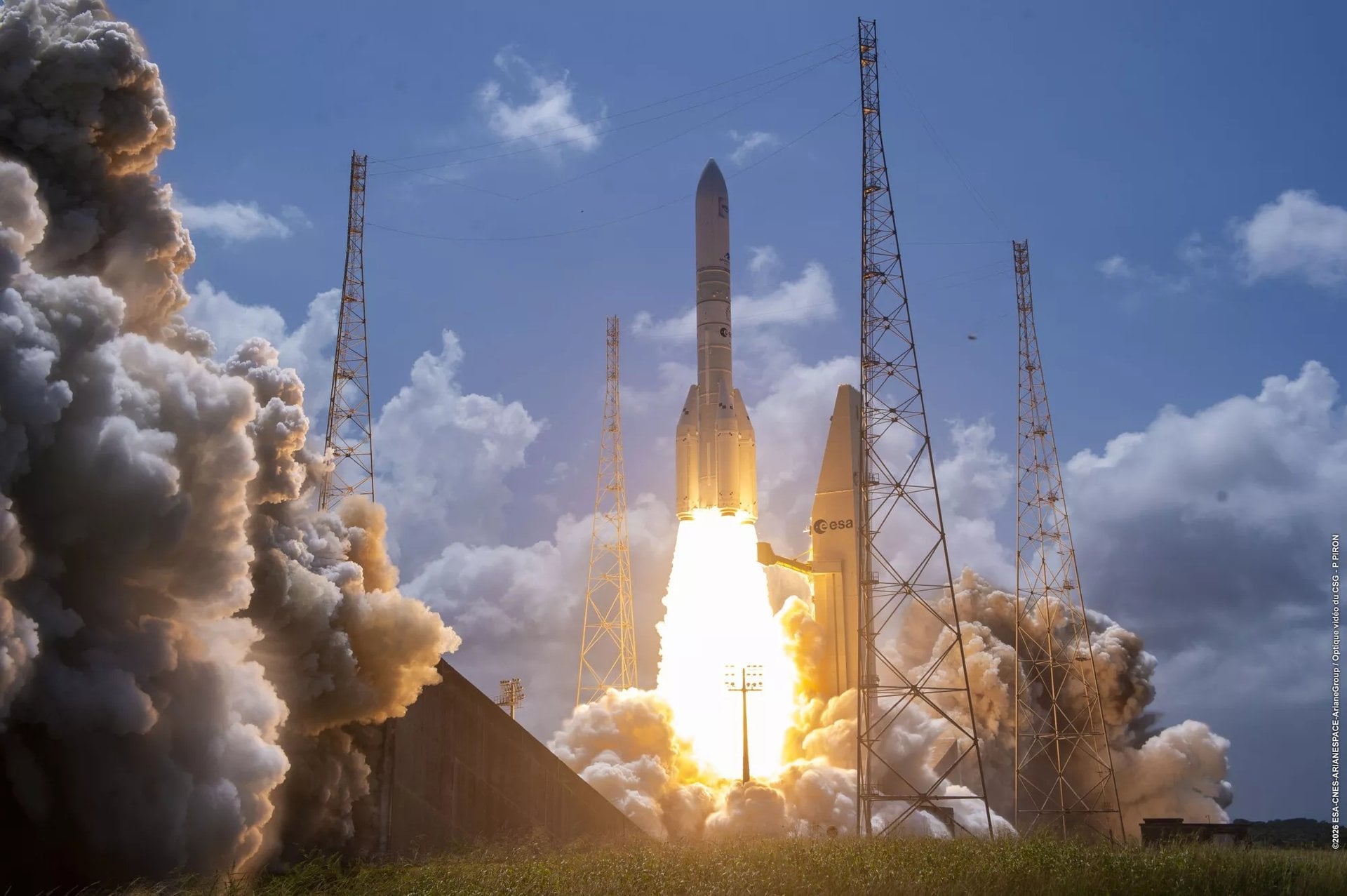
The European Space Agency (ESA) successfully launched the Ariane 6 rocket on February 12, 2024, marking a significant milestone in European space exploration. This event took place at 1:45 p.m. local time from Europe’s Spaceport in Kourou, French Guiana. The maiden flight, designated VA267, carried a payload of 32 satellites for Amazon’s Leo constellation, showcasing the rocket’s advanced capabilities.
The Ariane 6 is a three-stage expendable launch system designed to supersede the Ariane 5 vehicle. Its latest configuration, the Ariane 64, incorporates four strap-on boosters, enhancing its payload capacity to an impressive 21,650 kg (47,730 lb) to Low Earth Orbit (LEO) and 11,500 kg (25,400 lb) to geostationary orbit (GSO). The original version, known as the Ariane 62, had two strap-on boosters and offered a medium payload capacity of 10,350 kg (22,820 lb) to LEO and 4,500 kg (9,900 lb) to GSO.
Significance of the Launch
The successful flight of the Ariane 6 signifies a new chapter for the ESA, enabling Europe to pursue ambitious projects across various fields, from scientific research to commercial satellite deployments. This mission is particularly noteworthy as it represents the first time a European launcher has serviced a satellite constellation, and it is the first of 18 planned launches supporting the Amazon Leo constellation.
The enhanced heavy-lift capacity of the Ariane 64 allows the ESA to expand its launch services to commercial partners, previously limiting its operations primarily to government and scientific missions. As stated by David Cavaillolès, CEO of Arianespace, this capability opens new avenues for collaboration in the space sector.
Technical Innovations and Future Missions
One of the standout features of the Ariane 64 is its P120C solid rocket booster, recognized as one of the largest and most powerful currently in operation. Its carbon-fiber design, assembled in one piece, contains approximately 143.6 metric tons (158.3 U.S. tons) of propellant, comprising aluminum, ammonium perchlorate, and hydroxyl-terminated polybutadiene (HTPB). Each booster achieves a specific impulse of 279 seconds (2.74 km/s) and generates an average thrust of about 4.5 meganewtons (1,000,000 lbf).
The ESA released a promotional video detailing the capabilities of the Ariane 6 and the missions it will support. Upcoming missions include the exoplanet-hunting satellite, the PLAnetary Transits and Oscillations of stars (PLATO), scheduled for launch in January 2027. This mission aims to enhance the current understanding of exoplanets by measuring their sizes, detecting exomoons and rings, and characterizing host stars for potential habitability.
Another significant project on the horizon is the Argonaut lunar lander, a crucial element of the ESA’s lunar exploration strategy. The agency envisions deploying numerous landers to deliver cargo to the Moon’s surface, facilitating both robotic and crewed missions, including those aligned with NASA’s Artemis program. The goal is to establish an international lunar outpost, enhancing access to lunar resources.
In a statement, Martin Sion, CEO of ArianeGroup, emphasized the importance of the Ariane 6 in achieving these ambitious objectives. The launch not only showcases Europe’s technological advancements but also positions the ESA as a key player in the global space economy.
The Ariane 6 rocket represents a significant leap forward, promising to revolutionize how Europe approaches space exploration and commercial satellite launches.