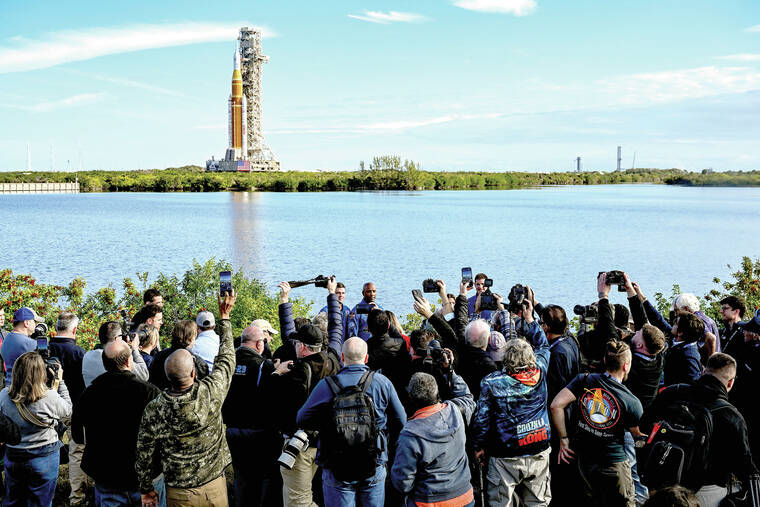
NASA successfully completed a critical countdown rehearsal for the upcoming Artemis II moon mission on Thursday night at the Kennedy Space Center in Florida. The test marked a significant improvement over a previous attempt that was halted due to hydrogen leaks, which had hampered progress on the ambitious project aimed at returning humans to the lunar environment.
The rehearsal involved filling the massive Space Launch System (SLS) rocket with millions of pounds of liquid hydrogen and liquid oxygen. During the rehearsal, only minor issues were encountered, a stark contrast to the complications faced earlier when substantial hydrogen leaks were detected at the rocket’s connection to the launchpad.
Jared Isaacman, NASA’s administrator, expressed pride in the team’s efforts, stating on X, “Proud of the @NASA team as this was a big step toward America’s return to the lunar environment.” The successful countdown rehearsal indicates that NASA is on track for a potential launch of Artemis II, tentatively scheduled for March 6, 2024.
Final Preparations and Next Steps
The Artemis II mission is set to feature a crew of four, including three NASA astronauts and one from the Canadian Space Agency. To ensure their health before the mission, the astronauts will enter quarantine starting Thursday. Lori Glaze, acting associate administrator for NASA’s exploration systems development mission directorate, stated that data from the rehearsal will undergo a rigorous review next week to confirm readiness for flight.
If all goes well, NASA may confirm the launch date shortly thereafter. Additional launch windows are available on March 7, 8, 9, and 11. Should Artemis II miss these opportunities, the next available launch dates will be in April.
During the two-day countdown test, engineers successfully managed the challenges associated with hydrogen, which, while efficient, poses containment difficulties due to its lightweight and small molecular structure. In the previous attempt, significant leaks occurred, leading to delays in filling the rocket’s tanks. By contrast, during this recent rehearsal, hydrogen concentrations at the connection point remained below the critical limit of 16%, allowing the countdown to proceed without major interruptions.
Technical Challenges and Achievements
The rehearsal included a practice of resetting the countdown clock, simulating how NASA would respond to last-minute issues without scrubbing the launch attempt entirely. This involved replenishing the rocket’s propellant tanks, which the team completed in an impressive 57 minutes. Charlie Blackwell-Thompson, the launch director, noted, “Really no leakage to speak of,” highlighting the progress made since the last test.
As the Artemis II rocket sat poised for its upcoming mission, another launch took place at the nearby Cape Canaveral Space Force Station, where a SpaceX Falcon 9 rocket successfully carried a load of Starlink satellites into orbit. This bustling activity at Florida’s space launch facilities underscores the growing momentum in the aerospace sector as multiple missions prepare for liftoff.
The Artemis II mission aims to send astronauts on a ten-day journey around the moon, marking the first time humans will venture beyond low-Earth orbit since the conclusion of NASA’s Apollo program over fifty years ago. While the crew will not land on the lunar surface, their mission represents a pivotal step in humanity’s return to deep space exploration.