The Vienna State Opera’s production of Luisa Miller, composed by Giuseppe Verdi, opened its 2025-26 season with a blend of tragic storytelling and controversial directorial choices. The opera tells the poignant story of young peasant Luisa, whose love for Rodolfo, the son of nobleman Count Walter, is thwarted by social hierarchy and political machinations. The production, directed by Philipp Grigorian, faced criticism for its execution, which many felt overshadowed the opera’s emotional depth.
In this tragic narrative, Rodolfo’s father pressures him to marry the Duchess Federica for political gain, while the scheming courtier Wurm threatens Luisa’s father with execution unless she falsely declares her love for him. When Luisa complies, she unwittingly drives Rodolfo to despair, leading to a heart-wrenching conclusion where both lovers die, realizing too late that their love was genuine.
Directorial Choices Spark Debate
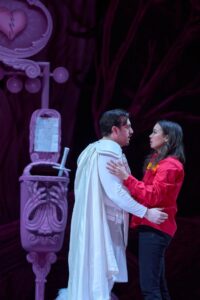
The production’s direction appeared to lack a cohesive vision, leading to a fragmented presentation of the opera. Critics noted that Grigorian’s staging resembled a stream of consciousness rather than a thoughtfully curated performance. The setting transformed the village square into a brightly colored warehouse, and Rodolfo was depicted as a delivery driver, which detracted from the original context of the story.
The overarching theme—that Luisa’s father recalls the events from a bus stop—was not consistently developed, resulting in a visual experience that felt superficial. The vibrant costumes and peculiar character interpretations, including the use of ballet dancers as fairy godmothers and an inexplicable red teddy bear, led some to feel that the director was dismissive of the opera’s significance.
Musical Excellence Shines Through
Despite the directorial shortcomings, the musical integrity of the performance was upheld by conductor Michele Mariotti. His adept handling of the Vienna State Opera Orchestra produced a sound that was both rich and dynamic, effectively conveying the emotional weight of Verdi’s score. Mariotti’s commitment to the music ensured that the dramatic arcs were articulated with clarity, providing strong support for the singers.
The role of Luisa was performed by Nadine Sierra, whose interpretation was met with acclaim. Her technique was impeccable, allowing her to navigate the opera’s demanding coloratura with emotional depth. Sierra’s radiant high notes and the darker hues of her voice added a profound weight to her character, culminating in a performance that resonated with the audience.
Rodolfo, portrayed by Freddie De Tommaso, delivered an impassioned performance. His tenor voice was robust, though at times he struggled with the bel canto style, particularly during the famous aria “Quando le sere al placido.” Nonetheless, his engagement and charisma left a strong impression.
The character of Miller, Luisa’s father, was brought to life by George Petean, whose baritone was well-suited for this quintessential Verdian role. His portrayal, alongside Sierra, was marked by emotional expressiveness and stylistic authority, drawing parallels to Verdi’s later masterpiece, Rigoletto.
The supporting cast offered strong performances as well. Daria Sushkova, as the Duchess Federica, contrasted well with Sierra’s soprano, while bass performers Roberto Tagliavini and Marko Mimica effectively embodied the opera’s villains. Their performances added layers of complexity to the narrative, enriching the overall experience.
In summary, the Vienna State Opera’s staging of Luisa Miller showcased both the grandeur of Verdi’s music and the challenges of modern interpretation. While the production’s directorial choices raised questions about artistic intent, the musical performances delivered by the cast and orchestra highlighted the timeless beauty of this tragic opera. The evening ended with a poignant reminder of the fine line between love and tragedy, leaving a lasting impression on those in attendance.