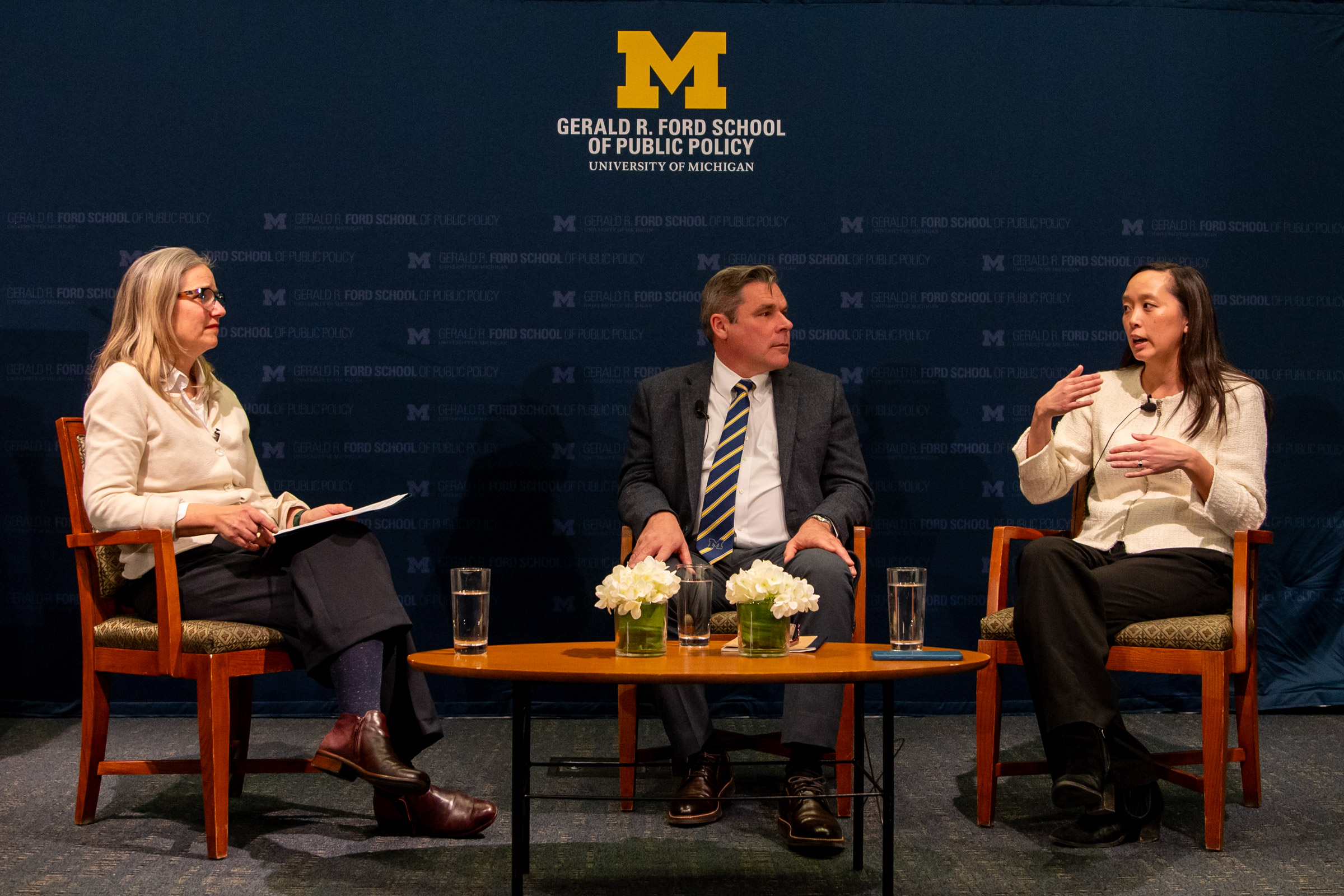
UPDATE: Just announced, Michigan state Senators Stephanie Chang and John Damoose called for urgent bipartisan cooperation during a critical event on February 26, 2026. The discussion, titled “Conversation Across Differences,” was held at the Walter and Leonore Annenberg Auditorium, drawing an audience of around 75 attendees eager to hear insights from both sides of the aisle.
The event, hosted by the Ford School of Public Policy at the University of Michigan, featured a compelling dialogue moderated by political science professor Jenna Bednar. Emphasizing the importance of building relationships beyond political party lines, Damoose stated, “There isn’t anybody on Earth who can make me stand up and say anything negative about Stephanie Chang as a person.” His remarks underscore a growing sentiment that personal connections can transcend political divides.
Senator Chang highlighted the necessity of bipartisan compromise, referencing her successful collaboration with Republican Senator Ruth Johnson on Senate Bills 611 and 612. These bills aim to enhance protections for domestic violence survivors by mandating that protection orders are served within 72 hours at no cost to survivors. “We were able to pass that legislation through the Senate with unanimous support, and it would not have been possible without bipartisan sponsorship,” Chang declared.
Both senators addressed the implications of term limits on their legislative effectiveness. Chang noted that her longer tenure in the Michigan Senate has fostered deeper relationships, allowing for more substantial bipartisan initiatives compared to her time in the House. “I think that because we serve longer terms, there is more of a chance for actual relationship building,” Chang explained, stressing the Senate’s unique position for collaboration.
Damoose shared his firsthand experiences collaborating with Chang on initiatives like the Michigan Water Plan, designed to alleviate water bills through the creation of a new state program fund. He praised Chang’s willingness to listen to constituents’ concerns, stating, “Sen. Chang got on a Zoom call for over an hour with leaders from my district and listened to every one of their concerns and then made changes in the bill.”
The conversation took a pivotal turn when Bednar questioned Damoose about his recent break from party lines during a budget dispute in December 2025. Damoose revealed that he was motivated by a desire for integrity, saying, “If something’s right, I’m going to do it.” This stance has drawn criticism from fellow Republicans, but Damoose remains resolute in prioritizing good governance over party loyalty.
As the discussion concluded, Damoose urged attendees to foster meaningful relationships across political divides. “Relationships do matter. Go out of your way to bring different groups together — not just to debate, but to actually spend time together,” he said. His message resonated with attendees, including Nina Attisha, a sophomore at the University of Michigan, who expressed hope in the potential for bipartisanship. “Even though the media shows that there’s so much polarization in politics, there’s still ways that politicians work across that and collaborate,” she remarked.
This urgent call for bipartisanship comes at a time when political polarization is at an all-time high, making the senators’ commitment to collaboration all the more crucial. As Michigan continues to navigate its legislative challenges, the dialogue between Chang and Damoose serves as a beacon of hope for those seeking progress in a divided political landscape.
Stay tuned for more updates on this developing story.