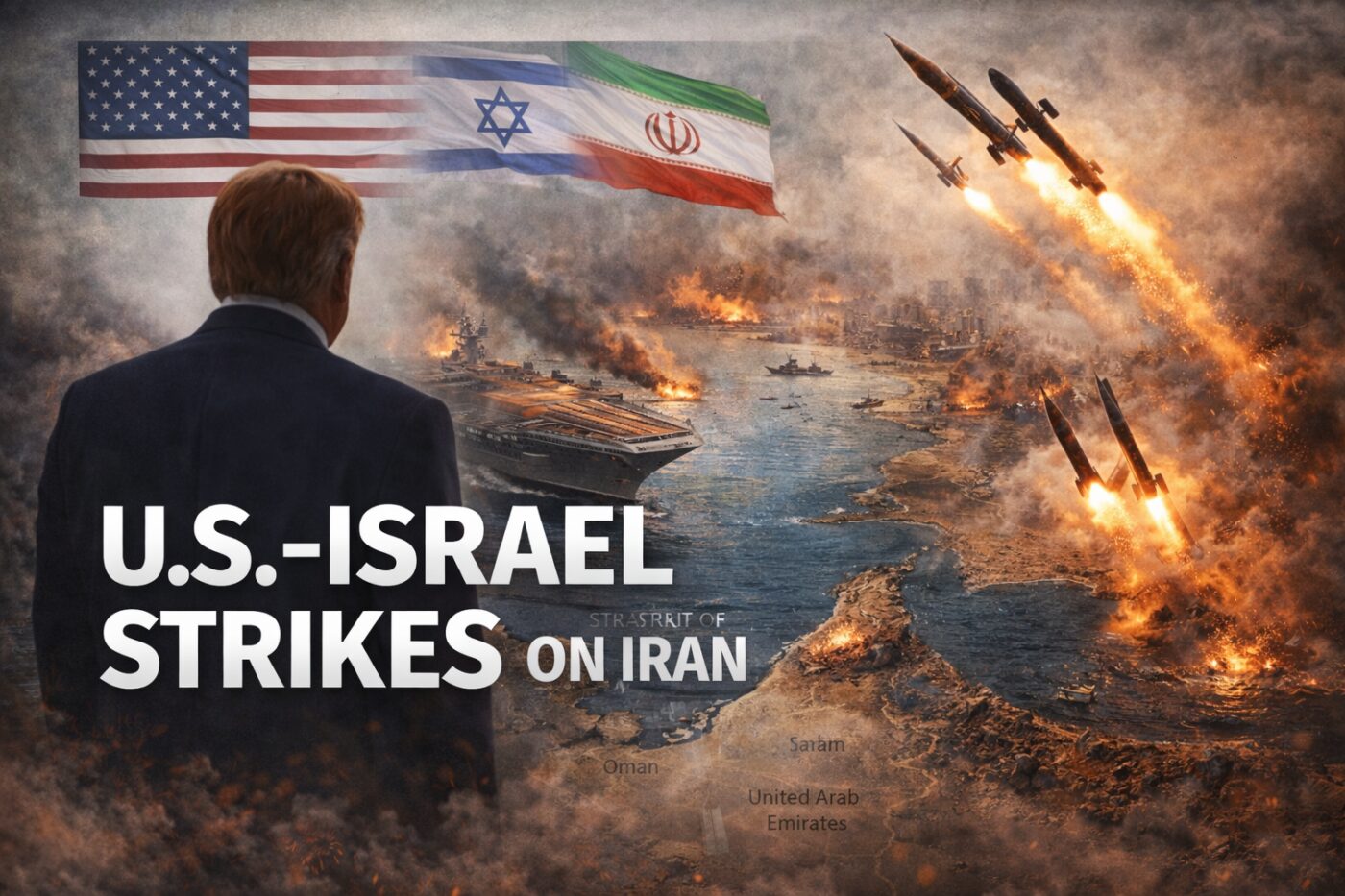
A coordinated military operation by the United States and Israel against Iran was announced on February 28, 2026. This escalation marks a significant increase in tensions across the Middle East, with implications for both regional stability and global security. The campaign aims to dismantle Iran’s ruling leadership and disrupt its missile and naval capabilities while promoting a potential uprising among the Iranian populace.
Initial reports indicate that Iran has retaliated against U.S. interests and allied positions throughout the region. A representative from the Islamic Revolutionary Guard Corps (IRGC) stated that ships in the region have received warnings against all maritime traffic through the Strait of Hormuz, a critical chokepoint through which approximately 20% of the world’s oil is transported.
President Donald Trump described these operations as essential to counter an alleged imminent missile threat from Iran. Yet, assessments from various sources familiar with classified intelligence suggest that this assertion lacks solid evidence. A 2025 unclassified report from the Defense Intelligence Agency indicates that Iran may be able to develop a “militarily-viable” intercontinental ballistic missile (ICBM) by 2035, but only if the country actively pursues such capabilities. Current intelligence does not suggest that Iran has an operational ICBM program directed at the United States.
While Iran does possess a range of short- and medium-range ballistic missiles that threaten U.S. bases and personnel in the Gulf region, conflating these regional capabilities with intercontinental threats creates a misleading strategic landscape.
The undertaking of regime change in Iran poses significant complexities. Historical precedents suggest that such efforts are far more intricate than those seen in Iraq and Afghanistan. Iran is geographically expansive, covering an area roughly six times larger than Iraq and home to approximately 92 million people. These factors contribute to substantial military, political, and logistical challenges.
For a successful regime change, certain conditions must typically exist: support from elites, credible opposition, and defections within military ranks. Currently, none of these prerequisites appear to be in place within Iran.
The political miscalculation may be more pronounced than the military aspect. Trump seems to believe that overwhelming military force will compel Tehran’s leadership to surrender. However, historical context indicates that Iranian hardliners view capitulation as a greater threat to their survival than war. Research suggests that Iran is more inclined to escalate tensions rather than yield under pressure.
In a striking declaration, Trump urged the Iranian regime to disarm, stating, “You must lay down your weapons and have complete immunity, or in the alternative, face certain death.” Iranian leaders seem to believe they can endure conflict, especially in the absence of U.S. ground troops. A surrender could jeopardize their already fragile domestic support, which primarily consists of radical and hardline factions essential for regime stability.
As reported by investigative journalists Jeremy Scahill and Murtaza Hussain, Iran has launched a series of missile and drone strikes targeting U.S. military facilities across the Persian Gulf, including in Qatar, the UAE, Kuwait, Bahrain, Syria, Jordan, and Iraq.
The efficacy of air campaigns and precision strikes in achieving regime change has been historically limited. The U.S. has spent over $7 billion bombing Yemen under both the Biden and Trump administrations yet failed to dislodge the Houthi movement.
Since the first Gulf War, the United States has struggled to achieve clear and stable political outcomes from military interventions in the Middle East. The current situation is precarious, as the ongoing confrontation heightens the potential for regional spillover, resource depletion, and a renewed long-term U.S. commitment to the region.
The U.S. administration aims for a swift victory, but prolonged military engagement could deplete vital munitions, including Tomahawk missiles, already in limited supply. Adversaries of the U.S. may find the prospect of American involvement in a prolonged conflict appealing, as it could divert focus from strategic challenges in Asia.
Ali Vaez, the International Crisis Group’s Iran Project Director, emphasized that history indicates external attacks tend to consolidate rather than topple regimes. Merely leveraging airpower does not create viable political alternatives or facilitate regime change.
This recent phase of military intervention in the Middle East follows a well-trodden path of preemptive strikes conducted without congressional approval and lacking a clear imminent threat to the U.S. The potential consequences for Iran, its citizens, and the broader region could be profound. By maximizing military assets while offering minimal diplomatic solutions, Washington may have unintentionally increased the likelihood of an extended conflict, rather than the swift resolution it seeks. The coming weeks and months will test the dynamics of deterrence, escalation control, and the risks of miscalculation in this volatile region.