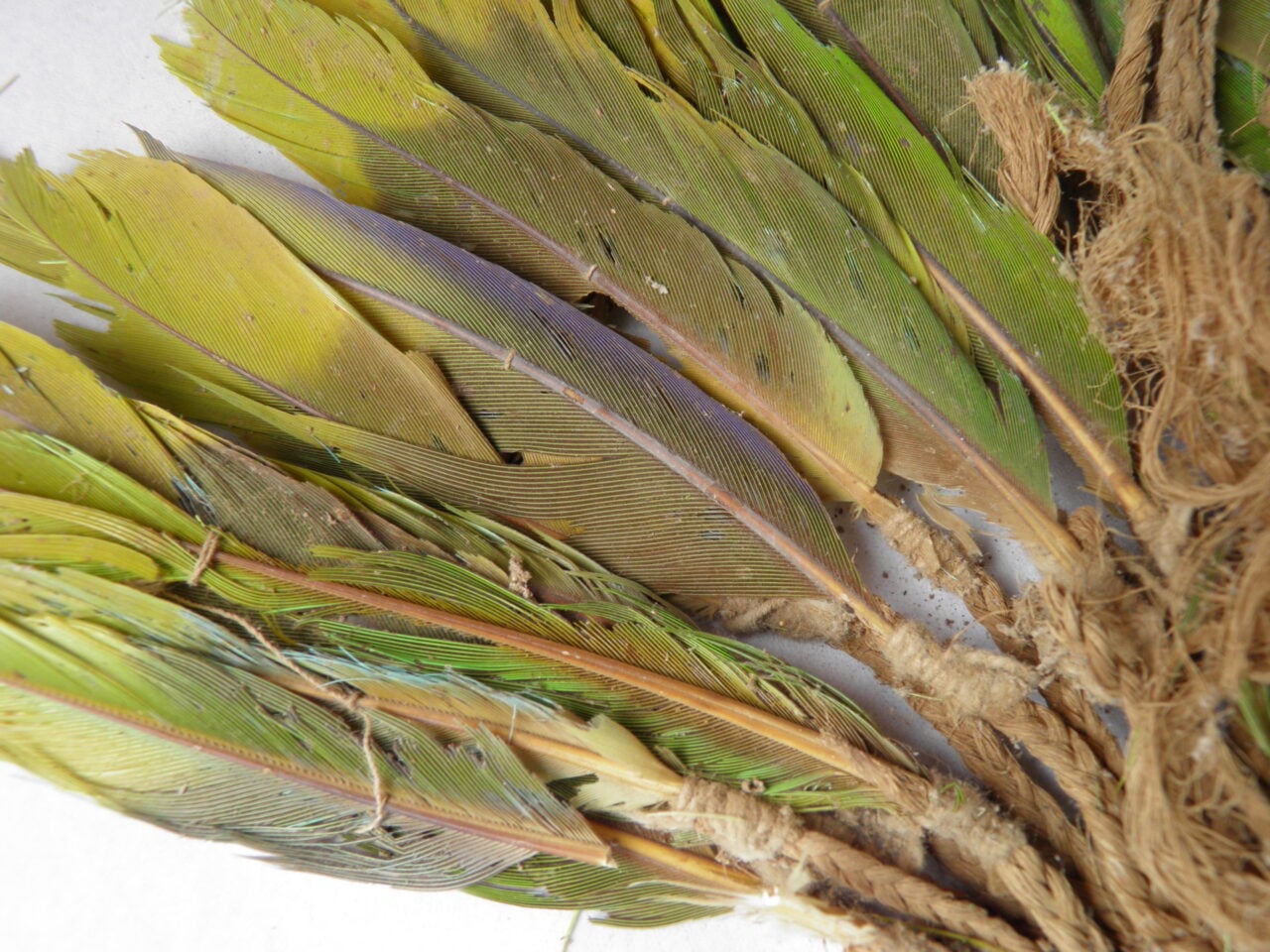
Recent research reveals that ancient Peruvian civilizations, long before the rise of the Inca Empire, transported live parrots over the treacherous Andes Mountains to acquire their vibrant feathers. An international team of researchers discovered preserved feathers from tropical parrots in a dry tomb at Pachacamac, a significant archaeological site, and sequenced their DNA to uncover their origins.
The study, published in Nature Communications, indicates that the feathers belonged to four species of wild-born tropical parrots. Furthermore, chemical analysis suggested that these parrots were kept in captivity near the coast, far from their natural rainforest habitats. This discovery sheds light on the complex trade networks that existed among pre-Inca societies, particularly the Yschma Kingdom, which thrived between 1100 and 1460.
Uncovering Ancient Trade Practices
Led by George Olah, an interdisciplinary geneticist at the Australian National University, the research stemmed from earlier archaeological findings. In the early 2000s, Izumi Shimada, a retired anthropologist from Southern Illinois University, directed the Pachacamac Archaeological Project, which unearthed a large gravesite belonging to an elite member of the Yschma Kingdom. Among the funerary items, five bundles contained colorful bird feather ornaments, prompting the team to investigate the origins and transport of these feathers.
As Shimada noted, “It has long been known that the colorful feathers of Amazonian parrots were highly valued by ancient cultures across the Americas.” However, questions remained about the specific identities of the birds and the logistics of their trade.
Tracking the Journey of Parrots
To identify the species of the feathers, the team conducted DNA sequencing, revealing the presence of the scarlet macaw, red-and-green macaw, blue-and-yellow macaw, and mealy amazon—all native to the lowland tropical forests across the Andes from the Yschma Kingdom. The genetic diversity among the samples indicated that these parrots were indeed wild-caught.
Further analysis of the parrots’ diets, using isotope chemistry, suggested a diet rich in coastal resources, implying that the birds had been transported alive and kept in captivity along the Pacific coast. The researchers proposed two potential routes for their journey: a northern path along the coast or a more challenging eastward crossing of the Andes. Archaeological evidence leans towards the northern route, which would have involved navigating through the territory of the contemporary Chimú Empire.
The findings indicate a sophisticated economy and extensive trade practices within Yschma culture, long before the Incan Empire emerged.
Redefining Peruvian History
This research challenges the prevailing view that pre-Inca societies were isolated and limited in their trade practices. According to Olah, the study reveals that these ancient civilizations managed intricate logistical networks that facilitated long-distance trade.
“Our study demonstrated human ingenuity and the drive to overcome the physical challenges of acquiring desired items over vast distances,” Shimada stated. The results also highlight the interconnectedness of ancient societies, suggesting that they were more advanced in their trade and economic strategies than previously understood.
The research not only enriches our understanding of the Yschma Kingdom but also opens up new inquiries into the numerous pre-Hispanic featherworks preserved in museums across Peru and Chile. As Olah concluded, “Understanding how ancient societies utilized, managed, and traded these iconic species gives us a much deeper baseline for how we manage and conserve them today against modern anthropogenic threats.”