Astronomers have identified evidence of a significant planetary collision that occurred in a distant star system, providing insights into cosmic events that may have shaped our own solar system. The study, published in the journal The Astrophysical Journal Letters, highlights how this cataclysm could resemble the impact that formed the Earth and its Moon.
The star at the center of this investigation is known as Gaia20ehk, which initially appeared to be a typical main sequence star, shining steadily like our own Sun. However, observations beginning in 2016 revealed unusual fluctuations in its brightness, culminating in a dramatic change around 2021. Lead author Anastasios Tzanidakis, an astronomer at the University of Washington, noted, “The star’s light output was nice and flat, but starting in 2016 it had these three dips in brightness. And then, right around 2021, it went completely bonkers.”
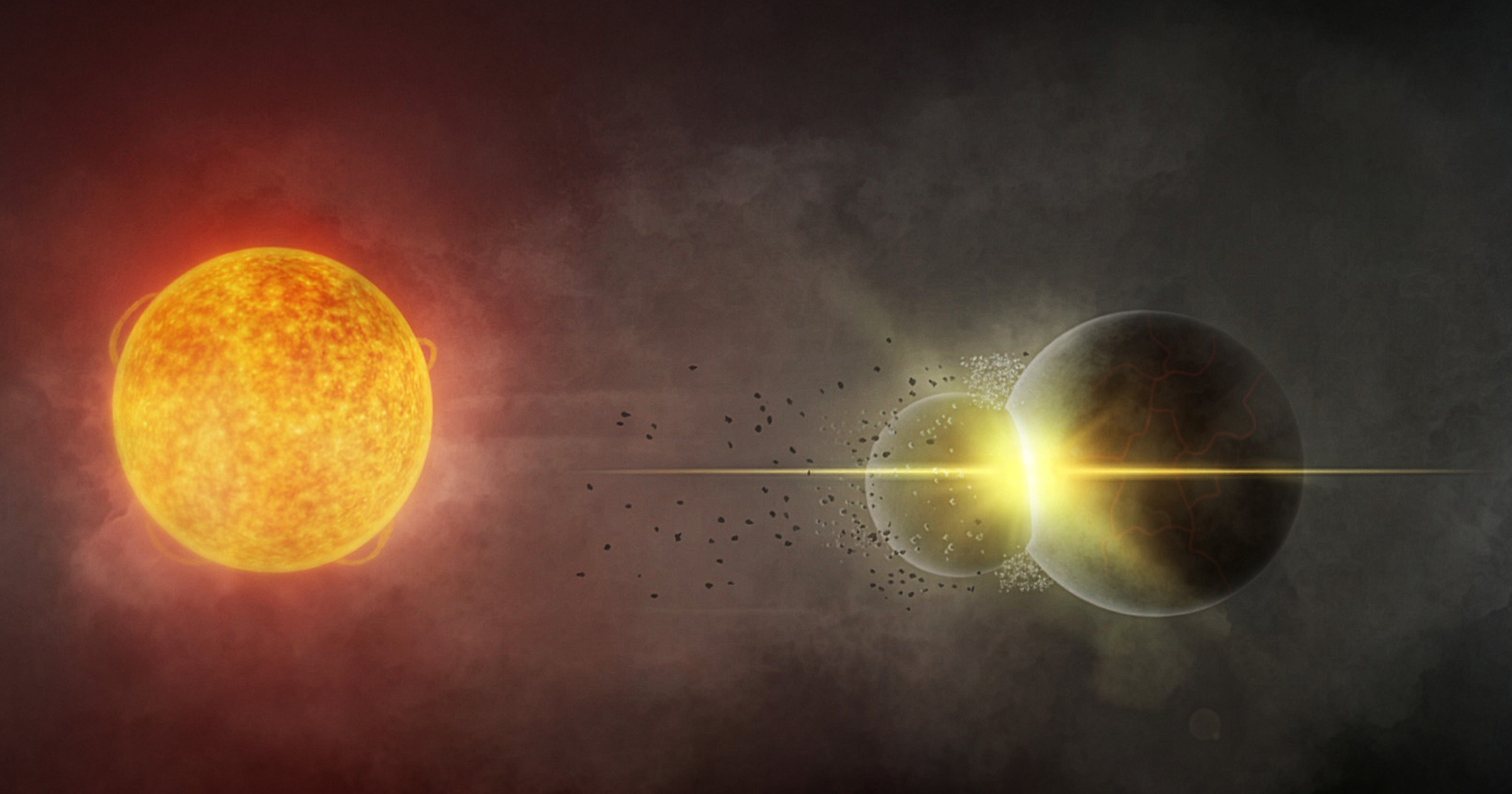
Upon further investigation, astronomers discovered that the flickering was not due to the star itself, but rather enormous streams of rock and dust passing in front of it. The researchers concluded that these materials were likely the remnants of a violent collision between two planets. The scale of the debris was significant enough to partially obscure the star’s light, which indicated a major cosmic event.
Insights into Planetary Formation
Additional observations using infrared data revealed a spike in brightness, suggesting that the material blocking the star was extremely hot, potentially glowing in the infrared spectrum. Tzanidakis explained, “A collision between two massive bodies would produce these levels of heat.” He described how the planets likely spiraled closer to one another over time, initially experiencing grazing impacts before culminating in a catastrophic collision.
“This is an incredible opportunity. Various telescopes caught this impact in real time,” Tzanidakis added. The findings draw parallels to the ancient collision theorized to have formed the Earth and Moon. Approximately 4.5 billion years ago, a hypothetical planet named Theia, comparable in size to Mars, is believed to have collided with Earth, ejecting debris that eventually coalesced into the Moon.
The current research offers vital clues about planetary formation processes across the universe. The dust cloud surrounding Gaia20ehk orbits at a distance akin to that of Earth from the Sun, known as one astronomical unit. This raises intriguing possibilities about the formation of rocky satellites around other celestial bodies, potentially influencing conditions for life.
Implications for Astrobiology
The relationship between planetary collisions and the size of moons presents an important avenue for understanding the rarity of life in the universe. Tzanidakis noted that the Earth’s Moon is unusually large relative to its host planet, serving as a significant stabilizing force for our climate and environment. He remarked, “If collisions that lead to an outsized moon are rare, perhaps life is all the more rarer.”
As researchers continue to monitor cosmic events, the findings from Gaia20ehk could enhance our understanding of the dynamics involved in the formation of planetary systems. Tzanidakis emphasized the importance of capturing more such collisions to further unravel the mysteries of our solar system’s evolution.
This discovery not only adds to the existing knowledge of planetary dynamics but also highlights the complexity of celestial interactions and their potential impact on life-sustaining conditions. As astronomers explore the cosmos, the implications of these findings could reshape our understanding of where and how life might arise beyond Earth.