Berlin Unveils Official Yiddish Street Signs Challenging Germany’s Minority Language Rules
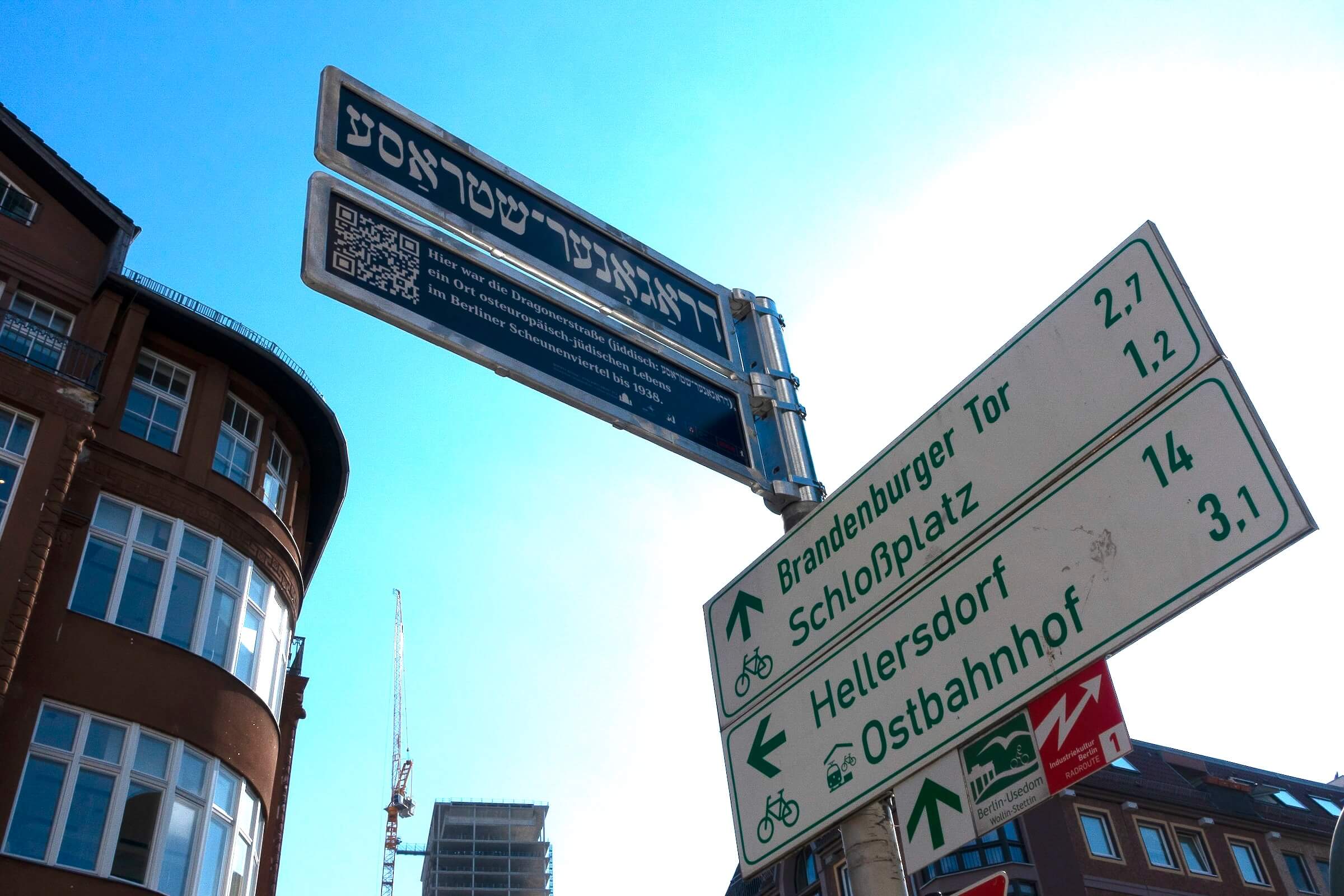
Berlin, Germany — In a significant cultural milestone, official Yiddish street signs have been unveiled in Berlin’s historic Jewish quarter, reigniting urgent debates over Yiddish’s recognition as an official minority language in Germany. The event took place on March 11, marking a pivotal moment for the Jewish community and language activists who have long demanded greater visibility for Eastern European Jewish heritage.
Artist Sebestyén Fiumei initially sparked the movement in spring 2021 by illegally installing a white street sign on a central Berlin pole bearing the antiquated Yiddish spelling of “Grenadierstrasse,” a street once central to Berlin’s vibrant Yiddish-speaking Jewish population. Although his rogue sign was swiftly removed by local authorities, it inspired Jewish district official Nathan Friedenberg and historian Jess Earle to push for official recognition of Yiddish street signage, aiming to reflect how Jews lived, not only how they perished during the Holocaust.
The project faced significant bureaucratic resistance, including rigid regulations that initially prohibited even the use of a white background or phrases like “sign” and “art.” The fact that Yiddish is not recognized under Germany’s current minority language framework posed the greatest obstacle, making official use of the language nearly impossible.
Official Signage Brings Yiddish Back to Berlin Streets After Decades
Despite these hurdles, the September unveiling featured a marker that preserves Fiumei’s original Yiddish spelling of Grenadierstrasse, accompanied by a contextual plaque in German and English as well as a QR code linking to “Without a trace?” — a new local history website tracing the Jewish quarter’s past.
The approximately 30 attendees included Yiddish cultural professionals thrilled to witness the language’s reemergence in public space, although the ceremony notably excluded spoken Yiddish — a choice justified by Earle herself who stressed that the language “is only mentioned when completely necessary.” Friedenberg has since promised to broaden Yiddish involvement in future events.
Historic Roots Meet Contemporary Culture In Berlin’s Changing Jewish Landscape
Yiddish, originally rooted in Germany’s Ashkenaz region but nearly wiped out by the Holocaust, remains a vibrant cultural force through new immigrant waves from Eastern Europe. Contemporary Yiddish singer Sasha Lurje, who settled in a Berlin immigrant neighborhood similar to the old Jewish quarter, actively fosters a growing Yiddish music scene through organizations like Shtetl Berlin and Yiddish.Berlin.
The current month alone has seen multiple community events including concerts, poetry readings, and Yiddish-speaking social meetups—demonstrating a living cultural revival despite the language’s unofficial status.
Germany’s Minority Language Model Poses Barriers for Yiddish
Germany officially recognizes several minority languages, including Lower and Upper Sorbian in Lusatia, which benefit from legal protections, school programs, research institutes, and public signage under the European Charter for Regional or Minority Languages. These languages have endured centuries of suppression, yet today they receive crucial funding and visibility that Yiddish lacks.
Sorbian language activists credit bilingual signs for revitalizing their endangered language—a contrast that highlights Yiddish’s marginalization in official discourse. Language advocate Měto Nowak publicly questioned why Yiddish remains excluded despite its historical significance and sizable contemporary speaker base across Europe and Germany.
Campaign to Recognize Yiddish as Germany’s Eighth Minority Language Gains Momentum
Meanwhile, Fiumei and former roommate Eliana Jacobs have renewed calls to make Yiddish an officially recognized minority language in Germany. Their campaign, quiet for several years, has experienced renewed energy following the street sign unveiling, with Jacobs affirming that official recognition is now “very realistic.”
For American readers and South Carolinians interested in cultural and linguistic preservation, the story resonates as a global example of revitalizing endangered languages and confronting historical erasure. The evolving debate in Berlin shines a spotlight on how government recognition and community activism intersect to protect vulnerable cultural identities.
As Yiddish reclaims space on Berlin’s streets, its fate remains uncertain without formal minority language status. But the current developments mark a decisive step toward reclaiming a near-forgotten legacy—and invite worldwide support for protecting minority languages everywhere.
Nathan Friedenberg: “German memorials must reflect how Jews lived, not only how they died.”
The SC Journal will continue covering this developing story on minority languages, immigrant cultures, and Jewish history in Europe and beyond.