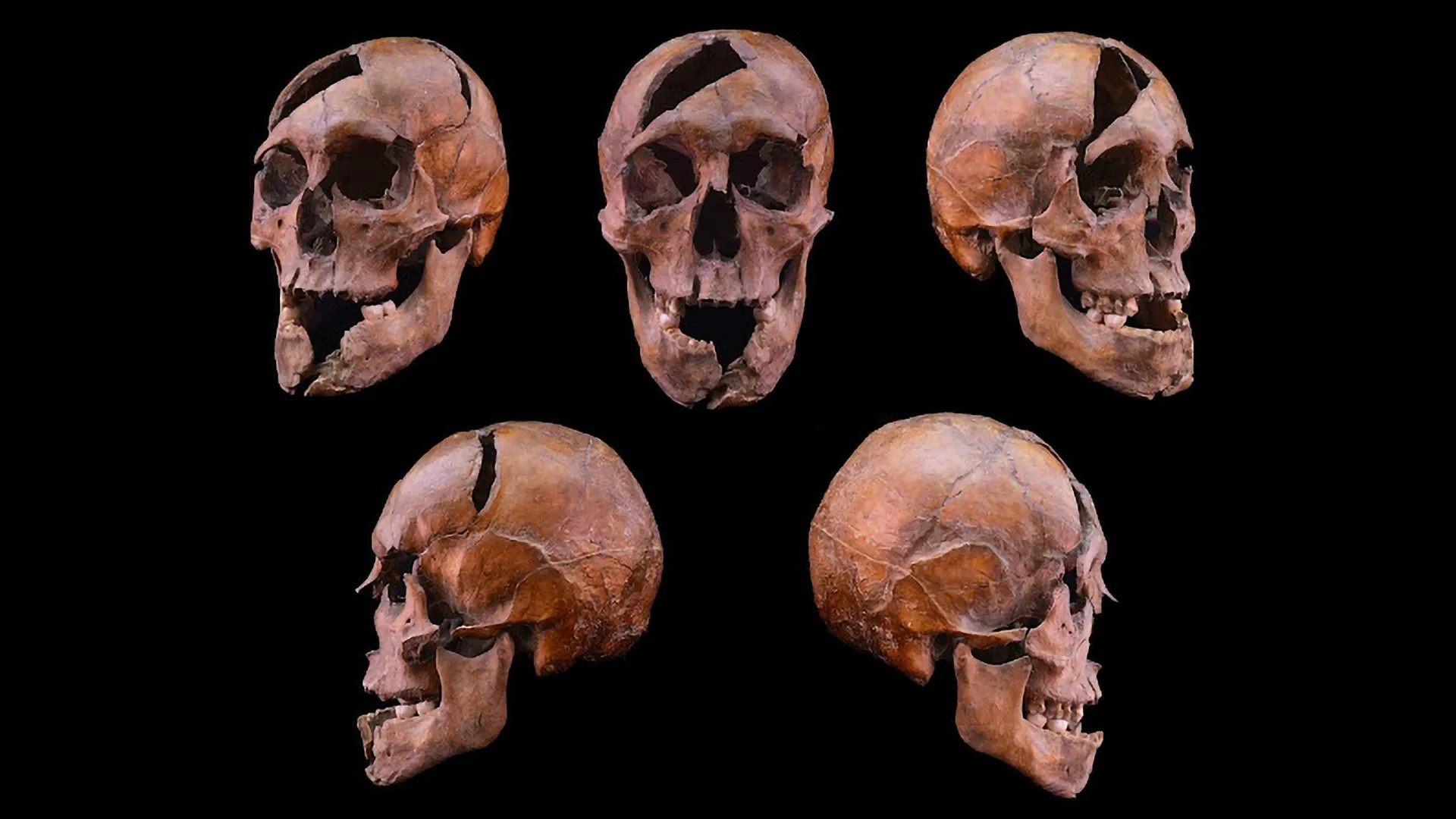
URGENT UPDATE: Groundbreaking research confirms the identity of Duke Béla of Macsó, a royal murdered 700 years ago. An international team led by Hungarian scholars from Eötvös Loránd University has utilized cutting-edge genetic, isotopic, and forensic analysis to solve this ancient mystery, revealing critical insights into his life and brutal assassination in 1272.
This remarkable finding sheds light on the young nobleman’s Scandinavian-Rurik roots and his violent death, marking a significant achievement in the fields of archaeology and genetics. The study, published in Forensic Science International: Genetics, not only identifies the remains but also reconstructs the circumstances surrounding his death, which involved a calculated attack driven by intense emotion.
The bones of Duke Béla were unearthed in a Dominican monastery on Margaret Island, Budapest, during excavations in 1915. Initial assessments suggested these remains belonged to the Duke, but it wasn’t until this recent collaboration that the identity was confirmed. The research team, organized by Tamás Hajdu, included experts from various fields—anthropologists, geneticists, archaeologists, and isotope specialists—who worked together to verify the findings.
In the early 20th century, the remains were studied by Lajos Bartucz, who documented 23 sword cuts on the skeleton, suggesting a coordinated attack by multiple assailants. However, the remains vanished during World War II until they were rediscovered in 2018, stored among thousands of specimens in the Hungarian Museum of Natural History.
The latest forensic analysis revealed that Duke Béla was in his early twenties at the time of death and had significant physical trauma, including 26 perimortem injuries. The attack appears to have been premeditated yet emotionally charged, indicating a violent confrontation involving three assailants. Researchers believe he was likely unarmored at the time, as the depth of the wounds suggests he had no protective gear.
Genetic testing confirmed Duke Béla’s lineage, establishing him as a descendant of both the Árpád and Rurik dynasties. His genetic profile shows a strong Scandinavian heritage, with nearly half of his ancestry linked to the Rurik dynasty, known for producing numerous Grand Dukes of Kiev. This connection was further supported by a recent Russian study linking present-day descendants with historical figures.
Researchers have also provided insights into Duke Béla’s diet, revealing he may have consumed a variety of high-protein foods, including fish and ancient grains, which shaped his nutritional profile. These findings not only enhance the historical narrative but also offer a glimpse into the everyday life of a royal in 13th-century Hungary.
The implications of this discovery are profound, not only for understanding the historical context of Duke Béla’s life and death but also for the future of forensic archaeology. The collaboration between the humanities and natural sciences showcases how modern techniques can validate historical accounts and reconstruct past events with remarkable accuracy.
As the story of Duke Béla’s life and death unfolds, researchers emphasize the need for continued exploration of historical mysteries. This investigation serves as a powerful reminder of the intricate connections between our past and present, and the stories that still await discovery.
Stay tuned for more updates as this research develops and reveals further insights into the life of this long-lost royal figure.