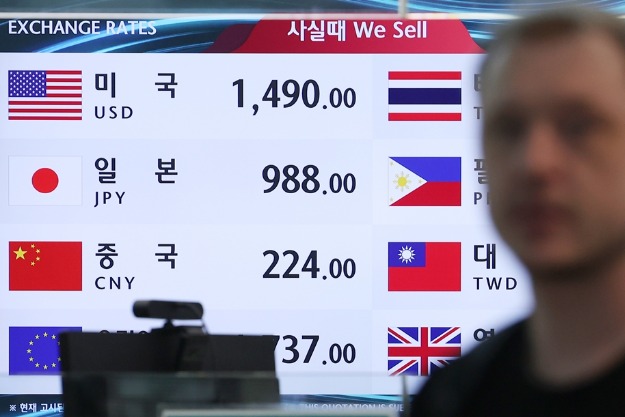
South Korean companies are preparing for a prolonged period of a weakened won, with a survey indicating that the majority expect exchange rates to remain above 1,400 won per dollar through 2026. Conducted by The Korea Economic Daily from November 17 to 19, the survey of 100 treasury and foreign exchange specialists reveals a consensus that elevated currency volatility will persist, prompting calls for regulatory reforms to stabilize the market.
The findings show that 58.7% of respondents are basing their business strategies on an exchange rate of at least 1,400 won to the dollar. Among these, 37.1% predict rates will fall within the 1,400 to 1,450 won range, while 17.5% anticipate a range between 1,450 and 1,500 won. Notably, 4.1% of respondents foresee levels exceeding 1,500 won, a threshold often linked to economic distress.
As of November 19, 2025, the won closed at 1,465.6 won per dollar, reflecting a decline of 0.3 won from the previous day. The benchmark Kospi index fell by 0.6%, settling at 3,929.51, while the Kosdaq dropped 0.8% to 871.32.
Weak Won Era Solidifies, Impact on Economy
A significant 66% of survey participants believe that the current weak-won environment is becoming entrenched. This sentiment is driven primarily by a surge in outbound investments by both individuals and institutions, particularly in US equities. According to the Bank of Korea, the nation’s external financial assets reached a record $2.8 trillion by the end of September. Notably, overseas securities investments increased by $89 billion since June, marking a substantial portion of Korea’s foreign asset growth.
Economic experts indicate that the structural factors influencing the won’s value offer little hope for a turnaround. Kim Jong-deok, Chief Financial Officer of Daehan Shipbuilding, remarked, “Korea’s weakening growth potential has made the current dollar-won exchange rate a new normal.” He emphasized the absence of catalysts that could strengthen the won.
Furthermore, Joo Tae-young, head of investment banking at KB Securities Co., noted an increase in corporate demand for dollars following recent trade negotiations with the United States. He stated, “Given the growing external uncertainty, large Korean companies strongly feel the need to hold dollars.”
Shift in Export Dynamics and Policy Recommendations
Industry leaders have concluded that the long-held belief that a weaker won enhances export competitiveness is now outdated. The survey indicated that 61.8% of respondents view an exchange rate above 1,400 won as predominantly negative for the South Korean economy, while only 6.2% perceive any net benefits. A third of experts believe the domestic economy can “tolerate” the current exchange rate.
Corporate finance teams assert that the traditional formula linking a weaker won to increased export strength is no longer applicable. With global supply chains diversified, a declining won often leads to higher costs for imported raw materials, adversely affecting profit margins. A bond manager from a domestic asset management firm commented, “Korea has moved far beyond the emerging-market phase where currency depreciation boosts manufacturing competitiveness.”
Concerns about rising input costs are intensifying, particularly for domestic-focused businesses. Hwang Jae-seon, a team leader at Samyang Roundsquare, warned that increasing production costs could contribute to broader inflation, negatively impacting household spending.
In light of these challenges, 48.5% of survey respondents advocated for regulatory easing and enhanced labor-market flexibility to attract corporate investment back to South Korea. The nation’s overseas direct investment reached a record $34.57 billion last year, a trend that policymakers worry could worsen without improvements in the domestic investment climate.
The survey also highlighted a need for reinforcing South Korea’s economic fundamentals. 35.1% of experts called for a more disciplined approach to fiscal expansion and debt sustainability. Other recommendations included measures to enhance productivity, strengthen foreign exchange reserves, and reduce state pension funds’ asset allocations to overseas investments.
The survey results illustrate a consensus that the current volatility in exchange rates is not simply a transient issue but a structural aspect of the Korean economy, compelling businesses to integrate these realities into their strategic planning.