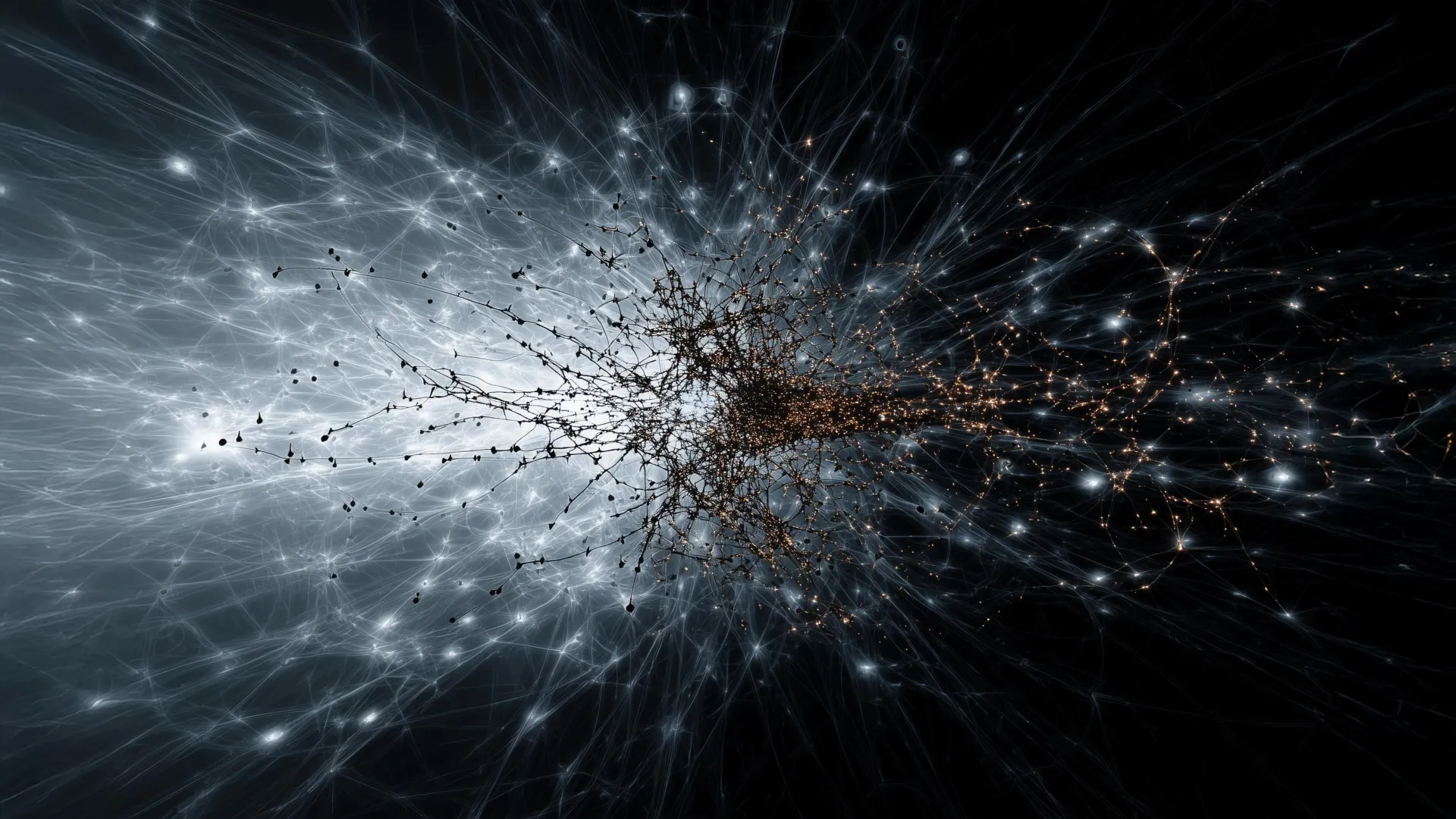
Scientists have potentially identified evidence of dark matter, a mysterious substance theorized nearly a century ago. Researchers at the University of Tokyo, analyzing data from NASA’s Fermi Gamma-ray Space Telescope, have detected a halo of high-energy gamma rays. These findings closely align with predictions about dark matter particle interactions, marking a significant development in astrophysics.
The concept of dark matter emerged in the early 1930s when Swiss astronomer Fritz Zwicky observed that galaxies were moving at speeds inconsistent with their visible mass. His proposal suggested the existence of an unseen mass providing the necessary gravitational pull. For decades, dark matter remained an enigma, detectable only through its gravitational effects on visible matter, as it does not interact with light.
Many scientists theorize that dark matter comprises weakly interacting massive particles, known as WIMPs. These hypothetical particles are believed to be heavier than protons and interact so weakly with normal matter that direct detection has proven elusive. However, theoretical models suggest that when WIMPs collide, they annihilate and produce energetic particles, including gamma rays.
Using new data from the Fermi Gamma-ray Space Telescope, Professor Tomonori Totani of the University of Tokyo may have pinpointed the gamma ray signal associated with dark matter annihilation. His findings, published in the Journal of Cosmology and Astroparticle Physics, provide compelling evidence in the search for dark matter.
Discovery of a 20-GeV Gamma Ray Halo
“The detected gamma rays have a photon energy of 20 gigaelectronvolts,” said Totani. “They extend in a halo-like structure towards the center of the Milky Way galaxy. The gamma-ray emission matches the expected shape from the dark matter halo.” The energy spectrum measured shows a close correlation with theoretical predictions concerning WIMPs, estimated to have masses about 500 times that of a proton.
The frequency of annihilation events inferred from the observed gamma rays aligns with theoretical expectations, further supporting Totani’s hypothesis. Importantly, he notes that the unique gamma ray pattern cannot be attributed to known astrophysical sources or processes, reinforcing its potential link to dark matter.
If confirmed, this discovery could represent the first time humanity has directly “seen” dark matter. Totani emphasized, “This indicates that dark matter may consist of a new particle not included in the current standard model of particle physics, representing a major advancement in both astronomy and physics.”
Next Steps in Verification and Research
Despite the promising findings, Totani stressed the importance of independent verification. Other researchers will need to scrutinize the data to ensure that the detected gamma rays genuinely stem from dark matter annihilation rather than from alternative astrophysical sources. Future research could focus on identifying the same gamma ray signature in other areas rich in dark matter, such as dwarf galaxies orbiting within the Milky Way halo.
“To strengthen the case for dark matter as the source of these gamma rays, accumulating more data will be crucial,” said Totani. “If we can find similar signals in other regions, it would bolster evidence supporting the existence of dark matter.”
This research was made possible through funding from JSPS/MEXT KAKENHI Grant Number 18K03692. As scientists continue to explore the universe’s unknowns, the potential detection of dark matter could reshape our understanding of cosmic structures and the fundamental nature of matter itself.